 Click
an area of the map for world news.
Click
an area of the map for world news.


Affiliated Programs: 


World Press Review is a program of the Stanley Foundation.
|

When Two Elephants Meet
Sudanese Refugees in Cairo
Abdalla Hassan
Cairo
July 31, 2001
 |
| Sudanese
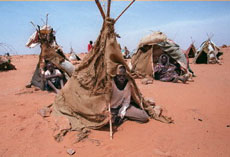
refugees in As-Salaam, a shantytown outside Khartoum
(Photo: AFP). |
“My
name is Naomi,” she says softly.
“In my home country I have a name given by my mother,
Yangi. This name [was] given to me because my mother had two
children who died before me. That is why I am called with
this name. Anyone who comes after two late children is given
this name.”
Naomi, who has worked as a schoolteacher for 30 years, was
born in Yei, a small town near Sudan's Ugandan border, in
1942. Today, Naomi is one of roughly 20,000 Sudanese refugees
living in Cairo. Smaller numbers of Somalis, Sierra Leonians,
Eritreans, Ethiopians, Libyans, Liberians, Bosnians, and Palestinians
have also found refuge in Egypt.
Two of Naomi's sons came to Cairo as students, part of a wave
of southern Sudanese émigrés who arrived in
the 1980s to get their university degrees and return home.
But as political conditions deteriorated in Sudan, many never
went back. With a war raging in the south, returning to Sudan
almost always meant conscription in the government army. For
many southern Sudanese, this meant enlisting in an army engaged
in a war against their friends and family. Another of Naomi's
sons left Sudan for Uganda and then Kenya. Her husband, who
is a prominent politician in Sudan, and their two daughters
remain in Khartoum.
Though Naomi has not returned to Sudan in the nearly four
years she has lived in Cairo, she often contemplates going
home. “Even if the war does not end, I have that idea
of going back to Sudan to see my family. I have to go back,”
she says. “I have to go and stay with my girls. Because
no one should leave girls with their father alone. It is not
too correct.”
Naomi taught in Khartoum for two years. By then, the Sudanese
government had made Arabic the only language allowed in schools,
and since her Arabic is poor, she opted to teach English to
young children. Government employees were required to undergo
military training. “I had to go for training to be like
a soldier going to war, but I [was] afraid. There is a system
that any government official has to go for military training
for three months: men and women. For three months you learn
how to shoot the gun, how to march like a soldier, all these
activities of armies. Then you are given a certificate and
you continue your work. I [felt] that this [was] something
I couldn't do. I decided to pull away from teaching and come
here.”
 |
| Sometimes
there [are] bad feelings that we are here because somebody
caused this problem... [But] when we come together and
we do our work together, it gives us the spirit of love.
That makes that hatred go away from our head. |
 |
Today,
Naomi supervises students at a skills training program for
refugees at All Saints' Cathedral's Joint Relief Ministry
(JRM) in Cairo. “Sometimes there [are] bad feelings that
we are here because somebody caused this problem,” she
says. “When we come together and we do our work together,
it gives us the spirit of love. That makes that hatred go
away from our head.”
For over a decade, the Joint Relief Ministry at All Saints'
Cathedral and St. Andrew's United Church—both in Cairo—have
assisted refugees from southern Sudan and all over the world.
A medical clinic at All Saints' Cathedral offers general,
prenatal, and pediatric care for a voluntary contribution
of LE 2 [US$0.50]. If medications are expensive, JRM covers
most of the cost.
Church programs augment the skills of refugees and give them
the opportunity to earn a small income. A food program distributes
beans, lentils, rice, sugar, oil, and powdered milk to pregnant
women, large families, and single-parent households. “Here
at the church,” remarks Reverend Huw Thomas, provost
of All Saints' Anglican Cathedral, “we do not have any
denominational test.”
As the fighting continues in southern Sudan, the flocks of
people seeking refuge in Cairo continue to grow. “Maybe
five years ago there were 8,000 or 10,000 southern Sudanese
here,” says Mark Bennett, coordinator of JRM. “Now
there are more than 20,000 in Cairo. There may be another
3,000 or 4,000 in Alexandria and small numbers in other places.”
A Liminal Space
Southern Sudanese are Egypt's largest refugee population.
Yet many of them hope their stay will be temporary. “Egypt
has become a country of transit, where getting refugee status
means getting resettled in a Western country,” explains
Barbara E. Harrell-Bond, distinguished adjunct professor of
forced migration and refugee studies at the American University
in Cairo.
If accepted by the United Nations High Commissioner for Refugees
(UNHCR), Sudanese migrants would have an opportunity to resettle
in the United States, Canada, or Australia. “The truth
of the matter is that probably only 30 percent of them will
find that opportunity,” Bennett says, pursing her lips
slightly.
Today, between 3-5 million Sudanese nationals live in Egypt.
The influx began after the signing of the 1978 Wadi El Nil
Treaty, which granted Sudanese people the right to live in
Egypt without a residence visa. In June 1995, when violent
Sudanese Islamists shot at Egyptian President Hosni Mubarak's
motorcade during his visit to Addis Ababa, Mubarak held the
Sudanese government responsible and revoked the treaty. And
while it is still easy for Sudanese to enter Egypt on a one-month
tourist visa, getting that visa renewed can be more difficult.
Fearing deportation, many Sudanese prefer to take their chances
and remain in the country illegally.
Without legal authorization to work, Sudanese refugees in
Cairo often find survival in the city difficult. Many southern
Sudanese women earn an adequate income as housekeepers. But
Sudanese men, for whom housework is not an option, do not
find jobs as easily. When they are able to find work, employers
often ask them to work 10 to 12 hours a day for salaries as
low as LE 250 [US$62] a month. In a city where narrow, sparsely
furnished apartments rent for between LE 400-500 [US$100-125],
many wind up sharing two rooms among as many as 12 people,
sleeping in shifts.
“A Nightmare Scenario”
 |
| War
Veterans: Former soldiers for the SPLA in their
classroom in southern Sudan (Photo: AFP). |
Famine
and war in Africa's longest-running civil conflict have claimed
the lives of as many as 2 million Sudanese and left 4.5 million
homeless.
Outsiders often cast the 17-year civil war as a religious
war between a Muslim and Arab north against a Christian and
animist south. According to this view, northern Sudanese—Arab
Muslims—control the government and use its force to persecute
southern Sudanese, who are usually black Africans. There is
some truth to this perception. But while religion is a widely
publicized dimension in the civil war, Harrell-Bond believes
that the roots of
the conflict are far more complex: “It has much more
to do in my view with oil, with water, and all kinds of other
resources that people want to control.” Indeed, recent
fighting in the south has been linked to control of nearby
oil fields.
Nearly 500,000 Sudanese refugees have fled to eight neighboring
countries. Slave raids occur regularly in parts of the south.
Armed militia groups, controlled by the hard-line National
Islamic Front, regularly attack military and civilian targets.
Overhead, noisy Russian-made Anotonov bombers pelt the countryside,
leaving no one insulated from the conflict.
Oil pipeline projects funnel millions of dollars to aid the
government's war effort. Rebel troops receive arms through
Kenya and Uganda, augmenting the weapons they capture from
stockpiles in government garrisons.
Civilians are inevitably caught in the middle of the struggle.
“The military lives off the civilians. The gun is your
salary. The gun is how you keep yourself alive,” Harrell-Bond
observes. “Civilians are the victims exploited by the
very groups that are supposed to be liberating them.”
Sudanese civilians fleeing to neighboring Congo find themselves
caught in another bloody conflict, as guerillas from the Sudanese
People's Liberation Army (SPLA) clash with insurgents from
Rwanda and Uganda. Those who flee from Sudan to Congo find
a life not much better than the one they left behind.
Father Claudio Lurati, vice pastor of Abbisseya's Church of
the Sacred Heart, is a Comboni missionary, an order of the
Catholic Church named after the first bishop of Sudan. In
1995, Father Claudio spent five months in the SPLA-controlled
village of Mapuordit, halfway between Yerol and Rumbek, in
what is known as the liberated areas. No church existed; prayers
were held under a tree. One thousand children attended a large
school constructed from bush material.
“We never had any contact with the government troops
or with the government authorities. The area was totally controlled
by the SPLA,” says Father Claudio. At the time, government
soldiers still remained in Yerol and Rumbek. They are no longer
there. The SPLA “liberated” them in a series of
bloody battles three years ago.
Most
of the Sudanese refugees living in Cairo fled from the south,
stopping in the shantytowns that surround Khartoum. According
to most estimates, 7,000 to 8,000 Sudanese refugees arrive
in Egypt a year. Father Claudio says that most of the refugees
he meets see Cairo as a stop on their journey: “A pulling
factor is that many people now have the chance to migrate
to the United States, Canada, or Australia as refugees, and
this has drawn many people. They come here at any cost because
they have a reasonable hope to travel to these places for
resettlement.”
“The conflict in Sudan is a nightmare scenario: endless
years of civil war, millions killed or starved,” says
Father Claudio. “The frontlines of the conflict are ambiguous,
marked by constantly shifting alliances.” Yet it has
ebbed into a forgotten war. “Journalists need quick events.
[In Sudan], it is not as if you can speak of a battle or a
huge advance. It is difficult to give constant coverage to
a war that has been going on for 17 years, and where there
are no changes.”
Will it ever end?
“I think you have to ask yourself whose interests are
being served by it not ending,” Harrell-Bond responds
pointedly. “There are many interests that converge in
this war… I wonder really how much the two parties want to
come to a reconciliation. Because for soldiers there isn't
a better business than war. Why should they stop it?”
“It is the Grass that Suffers”
Biar Alier, 33, has a quiet, likable demeanor. He came to
Egypt in early 1989 to study agricultural engineering at Alexandria
University. He spent three semesters in college before the
government suspended his scholarship. The Sudanese government
called on him to return home and attend one of the newly opened
universities in Khartoum. Instead he traveled to Cairo looking
for work. He earns enough cleaning bachelors' houses to contribute
his share of the LE 400 [US $100] rent for an apartment without
a phone in Hadayek El Maadi—a barren mud brick and cement
suburb of Cairo on the edge of the desert.
Biar, a member of the Dinka tribe, has his roots in the Upper
Nile region of southern Sudan in the Jonglei province town
of Bor, where construction of the ill fated Jonglei
Canal began. Biar's father owned hundreds of cattle. “Back
home we used to marry with cattle,” explains Biar, whose
father had six sisters, and each sister represented a dowry
of at least 30 heads of cattle. “If you calculate that—and
this number is going to reproduce—including what my father
inherited from his father, that means he was a millionaire,”
he laughs.
Before Biar was born, his family migrated north to the border
town of Kosti, leaving behind the family's cattle wealth.
Biar has two living siblings. One brother lives with him in
Cairo. Another is in a refugee camp at Kakuma, on the border
between Kenya and Sudan.
After selling everything they owned, those who made the journey
to Egypt have little intention of returning. “When you
think of going back there where you have nothing, it's just
like going back to hell,” says Biar. But for him the
prospect of returning one day to Sudan does not seem unimaginable.
“I don't know what will happen. [I am] just putting it
in God's hand, hoping for the best. And the best that can
happen is that peace will be back and I will go back home.”
|
| I
wonder really how much the two parties want to come
to a reconciliation. Because for soldiers there isn't
a better business than war. Why should they stop it? |
|
Born
in Bor, Michael Buol Man was 13 years old when civil war broke
out. He left Khartoum on Nov. 13, 1999 traveling to Cairo
via steamer. He bears the distinctive scars of the Dinka tribe
on his forehead. Branded at age 13, the markings represent
his passage into manhood.
While working 72 hours a week pumping gas at a service station,
he studied accounting at the African College in Khartoum.
There he was also a member of a Bible study group. He also
was one of nine arrested from the club and accused of engaging
in politics, not religion. After spending six months in prison,
he was released on Aug. 17, 1999. Security forces, Michael
says, demanded that he change his name to a Muslim one and
cooperate with them. He refused, determined to find a way
out of Sudan.
He is married with two sons: one is 4 years old, the other
is 2. Like Biar, his two brothers are in Kenya's Kakuma refugee
camp. His two sisters are in SPLA-controlled territory. “I
got news that they are married. I don't know the names of
their husbands or whether they have children or not.”
The last time he saw his sisters was in 1983. Rejected for
asylum by the UNHCR, he desperately searches for work. “Our
life is very difficult here,” Michael says. “I have
children. My life is very difficult. I need any work, even
cleaning the house. I can do it.”
Mayar Mayar Kuethpiny, 56, left his hometown of Wau in southern
Sudan's Bahr El-Ghazal province in 1985 for the last time.
For decades, he crisscrossed the country, selling dura, sugar,
lentils, and fruit. Armed conflict made travel prohibitively
dangerous and put an end to that career.
“I got stranded,” says Mayar, a tall and brooding
figure who has two wives and nine children, ranging in age
from 9 to over 20. As a businessman, he could afford to rent
a place in Khartoum, but with no business and no financial
means to pay his expenses he, along with 2 million other internally
displaced southern Sudanese, eventually wound up assembling
a makeshift dwelling on the outskirts of Khartoum.
“I also could not educate my children,” he adds.
“We embarked in educating our children through self-help
schools where we used to volunteer to be teachers.” Twenty-four
schools were built. Enlisting the support of non-governmental
organizations like Save the Children, the parents formed councils
to administer the school. Mayar is proud of his service as
the financial secretary for one such group. A year ago, the
government confiscated 10 of the schools. “It was just
Islamicization they were aiming at. We initiated these schools
on our own. We [could] not just surrender them,” Mayar
remembers. Eventually the government prevailed. Disgusted
and discouraged, Mayar left the shantytowns for Cairo. He
arrived on March 31, 2000.
“The government says, 'We are soldiers, we know how to
talk, which is through the gun,' ” he reflects. “They
say, when two elephants meet, it is the grass that suffers.”
Joseph
According to the United Nations, a refugee is a person who
has a well-founded fear of persecution—should he decide
to return to his country of origin—on the grounds of
race, religion, membership in a particular social group, or
political opinion.
Egypt was one of the original framers of the 1951 Geneva Convention
on the Status of Refugees. But when Egypt ratified the convention,
it entered a list of reservations. Refugees are not legally
entitled to work and have no access to national health facilities,
government schools, or subsidized housing.
Those fleeing Sudan pin their hopes on attaining formal refugee
status from UNHCR. Currently, 3,500 asylum-seekers, mostly
southern Sudanese, are waiting for the UNHCR and the Egyptian
government to determine their status.
As of June 30, 2000, there were 7,400 recognized urban refugees
in Egypt. The largest groups included Sudanese (44 percent),
Somalis (37 percent), Yemenis (9 percent), and Sierra Leoneans
(2 percent). The remainder was comprised of 20 other (mainly
African) nationalities.
The Cairo office of the UNHCR typically takes over a year
to make a decision. When they do, they reject candidates 70
percent of the time. Harrell-Bond thinks the UNHCR is working
to keep refugees away from industrialized nations. “If
you think of UNHCR as an instrument of northern countries,”
she muses, “then they want to keep refugees from reaching
their shores. And remember that UNHCR is very dependent on
those very same donor states for its budget.”
On any given day, the high arched ceilings of the Church of
the Sacred Heart—or the Church of the Sudanese, as its
neighbors know it—ring with the sounds of weddings, baptisms,
and christenings. A school for refugee children enrolls 900
students. The church clinic, open three days a week, is a
small room. Hanging on the wall, just above the doctor's desk,
is a picture of the sainted Sudanese nun Josephine Bakhita.
On summer evenings, hundreds of southern Sudanese gather in
the church courtyard. A canteen at one corner makes brisk
business selling soda pop, tea, and sweetened warm milk. Vendors
polish and mend shoes, others sell vinyl Republic of Sudan
passport holders and copies of the Bible in Arabic. Sudanese
youth spill out in front of the church gates.
I become fast friends with 8-year-old Joseph, who has two
sisters and a younger brother. Barefoot and clothed in undersized
hand-me-downs, he spots me quickly in a crowd. I recognize
him by his smile.
“Where do you live?” I ask him.
“Father Angelo lives in the church,” he says. “I
live in the church.” Finding no other safe or affordable
haven, many single mothers and their children have made the
church courtyard their home. In one corner, hand-washed clothes
hang to dry on the trunks of three palm trees, next to the
plastic bags and old suitcases that hold the refugees' possessions.
The children in the church's courtyard play with a tattered,
deflated ball, while others drum on empty cans of powdered
milk.
“Do you go to school?” I ask.
Joseph shakes his head 'no.'
“Where's mama?”
“In Sixth October, [Sixth of October City, a planned
community in the desert outside Cairo]” he replies.
“What does she do in Sixth October?”
He does not know.
“Where is papa?”
He pauses and shakes his head quizzically. “Ma feesh.”
There is none.
The Sacred Heart Riots
On July 24, as the temperature climbed past 110 degrees Fahrenheit,
a public bus struck a Sudanese man by the church. A confrontation
ensued between the passengers and the driver of the bus and
a small crowd of young Sudanese men, who demanded that the
injured man be driven to the hospital. The dispute intensified
when the Sudanese smashed the windshield of the bus. Preparing
for a showdown, an angry crowd of Egyptians armed with sticks
and stones began to form. The Sudanese retreated inside the
courtyard of the church locking its green gates behind them.
In an attempt to free the bus driver, who was falsely rumored
to be held hostage inside the compound, the mob of Egyptians
hurled rocks inside the walled church compound, and torched
the pastor's car in front of the church gate. The Sudanese
threw rocks back. Hours after the standoff began hundreds
of police officers in riot gear were dispatched to the area
to subdue the unrest. The events of that day were a plain
reminder that in this alien land, Sudanese are not always
welcome guests.
In a front a page story following the incident, the July 30
edition of the pro-government weekly Rose El Youssef blared,
“Refugees: Guests or Criminals?” Many African immigrants
are engaging in illicit activities such as drug dealing,"
the popular weekly magazine charged. “They get drunk
in the streets and harass women, throw wild parties, and in
general act like hooligans. Is this a way for guests in our
country to behave?”
The day after the incident, I asked Joseph to tell me what
happened.
“Egyptians [were] fighting with the Sudanese. They [were]
throwing stones.” From atop the roof of the church, he
points out an armored SWAT vehicle, a dark green van behind
the church—police. “The police are here to make
trouble.” I looked around and noticed for the first time
that police officers were stationed around the perimeter of
the church.
The courtyard of the Sacred Heart Church had been the informal
hangout for the Sudanese community. Crowds would only disperse
well past 10:00 at night. Now merely a handful of Sudanese
are present at the church. The gates close promptly at 8:30
in the evening.

|
|



