Asia-Pacific

Asia Tsunami Disaster: International Development Implications
 |
|
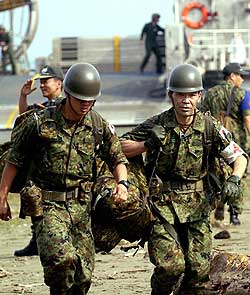
Japanese soldiers carrying medicines and equipment arrive at a beach in Aceh last month. (Photo: Adek Berry / AFP-Getty Images) |
As the international response to the Asia tsunami disaster gathers momentum, the major focus now is to provide basic health and social services to more than 5 million people the United Nations estimates say are directly or indirectly affected by the tragedy. The sheer magnitude of the tsunami tragedy, including, at least 150,000 dead, will have long-term implications for the 12 affected nations. However, the Asia tsunami tragedy has major international development implications as governments, bilateral and multilateral agencies, and the civil society assess their priorities in the coming years. I briefly discuss these implications.
Natural disasters will become fully recognized as a major risk factor in international development. Until Dec. 26, 2004, most development analyses or projections of the social and economic needs of Indonesia are unlikely to have included contingency planning for a major earthquake or tsunami. Indonesia will likely spend the next several decades battling the social and economic consequences of this tragedy. It is important however to note that natural disasters have been costly. According to a recent report by the United Nations Development Program (UNDP), annual economic losses from natural disasters worldwide averaged $75.5 billion in the 1960’s. The average annual economic cost was $138.4 billion in the 1970’s and $213.9 billion in the 1980’s. The cost in the 1990’s was $659.9 billion. The challenge is how to integrate disaster preparedness in short and long term development planning.
Global cooperation and collaboration will become stronger. The response to the tsunami disaster is a pointer to how the international community will respond to future natural occurrences. Governments, corporations, non-government organizations, and entertainers are now mobilized to assist the victims of this tragedy. In addition, collaboration on long-term disaster relief is already underway. At the January 2005 World Conference on Disaster Reduction in Kobe, Japan, delegates agreed that the United Nations will coordinate the implementation of a tsunami early warning system for the Indian Ocean. Another agency, the United Nations Human Settlements Program known as UN-Habitat is launching a financial program that sets aside funds for the long-term reconstruction of tsunami-affected countries.
However, a major challenge looms for international development experts: how to create the same kind of international sense of urgency and commitment for other daily, weekly and monthly “tsunamis” that take the same toll on human lives. As noted by the UNDP resident representative to Thailand, Joana Merlin-Scholtes, 11 million children that die every year from hunger, poverty and preventable diseases is equivalent to one Asia-tsunami every five days. AIDS kills 3 million people every year, equivalent to one Asia-tsunami every three weeks. At least half-a-million women die every year during childbirth worldwide, equivalent to one Asia-tsunami every four months.
United Nations is alive and well. The relevance of an entity like the United Nations became dramatically evident from the first few hours of the tsunami tragedy. Few organizations can boast of a collection of seasoned veterans with wide ranging experience in the multiple needs of disaster victims. The coordination and logistics of the gigantic tsunami relief operation fell by default on the United Nations system. The United Nations also strengthened its reputation by collaborating with corporations and organizations that have more specialized skill sets such as transportation, provision of vast quantities of bottled water and management accountability systems.
Coordination and logistics of international development assistance will likely undergo serious review. The tsunami disaster is showcasing what many development experts who work in the field already know: the need to streamline international development programs to avoid duplication of services and reduce the bureaucratic burden on poor, recipient nations. On-field coordination of relief efforts in tsunami-affected areas continues to be a challenge as various bilateral, multilateral and nongovernmental organizations rush to assist the needy. Lessons learned from the coordination woes of this early phase of relief response are likely to spur calls for serious review of how development assistance is managed. A possible outcome of this review is matching skill sets and recognized expertise of organizations with the specific needs of specific populations and specific countries or regions.
Prudent land management and infrastructure development is now a key feature of international development. Majorities of the affected areas have predominantly poor populations who live in shanty homes and own rickety boats. Many tourism centers and lodgings appear close to the shoreline. Any serious long term rebuilding effort in the tsunami-affected areas must address the issue of prudent land management and the enforcement of strict building codes for residential homes and tourist centers. The days of squatters and over-crowding in the coastal areas of tsunami-affected countries should be over if the horrendous losses of the tragedy is to be avoided in the future.
Tourism planning, management and emergency response is a central development strategy. Poor nations that depend on tourism for significant portions of their foreign exchange should expect greater scrutiny from the international travel industry, the insurance industry, tourists and foreign governments. With thousands of dead foreign tourists yet to be identified in some of the tsunami affected areas, virtually every developed country will demand accountability from tourist destinations regarding security, evacuation planning, emergency and routine medical care and the enforcement of building codes that meet minimum international standards. Tourists are also more likely to be cognizant of earthquake and tsunami prone coastal areas as they plan their travels. Technical assistance programs for the tourism industry will likely include training on disaster management.
Governments of poor countries will continue to face the challenge of meeting the basic needs of their citizens. With the exception of India, which proudly and strategically rejected foreign assistance, other affected countries are likely to depend on foreign assistance for quite some time. A recurring theme in most of the affected areas is the inability of governments to provide accurate baseline data on their people. Governments that are unaware of the numbers of their citizens residing in specific areas of the country are unlikely to meet their basic needs. A looming danger in affected areas, especially Indonesia, is that hundreds of thousands of survivors, after short-term relief assistance, may not have any means of livelihood as they attempt to rebuild their shattered lives. Increasingly, emphasis on anti-poverty initiatives will be matched with relentless focus on how recipient governments manage their resources and meet the needs of their citizens. This focus will go beyond the current constructs about governance reforms.
Rich nations will continue to spend money on international development assistance. The tsunami tragedy rendered moot ongoing debate on whether rich nations should significantly raise their development assistance to poor nations. It would be difficult for rich nations in the next few years to maintain a zero-sum approach to international assistance in the wake of the significant, immediate needs of tsunami survivors. Although controversy is brewing over the potential of tsunami-giving to offset other forms of assistance, future natural disasters and attendant media coverage will always force the hand of policy makers.
A critical objective of the coming years is to convince rich nations to take a longer view of development assistance. Rich nations should work with poor nations to reduce poverty levels and create opportunities for individuals to reach their full potential. Development experts should craft messages and policy positions that can build stronger constituencies among citizens of rich nations regarding the long-term benefits of sustained international development assistance for poorer nations.
Emergency Public Health is now an established specialty. This tragedy is showcasing the skills of a rare breed of public health experts: emergency public health specialists. These specialists, mostly physicians and epidemiologists, literally work with little or no baseline data as they design rapid health response mechanisms and coordinate the provision of health services, portable water supply and basic sanitation. So far, the World Health Organization is not reporting any major disease outbreaks in tsunami-affected areas. Emergency public health experts, especially with their capacity to make decisions in the field, will become indispensable in the management of future large-scale disasters.
The media is now an indispensable partner in international development. Without the relentless print and electronic media coverage of the Asia tsunami disaster, it would have been difficult to galvanize global attention and response to the tragedy. Personal stories of grief and miraculous survival elicited waves of sympathy worldwide. They may also have convinced policy makers in the West to intensify their response. A fundamental challenge of international development experts is to craft strategies for engaging the print and electronic media in other development tragedies occurring worldwide. The Internet will become increasingly critical as a medium for international development.
The Asia tsunami tragedy united the world in grief. It also led to an extraordinary outpouring of response. The challenge is to sustain global attention on the long-term development needs of tsunami survivors. A more challenging goal should be to engage our global attention on all deadly tsunamis that go unheralded, unheeded and ultimately forgotten.

Chinua Akukwe is a member of the board of directors of the Constituency for Africa, Washington, D.C., and former vice chairman of the National Council for International Health now known as Global Health Council, Washington, D.C.