Europe

News and Views From Around the World
Athens 2004 Olympic Games
Olympics 2004: Medals Table
Athens, Greece, August 29, 2004
|
Rank |
Country |
Gold |
Silver |
Bronze |
Total |
|---|---|---|---|---|---|
|
1 |
United States |
35 |
39 |
29 |
103 |
|
2 |
Russia |
27 |
27 |
38 |
92 |
|
3 |
China |
32 |
17 |
14 |
63 |
|
4 |
Australia |
17 |
16 |
16 |
49 |
|
5 |
Germany |
14 |
16 |
18 |
48 |
|
6 |
Japan |
16 |
9 |
12 |
37 |
|
7 |
France |
11 |
9 |
13 |
33 |
|
8 |
Italy |
10 |
11 |
11 |
32 |
|
9 |
Great Britain |
9 |
9 |
12 |
30 |
|
South Korea |
9 |
12 |
9 |
30 | |
|
10 |
Cuba |
9 |
7 |
11 |
27 |
|
11 |
Ukraine |
9 |
5 |
9 |
23 |
|
12 |
Netherlands |
4 |
9 |
9 |
22 |
|
13 |
Romania |
8 |
5 |
6 |
19 |
|
14 |
Hungary |
8 |
6 |
3 |
17 |
|
15 |
Greece |
6 |
6 |
4 |
16 |
 |
|
Gold, silver and bronze medals on display at the Athens 2004 Olympic Games.(Photo:Laurent Fievet/AFP-GettyImages) |
Israeli Press Savours First Olympic gold
BBC (international broadcaster), London, England, August 26, 2004
The wave of joy that swept through Israel as windsurfer Gal Fridman won the Jewish state's first ever Olympic gold medal crashes onto the pages of the press.
But some commentators look at the wider significance of the victory amid Israel's seemingly unanswerable problems.
The main Hebrew newspapers all lead with Mr. Fridman and his Olympic victory. Yediot Aharonot and Ha'aretz have an identical photograph of the 28-year-old windsurfer kissing his gold medal.
"Gal Grabs Gold", bellows the headline in Ha'aretz.
In remarks to Yediot Aharonot, Mr. Fridman says he thought of the Israeli athletes killed at the 1972 Munich Olympics. The paper says that only when standing at the podium did he just slightly lose his composure.
According to the paper, he will receive about a million shekels (£123,000) in grants - but the income tax authorities say the funds will be taxed.
Shimrit Berman, writing for Ha'aretz, sums up how many Israelis felt:
"After receiving the gold medal from International Olympic Committee member Alex Giladi, and after singing the national anthem Hatikva, the ceremony turned into an event that is hard to describe."
"Most of the audience descended on the awards podium, enveloping the silver and bronze medalists along with Fridman."
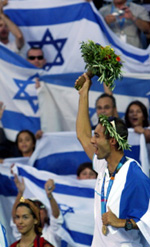 |
|
Gal Fridman is surrounded by supporters after receiving his gold medal on August 25, 2004.(Photo:Adrian Dennis/AFP-GettyImages) |
Herb Keinon, a columnist writing for The Jerusalem Post, says, "Special midday news coverage on Channel 1 generally sends shudders up and down my spine."
"When Channel 1 interrupts its regularly scheduled programming and trots out breathless reporters to give on-the-spot coverage, it is usually a sign of disaster - of a bus blown to bits, of torn bodies on the road. That is why it was so refreshing watching Channel 1's special coverage of Gal Fridman's gold medal."
Just like any "normal" country, Keinon says.
"The wires will predictably write that Fridman brought joy to Israel at a time where there is little to cheer about. But that's not it, there is something deeper, more symbolic, at play in our joy over Fridman.
"At a time when Jews in France are afraid to walk out their doors displaying any sign of their Jewishness, when the Foreign Ministry tells Israelis going abroad not to wear T-shirts with Hebrew writing, there was something deeply moving about watching Fridman proudly wrap himself in an Israeli flag," Keinon writes.
"This achievement speaks volumes about this country's vast reserves of resiliency. Thirty-two years after the Munich massacre, the Israeli flag was raised at the Olympics in victory, not lowered to half mast in mourning."
"Four years after the current war that has sapped so much time, energy, and treasure, the country retains trappings of normality - and nothing is more normal than sporting events, and a preoccupation with them - and that itself is a partial victory."
In a Ha'aretz editorial, Ron Koffman says Mr. Fridman has joined a select group of athletes "who confounded the Israeli athletic ethos that enshrines mediocrity and even aggrandizes it".
"Only in Israel does an eclectic bunch of bureaucrats, some of them state functionaries, determine an athlete's needs - how many training units he'll receive, and how many competitions he will attend."
"Youngsters who excel at athletics and swimming look for a way to escape the paralysing and paralysed system by going overseas to study on sports scholarships."
He concludes it is imperative that Israel appreciate every athlete whose sheer powers of perseverance push him beyond mediocrity
The Greek delegation at the opening ceremonies on August 13, 2004.(Photo:Jean-Philippe Ksiazek/AFP-GettyImages)

Where Are the Greeks?
- Paul Kelso, The Guardian (liberal), London, England, August 21, 2004
For all the enthusiasm of the volunteers, the good intentions of the organisers and the hospitality of Athenians, the parochialism of the Greek sporting public is undermining Athens 2004.
Any Olympics needs the support of the people whose taxes end up paying for them, but none more so than this one. Battered by doubts about organisation and security, Athens needs its people to turn out and transform the venues from soulless concrete expanses into vibrant theatres worthy of the athletes...but thus far there is little sign the Greeks are ready to come to their own party.
Climb into a cab or on to a bar stool and you will hear several theories…as to why they have stayed away. For every taxi driver who explains that the games opened during the holiday season when most Athenians head for the islands, there is a barman who will tell you that the embarrassing drug scandal surrounding Kostas Kederis and Ekaterini Thanou undermined Greek interest.
Over-hyped security fears and equally inflated hotel rates have contributed to the echoing halls and stadiums, and ticketing appears to be the one area where organisation has broken down. As Alison Williamson won her archery bronze on Wednesday at the magnificent Panathinaiko Stadium, the queue for tickets for Sunday's women's marathon finish stretched in the sun to a single box office window. Many potential punters walked away rather than waste an afternoon waiting.
For all these explanations the central problem facing Athens is that the Greek public are partisan to the point of indifference when confronted with events in which their athletes are not competing. Even the beach volleyball stadium, one of the few that has been repeatedly full, emptied when the Greek pair left the court on Wednesday night. The contrast with Sydney, where venues were reportedly full from the start, is harsh but inevitable.
Athens faces a crucial few days if it is to shake off the sense of anti-climax that has dominated the first week. With Kederis and Thanou now a footnote rather than a headline, the track and field events which begin today offer the hosts a chance at redemption. Reliable sales figures are elusive, but the indications are that the stadium will be well attended.
Tomorrow should see further domestic triumph when the weightlifter Pyrros Dimas goes for his fourth gold, while the triple-jumper Hristos Meletoglou and the javelin silver medallist from Sydney, Mirela Manjani should perform credibly next week.
...There is also the marathon. Starting in the city whence the legend sprang, and ending in the stadium that witnessed the rebirth of the modern Olympics, regardless of where Paula Radcliffe finishes it will provide an eloquent reminder of why the games came to Greece. All that remains is for Greece to return the favour.
 |
|
Australia's Ian Thorpe during a training session in Athens on August 8, 2004. (Photo: Thimothy Clary/AFP-GettyImages) |
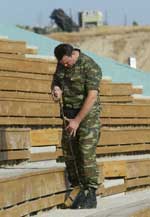
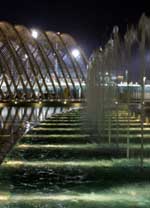
Thorpe Chases His Own Destiny Like every other swimming prodigy of the past three decades, Thorpe's achievements are measured against those of Mark Spitz, the American who won a record seven gold medals in the 1972 Munich Games. When Ian Thorpe won three gold and two silver medals as a 17-year-old at the Sydney Olympics, his destiny seemed assured. The Australian took the bait and started to prepare himself for a crack at the magnificent seven. The early signs were promising. He won six gold medals at the 2001 world championships in Japan but the events of September 11 suddenly reshaped his thinking. Thorpe was on holiday in New York that day and was on his way to the World Trade Center when the first plane struck the twin towers. The harrowing experience made him reassess his priorities and he vowed not to waste another day of his life. After finishing with six golds at the Commonwealth Games a year later, Thorpe abandoned his quest of pursuing Spitz. "It's not me," Thorpe said. "I'm not doing something to have accolades or the recognition." Thorpe's success in Sydney had already made him rich beyond his dreams but it came at a high price. He is a national hero in Australia but cannot lead a normal life. He is mobbed by fans every time he walks down the street and his every move is scrutinized by the media and public. Earlier this year, he was moved to address rumours about his sexuality after Sydney's gay community adopted him as an icon. For the record, he said he was not homosexual but was flattered by the description. Thorpe's decision not to chase Spitz's record not only lifted the pressure from him, but also helped him to clear his mind. He had begun to tire of the grind of training and needed fresh inspiration if he was to create his own legacy. He found it in Tracey Menzies, his former high school art teacher, who was appointed as his coach after he split with his long-time coach Doug Frost. Menzies encouraged Thorpe to explore life outside the pool and he took her advice, meeting presidents and queens, the rich and the poor, embracing his passion for fashion and developing his own line of clothing. One week away from competing with the Greek judo team at the Athens Olympics, Eleni Ioannou instead is fighting for her life after falling from the third-floor balcony of her apartment. Ioannou, 20, is on life-support machines in the intensive care ward at Red Cross Hospital with multiple fractures to her head and body, as sobbing relatives kept a vigil in the corridors outside her room. She is in critical but stable condition after undergoing several hours of surgery, according to a doctor at the ICU who spoke on condition of anonymity. Ioannou was injured Saturday in the fall, which followed an argument with her boyfriend in the apartment where she lived in the working-class district of Nea Ionia, police said. "It’s a miracle she’s alive," said Ioannou’s coach, Giorgos Bountakis, outside the hospital Sunday. "The doctors are not expecting anything positive. I hope she wins this fight." Ioannou had planned to moved into the Olympic Village with the rest of the team on Wednesday, two days before the start of the games. At some point during or after the argument, she fell from the balcony — but the reasons remain unclear. Police questioned her boyfriend, who had called the ambulance, but later released him. The incident remains under investigation. Family members and friends at the hospital did not want to talk to reporters. Yiannis Papadoyiannakis, the head of the Greek team, said her injury had "brought a sadness" and "cast a shadow" over the rest of the Greek Olympic team. Ioannou, a student at the Athens Gymnastics Academy, was a promising athlete in judo, a sport which has only recently gained popularity in Greece. With only four years of experience, Ioannou had won three national championships and a bronze medal in 1992 in the Balkan championships. A Greek army specialist searching seats in front of a Patriot missile on July 27, 2004. (Photo: Fayez Nureldine/AFP-Getty Images) Athens Installs Patriot Missiles Dozens of Patriot missiles have been put in place around Athens as the Greek capital began rolling out its security operation for the Olympics. Anti-aircraft missiles are in place at three Athens sites, including Tatoi Airfield near the athletes' village, and elsewhere around Greece. It is part of the most costly security plan in the history of the games. Hundreds of surveillance cameras are also being installed around Athens. The Greek authorities said the US-made Patriot missiles were progressively installed from 1 July, and would remain in place until after the games end on 29 August. Three police helicopters and a Zeppelin airship, also equipped with surveillance cameras, will operate almost around the clock during the Olympics, a police source told Reuters news agency. Patriot missiles and other anti-aircraft devices will also positioned at other cities in Greece. Russian-made S-300 anti-aircraft missiles are protecting the city of Heraklion on the southern island of Crete, Greek Air Force spokesman Constantinos Prionas told AFP news agency. The Associated Press said Patriot missile sites were also being installed in the northern city of Thessaloniki and one on the Aegean Sea island of Skyros. Athen's main Olympic complex on August 3, 2004. (Photo: Aris Messinis/AFP-Getty Images) Olympic Village Opens Americans, Australians and Finns were among the first to check into the Olympic Village as the venue opened its doors to athletes. The village is protected by double walls with sensors and guarded by hundreds of police. It has 2,292 apartments as well as swimming pools, theaters, restaurants, bars and places of worship. Greek Premier Costas Caramanlis toured the main Olympic complex and declared that Athens was "fully prepared" to host the Games after years of questions about the state of preparations. Caramanlis predicted the August 13-29 Games would be "extraordinary," but noted that fears of terrorism forced "conditions of maximum security." Palestinian Teenager Will Proudly Carry The Palestinian Flag When I finally caught up with Sana Abu Bkheet a week before she left for Athens, the young Palestinian runner was juggling two separate interviews in between her daily training routine. From the sound of it, one would think Abu Bkheet was a national sports phenomenon. But take a closer look and you'll be quick to wonder how she even made it this far. When we spoke, Sana had just finished several "laps" around her "track:" a small sandy lot just outside of the central Gaza Strip town of Deir al-Balah that winds its way around greenhouses and partially built tin-roof houses. It is littered with stray copper wires, refuse and thorny wild bushes. No more than 2 kilometers north of us was the Jewish settlement of Nezarim, a hotspot for frequent exchange of gunfire between Israeli Army snipers and Palestinian resistance fighters. Bullets have too often found their way into a young child's head around these parts.
Sana Abu Bkheet in Gaza July, 2004. (Photo: The Daily Star)
- Times Of India (conservative), New Delhi, India, August 9, 2004
Greek Judo Champion Fights for Her Life in ICU
- Daily Jang (pro-government), Karachi, Pakistan, August 9, 2004
- BBC News (international broadcaster), London, England, July 27, 2004
- The Independent (liberal), London, England, July 31, 2004
- Laila al-Haddad, The Daily Star (English-language), Beirut, Lebanon, July 31, 2004
This is Sana's domain. A far cry, of course, from the multi-million dollar stadium where she will be competing in Athens next month. Olympic rules allow teams whose members fail to meet the qualifying times to enter two of their best athletes in any competition. Sana was chosen for the 800-meter run. While her chances of winning are slim by her own admission - her best time being a full 30 seconds off the Olympic qualifying time - Abu Bkheet says she's honored to simply be representing Palestine.
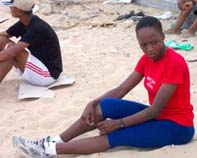
Sana is the very picture of determination, and it is clear where she gets her tenacity. Her mother, Amina, is by her side at every training session, and for almost every event she competes in. With her husband sick and out of a job, Amina holds the house together. She actively encouraged her daughter to continue despite the quizzical looks she received running through the winding roads of her refugee camp. "At first people found it odd and criticized me - it was the first time they'd seen a girl running through the streets like that. You have to remember we live in a society closed off from the outside world. Now they cheer me on - they are proud I am from their neighborhood."
But even strong-willed young athletes are not made of stone, especially if they are only 18-years old. Fighting back tears, Abu Bkheet told me it just wasn't fair. "All other athletes have left their countries in preparation for the Olympics several months ago, and I'm stuck here. And look at where we train. I know I can be so much better if I'm just given a chance to train properly," she said. "People just don't realize how tiring it is. We need an opportunity like anyone else. If I get the proper training I know I can accomplish great things. I love my country, but in my situation, some days I wish I was elsewhere."
Even her trip to Athens is no break from her daily routine. Israelis destroyed Palestine's only airport in the southern Gaza Strip at the start of this intifada. So Sana - along with thousands of other Palestinians - must make the grueling 14-hour journey to Cairo's airport by land, after first filing through a matrix of Israeli checkpoints with all the humiliating drawn-out searches and procedures they entail.
"With the proper training, she could be a star. But we don't have the means to make that happen," said her trainer Samir al-Nabaheen, as he casually removed bits of broken plastic pipe out of her path. "Considering the ground we train on, we've done extremely well," he added.
The Israelis destroyed Gaza’s only running track after the 1967 war. After that, local drug dealers turned it into a marijuana farm of sorts until it was cleaned up several years ago. Several foreign initiatives to renovate the run-down stadium have failed, according to Nabaheen. They used to train there anyway, Nahaleen says, but it simply became too dangerous, too difficult and too expensive. The taxi ride alone, nearly a $2 roundtrip, is the daily income of more than 80 percent of Gaza's impoverished population.
Half of the Gaza running team runs barefoot. Not out of habit, but because they are simply too poor to afford the luxury of running shoes. Sana is the exception, having been given a pair by a sympathetic German television crew. After hearing her story, the Arab-American Anti Discrimination Committee in the United States contacted Nike, and was able to secure training gear and sprinting shoes for her. They have been held up in Israeli customs for "security reasons" for nearly a month now, and Sana has since made her way to Athens.
Before she left, Sana told me she had grown tired of the useless excess of media coverage. "Journalist after journalist comes here, highlighting my story just because it's a compelling story to tell, but no one has done anything to help," she says.
Asked what she hopes to accomplish in these Olympic games, the steely-eyed Abu Bkheet acknowledged her situation left little room for accomplishments, and she said she was happy enough to be carrying the Palestinian flag in the opening ceremony.
"I know for sure I won't accomplish anything. But I want to show the world who the Palestinians are. I want to let them know that the Palestinian society is not absent," she said.
Sana told me she dreams of becoming a world champion like her role model Maria Mutola of Mozambique, whom she hopes to meet - and even one day compete against.
Like her role model, Sana herself is unconsciously paving the way for hundreds of other Palestinian girls to actively participate in sports, despite the taboo and the difficult political circumstances.
In the end, it was clear that Sana simply wanted to be like any other athlete, and for that matter, like any other teenager. But that doesn't seem likely anytime soon. For now, all she can hope for is to be able to proudly carry her nation's flag around the Athens Olympic Stadium in front of millions of people, with no Israeli checkpoints to stop her.
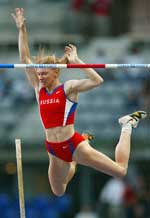 |
|
Russia's Pole Vaulter Svetlana Feofanova on August 25, 2003. (Photo: Gabriel Bouys/AFP-GettyImages) |
Russia to Fight for First in Athens
- Leonid Chizhov, The Moscow Times (independent), Moscow, Russia, July 14, 2004
More than a decade after the Soviet Union's collapse undermined Russian sports, the country's athletes are aiming to resume domination of the Olympics, Russian Olympic Committee head Leonid Tyagachyov said. "For the first time in recent years our team is ready to give a serious fight to the Americans, Chinese, Germans and French. Our hopes are backed by perfect results at the World Championships," Tyagachyov added at a recent news conference. "We have a strong team, strong coaches, strong athletes and every federation and every athlete are striving for a victory," Tyagachyov said. Tyagachyov made his comments after visiting the new training center in Rostov-On-Don in southern Russia, where the weather conditions are similar to those of Athens.
Russia's contingent in Athens will be one of it’s biggest ever: 467 athletes have qualified for the Games.
Since Sydney, when Russia placed second with 32 gold medals, the country has made progress in a number of sports, especially in track and field. Russia trailed the United States by just one medal at the World Championships in Paris and dominated the Indoor Championships with 19 medals in Budapest in March.
Russia also expects to continue to be strong in freestyle and Greco-Roman wrestling, as well as in boxing. Russia will fight for gold in women's basketball and volleyball. Men are defending champions in handball.
But the key sports for the team overall victory are swimming and track and field, Tyagachyov said. In Sydney, Russia won only three gold medals in these sports against 27 for the United States.
"This time it should be different. If swimming and track and field will give us 12 gold medals -- and I'm downplaying our chances -- then our team will gain advantage over our rivals," said Tyagachyov.
The athletes have incentives beyond personal and national pride to turn in top performances. The government issued a bill in which Olympic champions will be paid $50,000. Silver and bronze medallists will get $30,000 and $20,000 respectively.
Russia is also taking stronger measures to guard against a problem that has reduced its medal count in the past -- drugs.
"It's the most terrible thing when an athlete wins a medal and then is stripped of it after the Games," Tyagachyov said.
All Russian athletes are to undergo thorough doping tests to avoid the 2002 Salt Lake City Olympics scandals, when Russian skiers Larissa Lazutina and Olga Danilova were stripped of gold medals after testing positive for performance-enhancing substance darbepoetin.
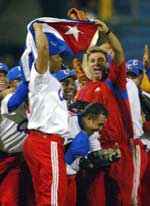 |
|
Cuba's baseball team on October 25, 2003. (Photo: Omar Torres/AFP-Getty Images) |
Cuba Hopes to Finish in the Top Ten
- Anne-Marie Garcia, Granma (communist party), Havana, Cuba, July 27, 2004
Cuba is attending the upcoming Olympic games with the express intention of finishing within the top ten nations on the final medal table.
“Don’t ask me how many medals we think we can win; I can only say that we’ll finish ahead of tenth position”, José Ramón Fernández, president of the Cuban Olympic Committee, told Granma International.
Fernández stated that the island is to be represented in Athens with a delegation of 159 athletes – in Sydney 2000, 238 Cuban athletes took part – “substituting quantity for quality”.
The official commented that commitment to the homeland is the priority of the Cuban team in Athens where they will take part in 16 out of 28 disciplines.
Each flag-bearing ceremony – there is one for every sport – ends with the slogan “Patria o muerte, venceremos”. During the baseball ceremony, catcher Roger Machado read out the oath of the players, who committed themselves to “fight for the triumph of dignity, patriotism, simplicity, and dedication,” as well as “rejecting any offer attacking Cuban principles”.
The island’s sporting officials affirmed that in international competitions its athletes, and in particular the baseball players, are “besieged” by “agents” who offer them huge sums of money to defect.
Fernández emphasized the challenge faced by the baseball team representing the national sport. “This is one medal we can’t do without, it’s a point of honor for all Cubans.”
Cuba lost 4-0 in the 2000 final against its eternal rival the United States; a team that has not qualified for Athens.
While the island’s sporting authorities have not related the economic crisis the country is experiencing to the effects of the 40 years-plus U.S. blockade, this could explain the reduced Olympic delegation.
René Romero, the high performance technical coach from the National Sports Institute, did not mention the existence of a special Olympic budget, but merely affirmed that “the state finances sport on the island”.
Cuban sports facilities are not luxurious, they possess only what is strictly necessary; the gymnasiums are basic but are decorated with inspirational images of Comandante Ernesto Che Guevara.
There are also sports medicines facilities, as well as Havana’s anti-doping laboratory - accredited by the International Olympic Committee in 2003 – a canteen for the athletes and an entertainment room with a television and other equipment.
At the capital’s track and field stadium, the athletes are training on a daily basis beneath a scorching sun and the gaze of Che Guevara, whose image covers a huge wall along with the words “Hasta la Victoria siempre”.
With respect to security in the Greek capital, Romero said that the country had confidence in the organizing committee of the first Games to be held this century.
Meanwhile, Romero explained that in Cuba, an athlete’s training begins at elementary school, where physical education is a mandatory subject.
At 12 years of age, children with aptitude continue in sports schools. There is one in every province and they produce both good sports and academic results.
Cuba took part in the Olympic games for the first time in Paris in 1900, where Ramón Frost won the island’s first gold medal in the men’s fencing event. Cuba has won a total of 57 gold medals, 14 of which were won in Barcelona when the island had its best ever result. In Sydney, Cuba finished in ninth place with 11 gold, 11 silver and 7 bronze medals.
Iraq Celebrates
- The Globe And Mail (centrist), Toronto, Ontario, May 13, 2004
Gunfire erupted across Baghdad and tracer bullets lit the night sky. But for once, this was not war but joy – Iraq’s soccer team had qualified for its first Olympics with a win over Saudi Arabia.
A year after the U.S. invasion that toppled Saddam Hussein, the American-occupied country is still not safe enough for international sports. The final home game of the qualifying tournament was played in Amman, the capital of neighboring Jordan.
But fans glued to television screens erupted in traditional Iraqi manner, blasting shots from Kalashnikov rifles and machine guns in the air when Hawar Taher made the score 3-1, one minute before the end of the game. Carloads of men drove crazily through Baghdad.
“We are all ecstatic,” national Olympic coach Adnan Hamed told Reuters in Amman. “Iraq has a bright future before it. I’m sure we’ll do well in the Olympics.”
Iraq’s Olympic Team
- Mail & Guardian (liberal), Johannesburg, South Africa, May 17, 2004
Her starting blocks are uneven, shallow holes kicked out of the dirt track. There is no discernible starting line and the finish 100 meters away is just a scratch in the sand. The track is rock hard and unforgiving; no serious athlete would consider running here. But for decades the al-Kishafa stadium in Baghdad has been the training ground of Iraq's athletic champions, and Ala'a Hekmet, a charming, intensely focused 18-year-old, is its latest star.
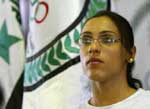 |
|
Ala'a Hekmet is the only Iraqi female to compete in the 2004 Olympics. (Photo: Roslan Rahman/ AFP-Getty Images) |
"It's a courageous track, that produces the most courageous athletes in Iraq," says her coach Abdul Zahra al-Soudani. For the past hour he has been watching Hekmet stretching, jogging gently and working on her starts. Today is a light workout. She has an important race in a few days and then she is off to a training camp in Germany - the final preparation for the race of her life: the 100 meters at the Olympics.
Like many in the small group of Iraqi athletes competing in Athens, Hekmet, Iraq's only female competitor, was excused from having to qualify, thanks to a wild-card entry system designed to include athletes from across the world. Each morning she studies computer maintenance at a local college, then, most afternoons her devoted mother Hanna takes her in a taxi across town to the al-Kishafa stadium for training.
The family comes from a poor middle-class background. Hekmet's father was an army officer who died of a heart attack five years ago. Her mother, a sprinter herself in her student days, was forced out of her job as a school teacher because of a row with Saddam Hussein's regime, and now the family live in a small rented house with a corrugated iron roof, little running water and only intermittent electricity. Hekmet receives a stipend of 75,000 Iraqi dinars month from the national Olympic committee, barely enough to pay for taxis, her food and the second-hand pair of tatty Nike trainers she picked up in Jordan. Several times, while returning from training, she has had to dodge gun battles in the street outside her home in the heart of Baghdad. "I can run, but not faster than a bullet," she says.
She talks about qualifying to become an engineer in the future, but clearly loves her sport. "If you don't love running, you can't win. When I reach the limit of my energy as I'm running, I just feel I want to push more and more. At the start line you feel very scared but once you start running you forget everything. All you feel is your body moving and then you reach the limit and you know you are going to win."
Six Iraqi athletes have been given wild cards. They include a second track and field athlete, A'ala Hussain, who will run in the men's 400-metre hurdles; Raid Abbas Rashid, a tae kwon do fighter; Najah Salman Ali, a boxer; and Ali Abdul Munim-Mohammad, a weightlifter. One male swimmer has also been invited and two young Iraqi men, Mohammad Abbas and Zaid Saeed, are competing for the place at a swimming camp in Vancouver.
The only Iraqi sportsmen to qualify on their own merit for the Olympics are the under-23 soccer team, who came top of their group in a remarkable final match, becoming the first Iraqi soccer team to reach the Olympics.
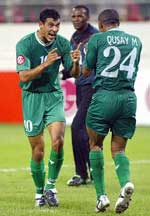 |
|
Iraq's Younes(L) celebrates his goal with teammate Qusay(R) on July 26, 2004. (Photo: Liu Jin/AFP-GettyImages) |
The officials in charge of rejuvenating Iraq's sports talk in hallowed terms of the effect it may have. Several times over the past year, officials from the US-led Coalition Provisional Authority have stood in public with athletes chanting their new slogan "Iraq is Back", as if sport alone will be enough to overcome the failures of the occupation. The US authorities have given $10 million for a sports program in Iraq and an additional $3million to rebuild the al-Shaab stadium.
"I think if we start with sport then we can get security through sport," says Ahmed al-Samarrai, the head of Iraq's Olympic Committee, who defected from the Iraqi military and fled to Britain in 1983. "Where there is football you can find the unity of all the Iraqi people, whatever their color, or religion or ethnicity - and then you start to break the ice. When the Iraqi flag is there in Athens, the civilized world will be delighted to see Iraq is back again in the shape of democracy and freedom."
Raid Abbas Rashid, Iraq's tae kwon do champion, is 27, tall and stocky and wears a thick dark beard. For a man with such a heavy build he is surprisingly supple and fights with a tightly controlled aggression. In 1980, Rashid's father and uncle were executed in the same week. His father, Abbas Rashid Abdullah, had been close to Saddam, and was eliminated for being a possible rival. Seven years later his brother, Rashid was also executed. Each time the family had to pay for the executioner's bullets. And yet the athlete chose not to keep a low profile, as might have been wise; he joined the national tae kwon do team under Saddam, earned a third dan black belt, and won medals across the Arab world.
Rashid took up tae kwon do when he was 11, graduated in sports studies from Baghdad University and worked in a sweet shop until he gave up to concentrate on his sport. "Because my life was very tough, my childhood was deprived of everything in life, I had to fight. I grew older and I found myself loving tae kwon do. Some kind of cruelty inside me began to rise up. That is why when I fight I feel satisfied."
Of all Iraq's Olympians, he has the best chance of a top-level ranking, perhaps even a medal. "First of all, just being part of this Olympic championship is a great thing for me, but my aim is to win something," he says.
Iraq has taken part in the Olympics before but has only ever won one medal - a weight-lifting bronze in 1960. Saddam was determined to change that, putting his eldest son, Uday, in charge of the national Olympic team. Uday's control of the team was through fear and intimidation. Those who failed to perform well enough were jailed and beaten. His Olympic committee building became a private jail, replete with torture devices, until it was flattened by an air strike during the war.
Rashid never suffered from this, but his teammate and now coach Ali Hussein Ajar did. In 1996 Ajar, now 30, won gold in tae kwon do at the Arab championship. Two years later, at the next championships, he won only silver, news that was received very badly on his return to Baghdad. "There was an order from above saying I should leave the sport for good and I should be jailed for three months. I have been trying to forget these days for so long," he says. "They call you at your house and ask you to go to the jail. If you don't go they will take you and your family. So I went there on my own and spent three months in jail."
After he came out he stopped competing. The tae kwon do union wrote to Uday just before the war, asking if Ajar could be reinstated. "Uday wrote back and he said: 'I accept, but only after the rains come in June.' You know Iraq. It never rains in June."
But Uday's particular passion, and victim, was the national soccer team. Basim Abbas, now 22, newly married and captain of the under-23 Olympic team, was jailed several times. In 2001 he was ordered to step in and play for al-Zawra, Iraq's leading club, in an Asian competition. He had a strike at goal halfway through the game but missed, and his side eventually lost. "Before the game, Uday told us: 'If you don't win, I'll make you walk back to Baghdad from Jordan.'" Abbas eventually spent six days in a jail at Radwaniyah and was ordered never to play again.
"Now, as sportsmen, we feel we can play freely, but today the problem is security," he says. Security is so bad that for the past year Iraq's club league has been cancelled. Abbas plays soccer professionally, though his monthly salary is just £140 - almost what it cost him to buy his own pair of blue Nike Air Zoom Total 90 boots. He has been offered jobs at respected professional clubs in the Gulf and in Egypt, but Iraqi officials are reluctant to let him go.
 |
|
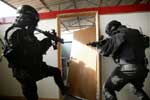
Greek police special forces during a security exercise on July 30, 2004. (Photo: AFP/Getty Images) |
Israelis to Get Additional Olympic Village Security
- The Globe And Mail (centrist), Toronto, Ontario, August 3, 2004
Israeli athletes have been given an additional layer of security at the Olympic Village, including a fence placed around the team's residential compound. The U.S. team also asked for a fence, but later withdrew the request. The Israelis also had an extra fence at the 2000 Sydney Olympics, Australian Olympic Committee chief John Coates said.
Hundreds of Olympic athletes arrived at Athens airport after the Olympic Village opened last week. A double-perimeter fence, 24-hour police and army patrols, scores of cameras, sensors and concrete barriers to prevent a car bombing, protects the village.
"There is no question that the Olympic venues are wonderfully secured," said Coates, who is visiting Athens. He said Australian guards escorting athletes are not carrying weapons.
The issue of arming overseas security agents in Athens remains sensitive. Authorities fear foreign guards could react inappropriately in an unfamiliar environment.
"Australia did not allow any other countries to come in with armed security personnel (at the Sydney Games) and that's the position here," Coates said. "We have some security directors in our team, unarmed, and some liaison police outside the village who are assisting us, unarmed, from Australia."
Greece is spending a record $1.5-billion (U.S.), with 70,000 police and soldiers providing security, and is receiving advice from Australia, Britain, the United States, Israel, Spain, France and Germany.
Olympic traffic restrictions — cordoning off a lane for games-related vehicles — went into effect Sunday to facilitate the arrivals and last-minute preparations.
Also on Monday, three suspected members of an urban guerrilla group were released from custody after the expiration of an 18-month limit on their detention. The suspects — on trial since February — are allegedly members of the far-left Revolutionary Popular Struggle, or ELA, and were arrested early last year in a crackdown on domestic terror groups leading up to the Games, which begin August 13 and run through August 29.
Australia Happy With Athens
- Mike Osborne, The Australian, (conservative), August 2, 2004
Despite fears of chaos at the games, the president of the Australian Olympic Committee said today he was impressed with the transport, food, housing and security provided by the organizers at the athletes' village.
"We had no problems with the athletes checking in," Coates told a media conference.
On the security front, Coates said he was relieved Australia was not subject to the same level of control as the Americans and Israelis.
"There is additional internal perimeter security for the US and Israeli teams in the Olympic village because they are seen as a greater risk," he said. "Sydney (in 2000) had that for the Israelis. "We are somewhere down the list (of nations with security concerns)."
Coates said the extra security for the Israelis and Americans in Athens involved another fence with a secondary access checkpoint inside the already heavily guarded athletes' village.
That means athletes from other countries can't mix with the Americans or Israelis without an invitation and going through security.
"There is no additional security for us," Coates said of the Australians. "I prefer it that way ... it would be inconvenient for our athletes. It is a fact that increased security does interfere with the intermixing of athletes in the Olympic village."
Kenya Robbed of Olympic Boxer
- BBC News (international broadcaster), London, England, August 2, 2004
A Kenyan boxing champion has pulled out of the Olympic squad after a robbery aggravated an injury sustained in a freak road accident.
Light flyweight Suleiman Bilali won the gold medal at the All Africa Games in Nigeria last October.
Despite spending two-and-a-half months on crutches after the traffic accident, he had still hoped to travel to Athens. But he was attacked by robbers while on an early morning training run outside his Nairobi home. Bilali, 28, traveled to Cuba for specialist treatment but although his knee improved, his ankle got worse.
"The good thing is that age is on my side and I will still represent the country in other major championships," said the police corporal.
But, as the fifth-ranked player in his division, he was confident of gaining a medal in Greece. "This was going to be my year. I wanted to power into the history books by becoming the second Kenyan boxer to win a gold at the Olympics."