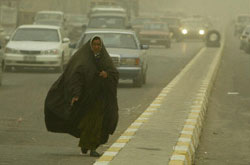
A sandstorm blows through Baghdad, Nov. 10, 2003 (Photo: Patrick Baz/AFP-Getty Images).
“I was appalled by what I saw in Baghdad after 25 years of exile,”says Iraqi journalist Mohammad Khalaf. A resident of Sofia, Bulgaria, he covers the Balkan region as a correspondent for Kuwait’s Al-Watan, one of the most influential newspapers in the Arab world. Khalaf disputes the assertions of many of his colleagues that the coalition forces are not welcome in Iraq anymore. He cites a recent opinion poll, which found that 76 percent of Iraqi respondents, fearing the outbreak of civil war, want the U.S. forces to stay.
Mr. Khalaf, you recently visited Iraq for the first time since Saddam Hussein’s regime banished you 25 years ago. How did you feel? For years on end, I had the same dream: I was in Iraq with my parents and my family. We were all happy to be together. Suddenly the security services broke in. At that moment, I invariably woke up terrified. This fear left me for the first time when I returned to Iraq. I did not even call my mother on the phone. I had to drive around for a while before I could find my family home in the city of Baquba. Everything had changed. I finally found the house after a chance passerby showed me the way. Later I learned that the man was a cousin of mine. He was a kid when I ran away.
Did your family recognize you? Yes, they did. I rang the doorbell. My sister came out, and the moment she saw me, she was yelling at the top of her voice: “Mama, hurry! Mohammad is back!” My mother stood petrified for several minutes. She could not believe her eyes: me, alive, 25 years later. The old woman started crying. She was praising God for bringing me back safely and cursing Saddam Hussein for having separated us. Then my brothers joined us. Soon our home was like a human beehive. The reunion was filmed by the crew of the Bulgaria’s Europa TV, as a part of a documentary they were making on Iraq.
Has everybody from your family lived to see the liberation? Alas, no. My father fell ill while in prison and died not long afterward. My entire family was detained after I defected in late 1978. Mother went on a hunger strike in her cell, as did my younger brothers. Ten days later the authorities were compelled to set them free. My relatives were taken hostage together with many other Iraqis. Saddam Hussein wanted them to cajole their sons back home.
Why did you defect? What was your story? I was working at one of the opposition newspapers—Al-Taahi, a mouthpiece of Massoud Barzani’s Kurdistan Democratic Party. Saddam Hussein closed the paper and invited us to join the staff of Al-Jumhuriya. At that time it was published by the Ministry of Information and was a ruling-party organ. A few days later, I and 15 other journalists were summoned to the office of the editor in chief. We were presented with an ultimatum: “You will either become members of the Baath party or you will be fired.” We felt as if we had been put in front of a firing squad. But all of us said no. We were instantly dismissed by a decree of the Revolutionary Command Council of Iraq, which was personally headed by Saddam Hussein. Then the arrests began. I was number 15 on the list, being the youngest. This, in fact, saved me. When I heard about the first detentions, I beat it right away.
What were your impressions of postwar Iraq? Seeing Baghdad after such a long absence, I was appalled. Was this really my fatherland, the richest country in the Arab world? Where had all the hundreds of billions of oil-derived dollars gone? Back in 1978, I had left it much more beautiful and wealthy. It hurt me to see so many tormented faces. I saw people who walked barefoot and hungry. While they lived with no shelter, Saddam Hussein had built scores of palaces for himself and his entourage. The money of Iraq had been squandered for weapons and wars—against internal and external “enemies.” But simultaneously I perceived something else: Those same Iraqis were filled with joy and hope that their country would not wage any more wars. Iraqis hate war and weapons. And now they kept saying: “We want Iraq to be a normal and democratic country.” In a matter of days, I sensed that this country without institutions was moving forward. Streets were jammed with cars. Buying autos was now in vogue, as it had been in Bulgaria in the early 1990s, since Saddam Hussein had not permitted Iraqis to own cars. Shops were full of goods and customers. And, strangely, all people were working diligently, as they would do in a functioning state. The minimum salary has leaped from $5 to $200 [a month]. Pensioners are now getting $100 instead of the mere $2 they got during the dictatorship.
What was the attitude toward the coalition forces? Foreign journalists tend to trust whatever stories they hear from taxi drivers or hotel porters. Most of the journalists do not venture outside of the Palestine Hotel, where they have been accommodated. And most of them are convinced that the Iraqis want the Americans to go home. But the latest public opinion survey refutes this hypothesis. Seventy-six percent of the respondents insisted that the U.S. forces should stay. They think that their departure would plunge the country into a civil war. The Iraqi national is a peculiar breed—he is never content and is used to complaining. But when you accost him on the street or offer him a cup of coffee, he will reveal that now his paycheck is three times as large and that his life is getting ever better.
How is the capital city faring? Are the Iraqis scared of the terrorist attacks? It is a pity that some Arab and Western media speak about nothing else but attacks. The truth is that a new, democratic society is budding in Iraq. There are 140 political parties in that country now. Every day, 160 newspapers hit the newsstands. Scores of radio stations have sprung up. Foreign correspondents neglect to mention that U.S. soldiers have renovated and furnished 1,500 schools. Those buildings had been completely abandoned by Saddam Hussein’s regime. I visited some of these schools in Baghdad. I saw the joy of the teachers and of the children. They told me that this was the first time in 30 years that they had new desks and that the curriculum had been changed. Saddam Hussein’s photo and the history of his Baath party were missing from the textbooks. So were the religious texts, which instilled hatred for other religions, nations, and any culture that wasn’t Arab. No one [from the foreign news media] speaks about the hospitals, which are being rebuilt and supplied with up-to-date equipment. The provisional U.S. administration has invited tenders for 5,000 infrastructure projects. A budget has even been prepared for 2004, to the tune of US$33 billion.
Currently the Iraqi Governing Council is responsible for Iraq’s governance. Criticism has surfaced in the European and Arab media that all of its members have been appointed by the Americans. What is the truth? The truth is that now in Iraq, for the first time in the history of the Arab-Muslim world (and here I am risking ostracism as a pro-American hack), there is political plurality. I am quick to explain that this council is the fruit of long consultations with the major political forces. It is not a foreign-appointed body. Sixteen parties are represented in it, alongside three independent politicians. You can find, sitting at one table, the general secretary of the Communist Party, the chief secretary of the Muslim Brotherhood, two leaders of the anti-American Shiite parties: Al-Dawa and the Supreme Council of the Islamic Revolution. In other words, the rightist, the centrist, and the leftist forces have all found a proper representation there. From an ethnic perspective, the council consists of Kurds, Arabs, Turcomans, and Assyrians. And from a religious perspective—of Muslems (Shiite and Sunni) and Christians...Moreover, there are three women on the council.
Who is behind the attacks? President Bush recently put the blame on foreign powers. I was told by various members of the council and ministers that some 3,000 members of Al-Qaeda, Islamic Jihad, Ansar al-Islam, and Abu Abbas had penetrated Iraq. All of them are working in alliance with the former secret services of Saddam Hussein and his Fedayeen, trying to wreak havoc and fan fears among the population in order to hinder the establishment of democracy in Iraq. Syria, for example, has been waging a 30-year-long war against Israel from Lebanon through Hezbollah. Now it is targeting the Americans in Iraq. How can we account for the fact that half of the 400 terrorists who have been arrested in Iraq hold Syrian passports? Saddam Hussein’s men pay them $500 per U.S. trooper killed. For the larger-scale attacks, they can earn as much as $2,000 dollars.
What were people saying about the whereabouts of Saddam Hussein? Whenever I asked Iraqis in the streets whether they still feared Saddam Hussein, they would reply: “We were afraid, but we are no longer. For us he is just a nightmare.” All were waiting for the day when the dictator would be caught, saying that it would be the Day of Judgment for him. He must answer for his crimes against his own people and humanity. The Iraqis are convinced that sooner or later this will happen!