
 |
|
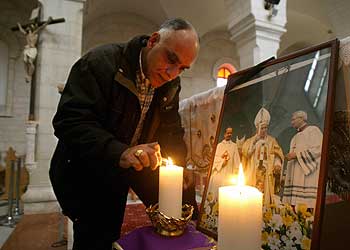
A Palestinian catholic lights a candle next to a portrait of late Pope John Paul II at the Church of the Nativity in Bethlehem earlier this month. (Photo: Musa al-Ahaer / AFP-Getty Images) |
Viewers who tuned in to watch the funeral of Pope John Paul II on April 8 may have noticed the extensive assembly of world leaders, some adorned with various headdresses such as turbans, yarmulkes and Arab kaffiyahs. Out of sight however, and underneath the respectful display, a new form of Middle Eastern parley was born: funeral diplomacy.
Among the foreign dignitaries seated on the steps of the basilica were Iranian President Muhammad Khatami, Israeli President Moshe Katsav and Syrian President Bashar al-Asad, each just inches from the other. According to Katsav’s initial statements after the funeral, he talked at length with Khatami in Farsi, Katsav’s mother tongue since he was born in Iran. Khatami later denied this but incidental photographs seem to confirm the encounter. Furthermore, Katsav and al-Asad reportedly shook hands twice and exchanged a few verbal pleasantries, and Katsav, racking up the handshakes, also added Algerian President Abd al-Aziz Bouteflika to his list. Elsewhere at the Vatican that day, Israeli Foreign Minister Silvan Shalom had a tête-à-tête with his Moroccan counterpart, Muhammad Ben Issa.
Meanwhile, back in the Middle East, audiences, equally engrossed and saddened by the pope’s funeral, had these historic handshakes to add to the day’s events. Yet despite the positive connotation that the handshakes represented, it was ephemeral. Each leader eventually downplayed or outright denied the encounter. It was left to Middle Eastern commentators to pick up the pieces and try to understand what just happened.
For example, the United Arab Emirates newspaper al-Bayan, which was one of the first to relate that Israeli news radio was reporting the Vatican encounters, tried to recreate the events following the handshakes. A front page article on April 10 detailing the Syrian “media muddle” traced the torturous path of Syria’s official denial, followed by a retraction, leaking of information through official and unofficial sources and then finally the terse confirmation that the handshake did indeed take place. After numerous probing questions by Arab reporters, as reported by al-Bayan, the final position of the Syrian presidential palace was announced that the handshake was of “no political significance, just as it does not change the position of Syria.”
Katsav, who returned to Israel, seemed to quickly descend from the ecstatic heights of his handshake coup and remarked that it was only a matter of being polite and had no policy implications. Shalom was even more caustic: “Khatami and Assad are two extremists … it could only have happened thanks to the truly magnetic personality of John Paul II.”
Israeli writer Uzi Benziman sarcastically evaluated the event in the left-of-center Israeli newspaper Haaretz. His April 11 op-ed evoked the image of a boy who steals a kiss from a middle school crush and then later shrugs it off as no big deal, with Benziman lamenting “President Katsav talked himself into a laughable fix: He declares with great fanfare that the Syrian president proffered his hand while the country of which he, Katsav, is president avoids a serious discussion with the Syrians over ending the conflict.” Ultimately for Benziman, the handshake was depressingly familiar: “There, at St. Peter’s Basilica, surrounded by the world’s dignitaries and restrained by the rules of the ceremony, the tribal leaders from the Middle East behaved in a civilized manner and shook hands; once back home they went back to being themselves …”
Jordanian writers in particular have a bone to pick after Arab leaders at the March 2005 Arab League summit in Algiers reacted with hostility to the so-called “Jordanian initiative” proposed by Jordan’s King Abdullah II which suggested normalizing relations with Israel before negotiating a peace settlement. This was the summit that was resolved, as Algerian Foreign Minister Abd al-Aziz Belkhadem famously stated, “[to] not be the summit of normalization.”
So with wry irony, Arib al-Rantawi notes in Jordan’s Addustour on April 10 that the leaders of the very same Arab governments that supported the quashing of the “Jordanian initiative” at the Algiers summit just two weeks prior to the pope’s funeral, were among those shaking hands and chatting with Katsav. Al-Rantawi probably smirked when he wrote “Even Iran, the government of [such] ideological political rhetoric, passionately refusing to accept Israel, found itself slipping down the slope of ‘funeral diplomacy’ and handshakes …”
Sultan Hattab bemoans the silliness of the whole episode in his April 9 op-ed in Jordan’s al-Ra’i. “I don’t think that non-Arab literature abounds with the act of a handshake between two individuals,” he proposes, “to the level that a handshake has become in our region: a political matter that provokes such reaction [over] whether it was ‘intentional or unintentional,’ ‘official or unofficial.’” Hattab is also critical of the subsequent governmental spin on the handshakes: “the problem is that commentators are searching for a sense of purity in politics and while they are talking and praising it was as if the two [Iranian and Syrian] leaders acted inadvertently or did not know who the Israeli president was and where he was sitting…”
Despite this possible papal miracle, media coverage of the handshakes was actually the sideshow to the genuine outpouring of sentiments for the pope in the Arab world. Arabs had long felt he was a great man and their sadness was sincere. They held great respect for his spiritual devotion but more importantly this had been the first pope to ever visit a mosque and a Palestinian refugee camp. He was an outspoken critic of the United States-led 1991 Gulf War and 2003 Iraq War as well as Israeli occupation of Arab lands. He visited various Middle Eastern countries and always advocated inter-faith dialogue.
Among the general commentary on the pope, none elicited more reaction than the April 5 column of Ahmad al-Ruba’i in Saudi Arabia’s Asharq al-Awsat. In his panegyric al-Ruba’i writes “The widespread reactions to his loss underscore a new truth, for Pope John Paul II was not merely pope of the Catholics, but rather an international personality who succeeded in crossing obstacles and boundaries between religions.”
Letters written to the newspaper in response to this column used the traditional Islamic formula for the recently deceased. One letter from Kuwait simply said: “May God have mercy on him, the foremost man of peace in the world.” A Qatari prayed “May God have mercy on this great man who worked with all sincerity in the interest of the oppressed peoples of Earth. We implore from God that He ensure the world with a successor to him that comes close to him in his deeds.”
While many more religious sentiments were expressed for the pope, much of his legacy was evaluated in political terms. In the U.A.E. al-Bayan on April 8, Lebanese writer Juzuf Samahah notes “There are those who say that the American administration was enabled in its struggle against the Soviet Union by two pivotal points: the first being Pope John Paul II, as the Polish Catholic symbol, at the same time as the second Afghani Islamic symbol — Usama bin Laden!”
Rakan al-Majali continues this Afghan theme in Jordan’s Addustour on April 6. He suggests that the United States also took advantage of the pope’s anti-Communist campaign, and furthermore with Pope John Paul II’s election in 1978, “religion started being employed in politics in an influential manner: it was a mobilizing [force] in Iran against the regime of the Shah, friend of the U.S. … however the picture was even clearer in Afghanistan, where the U.S. embraced in an unambiguous and overt manner extremist Islamic movements and organizations and mobilized them in Afghanistan to confront the Soviets.”
In many columns, the role of the pope in the Arab-Israeli conflict often took center stage. The April 4 editorial in Egypt’s al-Ahram declares “Arabs in general will not forget the late pope and his continuous call for the necessity of achieving peace between the Palestinians and Israelis, and for the impossibility of achieving this peace without Palestinians obtaining their legitimate rights, just as Arab citizens will not forget the efforts of the late pope to prevent the occurrence of the war on Iraq.”
The pope’s visit to the Palestinian refugee camp of Dheisheh evoked powerful symbolism for all Arabs and Yaha Ribah tried to capture this in the Palestinian Alhayat Aljadeeda on April 4: “this man who seemed like a candle beaming light … a brave man, brave indeed, and he knew exactly what he was doing; when he came to their refugee camp, he announced a message to everyone that the camp is the issue, that the refugee is the crucified body, and that the suffering here gushes like a geyser …”
And finally, with an obvious backhand to those Arab governments which prevaricated in the face of United States pressures in the buildup to 2003 Iraq War, Father Yusuf Munis writes in the Saudi Asharq al-Awsat on April 6, that “As for Iraq, Pope John Paul II stood with it and condemned preventative war and declared that there is no jihad nor just war in Christianity during a day of Arab silence …”
Copyright © 1997-2026 Worldpress.org. All Rights Reserved.
 Privacy Notice
Front Page
Privacy Notice
Front Page