
Analysis
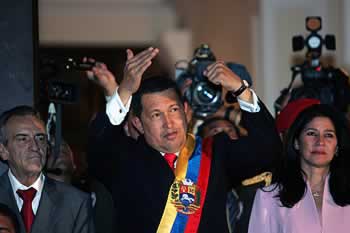 |
Venezuelan President Hugo Chávez waves to supporters upon his arrival to the National Assembly in Caracas on August 15 for his presentation of a project to modify the Constitution. (Photo: Pedro Rey / AFP-Getty Images) |
While crowds of cheering supporters gathered outside the National Assembly in Venezuela on Wednesday, Aug. 15, President Hugo Chávez outlined what could be the most radical phase of his proposed amendments to the constitution yet, the elimination of any term limits on the reelection of any candidate as well as lengthening each presidential term from six to seven years. These proposals reflect concerns in the Chávez camp over the shortcomings of the present constitution, which mandates that he will not be able to run again in 2012 when his third term comes to an end, according to the current constitution that was drafted under Chávez's supervision in 1999.
Since winning the presidency for a third term in 2006 (by a confirmed democratic vote of almost 60 percent out of the 75 percent of the electorate that chose to cast their ballot), Chávez has aggressively nationalized the oil, telecommunications, and electricity sector. He also introduced land reform and is now moving to end the autonomy of Venezuela's central bank in order to gain access to the country's foreign reserves, which he plans to use toward his ambitious social programs for the poor. Before any of this can happen, though, Chávez's proposed constitutional reforms must first be passed by the National Assembly, almost all 167 of whom are pro-Chávez, to be followed by putting the new amendments before a popular national referendum. If all goes to plan, the referendum could be voted upon in several months time, which leaves scant opportunity for the State Department to mobilize a campaign to thwart Chávez's ambitions.
Aside from drafting constitutional amendments and initiating dramatic domestic energy strategies, the Venezuela president has been busy making house calls to important trading partners around the region and the world. For several years, his bold socialist economic objectives have to an extent escaped being under the magnifying glass of American suspicion, due in large part to the Bush administration's preoccupation with its "war on terror" in Iraq and elsewhere in the Middle East, but now with more countries gradually signing up to join Venezuela's innovative development initiatives, Washington is finally mobilizing itself in a battle for influence throughout Latin America.
In an attempt to draw out any further progress in creating the United States-sponsored Free Trade Agreement of the Americas (F.T.A.A.), the Venezuelan government has been adamantly pushing for a more integrated and dependable trade and financial system for Latin America. For the last several years, Chávez's cure for economic dependency on the part of underdeveloped states, ALBA (Bolivarian Alternative for the Americas or Alternativa Bolivariana par las Américas), has been slowly drawing support and gaining members throughout South and Central America. Promoted as a humane alternative to the profit-maximizing logic of the F.T.A.A., ALBA, which translates to "dawn" in Spanish, aims not only to improve the region's economic integrity but also to create a vision of social welfare and mutual aid. Using the European Union as a model to decant his visions, Chávez claims that encouraging developing countries in Latin America to work in unison will decrease the number of trade disadvantages for small economies, enable better economic planning as a whole, and provide the region with a stronger international pollination of ideas.
Since ALBA is far from being hemispheric-wide in its acceptance, Venezuela, Cuba, Bolivia, and Nicaragua also have entered into a People's Trade Agreement (Tratado de Comercio de los Pueblos or T.C.P.) that points toward the same aforementioned general principals but leaves the door open to new members. Due to the expansion of Venezuela's social and economic programs in recent years, as well as the large number of Latin Americans who have directly benefited from Caracas' bilateral trade pacts, numerous countries—parties who are now receiving bilateral largesse from Venezuela—still remain uneasy about jumping on the ALBA bandwagon, fearing adverse reactions from Washington.
The Union of South American Nations (UNASUR), formerly the South American Community of Nations (C.S.N.), is an alternative regional integration body in the form of an intergovernmental union. Combining MERCOSUR and the Andean Community (CAN), UNASUR, in the long run, is attempting to adopt most of the same strategies as the European Union, including the creation of a common currency, free movement of all South American nationals, and the future elimination of tariffs on non-sensitive goods and services. The new Latin American bloc would comprise approximately 17.6 million square miles of territory and a population of over 400 million. The obvious difference between ALBA and the strictly South American UNASUR, is that under the latter, certain Central American and Caribbean countries, such as Cuba, would not be included. This poses a major problem for those who already have signed onto the Chávez-sponsored bloc, because attention will likely be drawn toward the larger and more influential South American trade union.
Cuba, having close ties with Venezuela, was the first to sign onto ALBA in 2004 and has provided a substantial amount of medical and agricultural resources to its effort. For example, the Miracle Operation, which provides free eye surgery to tens of thousands of Latin American and Caribbean citizens each year, has brought positive attention to the politically controversial country as well as ALBA as a whole. The Brazil Report observed that on April 29, 2006, the newly elected president of Bolivia, Evo Morales, who is known to be the leading ideological partner in crafting Chávez's "21st century socialism," signed the T.C.P. agreement and soon after enacted his plans to nationalize the country's enormous gas resources at the encouragement of President Chávez. In a similar feint, President Daniel Ortega of Nicaragua, who having previously rejected Brazilian offers of ethanol technology, signed the pact, and soon witnessed a $31 million dollar debt-forgiveness plan from Venezuela going into effect in January 2007. This made for an attractive contrast in terms of Managua's somewhat cautious participation in the Central American Free Trade Agreement (CAFTA). Other countries considering joining the T.C.P. in the near future include Ecuador, Honduras, and the tiny island nations of St. Vincent, Antigua and Barbuda, Dominica, and the Grenadines.
In addition to economic factors, there are also political implications that go along with becoming a member of ALBA, most of which stem from the close partnership between Venezuela and Cuba.
For decades, Cuba has helped stir up an array of controversial feelings within the international community. One of the most contentious of these issues has been Havana's continued explosive relationship with the United States, policy long advocated as well as stimulated by the conservative exile community in Miami, Florida, just 90 miles away from the socialist island nation. However, even though long-time Cuban strongman Fidel Castro has always been open to talking to the United States about economic integration and trade expansion, he realized that most of the miniature Caribbean island nations lack some very important natural resources and natural skills in order to participate in the market place. On Dec. 14, 2004, the Cuba-Venezuela Agreement was signed into action. As a result, Venezuela now delivers approximately 96,000 barrels of oil per day from its state-owned petroleum reserves to Cuba at a very favorable price. In return, Cuba has posted around 20,000 medical personnel to Venezuelan slums. This was, in almost any case, the first step in their progressive partnership in ALBA, since they have been linked up in, what Chávez likes to call, 21st century socialism. It seems as though this strong political strategizing by Chávez has not only withstood the negative backlash from Washington, but also has turned heads and brought attention to Latin America as an increasingly important player in world, let alone in regional, politics.
Early this summer, Cuban Agriculture Minister Maria de Carmen Perez and her Venezuelan counterpart Elias Java signed an ALBA-linked agreement to create five joint farming companies in hopes of further reducing their dependence on foreign imports. Located in Venezuela, the farms will produce top priority food and barnyard yields, such as leguminous plants, milk and yogurt, rice and poultry. Since then, five more agreements have been drafted, integrating food producing companies in the two countries and increasing their total bilateral trade to more than $1.8 billion.
The progress being shown in these collaborative programs is closely linked to another Chávez initiative, PetroCaribe, which held its third summit in Caracas on August 11, 2007. After meeting with several PetroCaribe leaders, Chávez said, in referring to future oil needs in the Caribbean Basin region, "the Caribbean shouldn't have problems this century and beyond." The populist leader also called for a new underwater pipeline connecting Venezuela to the neighboring islands of Haiti, Puerto Rico, and Cuba. According to the Venezuelan president, "If we [Latin America] truly unite … the grandchildren of our grandchildren will have no energy problems."
Chávez has proposed a variety of different initiatives directed toward improving the social and economic status of regional countries, as well as lowering the extent of their dependence on foreign aid and on multinational corporations. One of the first regional projects was the development of TELESUR, a Pan Latin American television network, which went on the air in October 2005, adding to American-owned CNN, Fox, and Univision, among several other similar enterprises, as a round-the-clock TV cable information station. Later that year, PetroCaribe, a Caribbean oil alliance with Venezuela, was established, allowing the sometimes heavily indebted countries to trade agricultural goods for concessionary oil prices. However, there are many critics of this agreement who believe that Cuba is receiving preferential treatment from Venezuela due to the unusually close relationship between Chávez and Cuban President Fidel Castro. In June 2007, in one of the latest initiatives unfurled by Chávez at the ALBA Summit in Caracas, the idea of launching Banco del Sur was presented. If implemented, the bank would largely take the place of the International Monetary Fund, which for decades has put harsh economic qualifications and restrictive standards on loans being granted to developing countries.
Several member states aligned with the two main trading blocks in South America, MERCOSUR and CAN (in 2006, Chávez pulled Venezuela out of CAN because he believed it required making too many concessions to Washington), have joined ALBA. Chávez has been actively soliciting the approval of Brazil, by far the largest economy in South America. Brazil's success in the biofuel industry has allowed for growing economic self-sufficiency as well as an increased number of trade opportunities with medium economies in the region, including Chile and Colombia. Like those two nations, Brazil is a strong trading partner of the United States, and Lula has expressed misgivings over a potential negative reaction from Washington if Venezuelan's trade programs are accepted by Brasilia. Instead, Lula has focused on technology deals, such as expanding the production of ethanol with Mexico and Honduras. Despite quiet efforts made to distance itself from Chávez, Brazil may have another budding relationship to worry about, which is coming from its southern MERCOSUR neighbor, Argentina.
Unlike Brazil, Argentina has been warmly welcoming Venezuelan petrol-dollars. In the past two years, Venezuela has purchased a total of $5 billion in debt relief investments from Argentina, recently adding another $1 billion in government bonds purchased from Buenos Aires, securing Caracas' chief lender status to the region. Although criticisms at home and from abroad have been levied against President Néstor Kirchner's decision to further ally himself with Chávez, the Argentine leader decided to meet again earlier this summer in Bolivia, where Chávez and Morales created more oil and gas deals, which this time included Argentina. Plans to transport $16 billion of Bolivian gas to Argentina is already underway, and with one of coldest winters on record taking a heavy toll on the country, the timing couldn't be better for Chávez's grand design for the region. Presidential hopeful Christina Kirchner, wife of President Kirchner, has also made comments supporting Chávez's initiatives, linking herself all the more to populist ideals.
Venezuela's oil wealth also has generated energy deals with innovation-minded Morales, including the signing of a $600 million joint venture with Venezuela which consisted of investments involving state-owned Petróleos de Venezuela (PDVSA) and Bolivia's Yacimientos Petrolíferos Fiscales Bolivianons (Y.P.F.B.). Not only did Chávez bring his country's checkbook to La Paz, but he also provided alternative production ideas for Bolivia's industries, including the cultivation of coca leaves, that have countered United States antidrug strategies. At the same time, plans are underway in Ecuador to build a major oil refinery with the help of around $5 billion in loans from Venezuela. To the south in Uruguay, which in recent years has been one of the most hesitant countries in forming economic and political ties with Venezuela, has now accepted special petroleum conditions that will allow for Uruguay to pay 75 percent up front for its fuel bill and the remaining 25 percent over a period of 15 years, at a convenient 2 percent interest. At the same time, Uruguay has begun to export dairy cows to Venezuela as a part of several agreements signed between the two countries since 2005. All in all, Latin American governments are finding Venezuelan deals to be too good to pass up, and with the United States unwilling to come forth with similarly attractive provisions, the decision for prospective partners has become an increasingly easy one to make.
Meanwhile, a sluggish State Department has been trying to counteract Chávez's plans by advocating more F.T.A.'s in the Americas. However, planning for these has not been going as smoothly as Washington would have liked. In early March 2007, President Bush began a tour of several Latin American countries (Brazil, Uruguay, Colombia, Guatemala, and El Salvador) in hopes of catalyzing the process for jump-staring a sequence of F.T.A.'s by promising additional aid to the region, but what he was greeted with in turn were noisy protests rather than warm receptions.
In July 2007, Iran's president, Mahmoud Ahmadinejad, announced (via an Iranian Web site) that his country would join ALBA as an "observer." In a related development, The New York Times reported that in the past several months Nicaragua has accepted finances from Iran in order to construct a $350 million ocean port as well as promises to choose a site for a $120 million hydroelectric project in hopes of solving the nation's current energy crisis. These moves were not particularly well received by all Nicaraguans, being seen by some as yet another foreign investment scheme to challenge national sovereignty with ambitious funding operations.
Though it seems improbable that a fiercely Islamic country thousands of miles away would be so interested in Latin America, Ahmadinejad has forcefully linked Iran's Islamic revolution to Chávez's secular revolution that is a mix of socialism and vague ideas drawn from Simón Bolívar. Economically, Iran has been contributing to ALBA since 2005, starting with Iran's participation in the construction of a tractor manufacturing company, which was jointly inaugurated in Venezuela by Chávez and Ahmadinejad. The factory can annually produce 5,000 tractors and agricultural machinery, of which some already have been exported to Bolivia and 170 of which are now being shipped to Nicaragua. In return for these shipments, Nicaragua and Bolivia have pledged to increase the amount of foodstuffs they export to Iran, including coffee, meat, and bananas. Venezuelan Energy Minister Rafael Ramirez, in a July 3 interview with the Iranian newspaper Shargh, announced an agreement to start exporting an undetermined amount of gasoline to Iran. Although Iran produces large volumes of crude oil, it lacks adequate refineries to process the raw crude into gasoline. Ramirez has estimated that the new $4 billion project, set to be built in the Orinoco region, would begin yielding a final product in 2009.
The political implication of having Iran as an ALBA member could bring as many problems as solutions to the table. The United States already is wary of Venezuela's growing relationship with Nicaragua, but now that Iran has come into the mix, particularly when it comes to energy ties, it may make being affiliated with ALBA even trickier for other Latin American states to get too close to the Caracas-led pact.

From the Council on Hemispheric Affairs.
Copyright © 1997-2026 Worldpress.org. All Rights Reserved.
 Privacy Notice
Front Page
Privacy Notice
Front Page