
Analysis
 |
After entering office in 2001, President Bush sought expanded uses for nuclear weapons through a series of nuclear policy pronouncements and proposals to Congress to fund a new generation of nuclear weapons. (Photo: Eric Feferberg / AFP-Getty Images) |
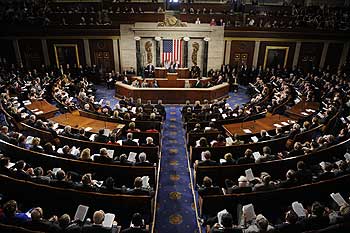
On Dec. 18, as Congress was about to head out of town, the Senate took three last votes on the war in Iraq. The outcome of the votes replicated a host of votes earlier in the year and ran into the same law of mathematics: 60 votes are needed to pass controversial legislation in the Senate, such as requiring American troops to return home from Iraq. Beyond that 60-vote barrier lies the president's veto pen, and a two-thirds majority in both houses of Congress is needed to overcome that barrier. There are not 60 votes in the Senate to end the Iraq War, and there is certainly not a two-thirds majority in either the House or the Senate.
This salient congressional failure to end the disastrous Iraq War in 2007, however, masked a series of less visible but nonetheless important triumphs on national security issues, particularly related to nuclear weapons. Congress was able to stop, limit, or reverse some ill-advised Bush administration initiatives—more on that later.
It is true that the war in Iraq continues unabated. It is true that the military budget has skyrocketed, approaching $700 billion in approved funding for the wars in Iraq and Afghanistan through passage of the $70 billion "bridge" supplemental. It is true that the missile defense program, the largest single Pentagon weapons program, continues to lead a charmed life and will receive $8.7 billion in the next fiscal year, despite the flawed national missile defense ground-based system that lies at the heart of the program.
Policymaking in Washington in 2007 reflected some old truths. Powerful defense contractor lobbyists and their defenders in Congress continue to protect Cold War-era weapons programs that should be canceled. Interest groups such as the newly cash-flush Freedom's Watch that back the Iraq War as part of what presidential candidate Rudy Giuliani bellicosely referred to as the "Terrorists' War on Us," a Clash of Civilizations against "Islamofascists," also seek to confront Iran as soon as possible with military force. And Republicans continue to maintain a religious zeal for missile defense, stemming from Ronald Reagan's embrace of the program 25 years ago; however, almost no corporations or interest groups support building new nuclear weapons or expanding the nuclear weapons complex. Even Republicans who salute Bush's military policies are silent, publicly opposed, or active participants in the rebellion against the administration's nuclear weapons plans.
Nuclear weapons. After entering office in 2001, President George W. Bush sought expanded uses for nuclear weapons through a series of nuclear policy pronouncements and proposals to Congress to fund a new generation of nuclear weapons. First, the administration tried to persuade Congress to fund research into a small, low-yield, and therefore supposedly more "usable" nuclear weapon. Congress refused.
Next, the administration promoted a nuclear bunker buster, formally known as the Robust Nuclear Earth Penetrator, designed to attack national leaders hiding underground or to target deeply buried bunkers harboring biological or chemical weapons. Congress said "hell, no" and promptly killed the program.
Not giving up on plans for a new nuclear weapon, most recently the Department of Energy proposed building a Reliable Replacement Warhead (R.R.W.), a program designed to develop a nuclear warhead it claimed was safer and more reliable than the existing stockpile. Before leaving town shortly before Christmas, Congress passed a huge Omnibus Appropriations Bill that denied any funds for this latest scheme.
Foes of these new weapons programs pointed out that more than 15 years after the Cold War, the United States still maintains huge numbers of nuclear weapons—albeit many fewer than at the height of the Cold War—with no real mission or purpose. A force designed to face off against a massive Soviet nuclear arsenal has much less raison d'être today.
Representative Peter Visclosky, Democrat of Indiana, chairman of the House Energy and Water Appropriations Subcommittee that originally nixed the funds for R.R.W., said in a statement after congressional action: "Despite the fact that the Cold War has ended, and we now face different national security threats that include terrorists acquiring nuclear material, the administration has not yet established a revised nuclear defense strategy and stockpile plan to reflect the new realities of the world. To put it simply, funding the R.R.W. right now puts the cart before the horse."
Senator Dianne Feinstein, Democrat of California, one of the Senate's leading opponents of the R.R.W. program, added: "The administration has pushed hard over nearly eight years to spend aggressively on new nuclear weapon programs that the nation does not need and which would make the world a more dangerous place. The Reliable Replacement Warhead was just the latest."
Another victory came when Congress refused to fund the administration's plan to build a new facility to produce annually 125 to 200 plutonium "triggers" or pits for nuclear weapons. These plutonium pits are of the cores of modern nuclear warheads, and the plan was a key part of the Department of Energy's plan to rebuild the United States' nuclear weapons complex. However, after a 2006 study by national laboratory scientists, reviewed by independent scientists, concluded that existing pits in current nuclear weapons could last reliably for several more decades than previously estimated, Congress saw little need for a major new "bombplex" plant and zeroed out the work.
Congress bolstered these program cuts with provisions launching two reevaluations of American nuclear weapons policy. Congress established a 12-member congressional commission "to look at the strategic posture of the United States in the broadest sense," including both conventional and nuclear. The commission was asked to include a threat assessment, a detailed review of nuclear weapons policy and strategy, and an examination of non-nuclear alternatives to nuclear weapons. The commission's report is due Dec. 1, 2008.
In addition, Congress mandated the secretary of defense to conduct a comprehensive review of the nuclear posture of the United States for the next 5 to 10 years. This report would make recommendations on: the role of nuclear forces in American military strategy; the policy requirements to maintain a safe, reliable, and credible nuclear deterrence posture; the composition of the nuclear delivery systems that will be required for implementing American military strategy; and what kind of nuclear weapons complex is needed to support these activities.
Significantly, both studies are designed to guide the next president of the United States as he or she takes office in 2009. Thus, while another year remains in Bush's second term, most of Washington is already looking forward to the next president's new policies beginning in 2009.
Nuclear nonproliferation. There were other positive developments in 2007 in the nuclear realm. In February 2006, the Bush administration unveiled its plans for reprocessing American and foreign nuclear waste as part of its Global Nuclear Energy Partnership program, reversing a 30-year practice of not reprocessing spent nuclear fuel. As part of this program, the Bush administration planned to build a full-scale commercial reprocessing plant and fast reactor to separate plutonium from the nuclear waste. Congress cut out more than half the funds, appropriating only $179 million, and Congress' last words on the program in the final bill were that the "controversial initiative … will cost tens of billions of dollars and last for decades, but it continues to raise concerns among scientists and has only weak support from industry."
The Bush administration has generally given short shrift to nuclear nonproliferation policies, never giving high priority to important programs that minimize the risk of nuclear terrorism by securing and disposing of vulnerable nuclear weapons in Russia and materials in more than 40 countries that could be used to make nuclear weapons. Congress proved itself more responsible than the Executive Branch, however, and reversed previous attempts to cut funding for such programs. This year, it added $623 million in two bills for core nonproliferation programs. Congress also eliminated bureaucratic restrictions that had long hampered carrying out these vital nonproliferation programs.
One priority of the arms control community is the ratification and entry into force of the Comprehensive Test Ban Treaty. Bush made it clear upon taking office that he had no interest in resurrecting the treaty, which the Senate failed to ratify in 1999. The fact remains, however, that the United States has not conducted a nuclear explosive test for 15 years. While the administration requested funds in earlier years to speed up an eventual resumption of nuclear weapons testing (which Congress wisely denied), it did not even try in 2007.
Congress took on the test-ban issue in two ways. First, while the administration requested only $18 million for the Comprehensive Test Ban Treaty Organization, the international organization that monitors worldwide for any secret tests, even as the United States fell into arrears in its dues, Congress increased that amount by one-third to $24 million. Second, a compromise of sorts came on language proposed by Senator Carl Levin, Democrat of Michigan, endorsing eventual ratification of the Comprehensive Test Ban Treaty. Conservatives, led by Senator Jon Kyl, Republican of Arizona, who was recently elevated to the number two position in the Senate Republican hierarchy, put together a letter signed by 37 senators objecting to Levin's language. With neither side willing to risk a Senate floor fight over the provision, it was quietly dropped.
Non-nuclear strategic weapons. Congress also rejected a Pentagon request to put conventional warheads on Trident nuclear-powered submarines. These Trident submarines are a cornerstone of the mighty American nuclear deterrent capacity. The Pentagon, looking for a way to strike targets quickly across the globe, proposed replacing some nuclear warheads on Trident submarines with conventional warheads that could be launched quickly at far-off targets. Congress demurred, concerned about whether or not other nations could reliably tell whether a missile flying overhead contained a nuclear or a conventional warhead. While recognizing the need for the United States to have a capacity to strike quickly with a conventional warhead, the Defense Authorization conferees stated: "The conferees remain concerned about prompt global strike concepts that would employ a mixed loading of nuclear and non-nuclear systems and believe that [the Department of Defense] should carefully address these ambiguity concerns."
Missile defense. While Congress continues to pour huge amounts of money into missile defense programs, it did establish limits on the administration's proposed missile defense system in Europe that is supposed to protect against Iranian nuclear missiles. The United States plans to place new interceptor missiles in Poland, along with tracking radar in the Czech Republic. This plan has already stirred up fierce domestic opposition in Russia, Poland, and the Czech Republic. Congress stepped into the controversy by barring any spending on "procurement, site activation, construction, preparation of equipment for, or deployment of a long-range missile defense system in Europe" until Poland and the Czech Republic give final approval and until the Pentagon's director of Operational Test and Evaluation submits a report certifying that the proposed interceptor "has demonstrated, through successful, operationally realistic flight testing, a high probability of working in an operationally effective manner." These conditions may mean that any deployment decision is delayed until the next American president takes office.
North Korea. Another area of progress on national security is the effort to stop North Korea's nuclear program. The Bush administration—reversing course after six years—devoted new energy this year to negotiations with the secretive North Korean regime as part of the six-party talks. These negotiations made significant progress after the departure of John Bolton, former United States ambassador to the United Nations and previous undersecretary of state for arms control, who, no longer in government, has been liberated to criticize his former colleagues from a comfy perch at the American Enterprise Institute. Progress in the talks has been followed by steps forward on the ground, and North Korea has taken concrete steps to shutter its nuclear facilities.
Hawks in Congress could have objected to the talks with North Korea, one of the members of the "axis of evil," and could have tried to withhold funds to implement the agreement. But the Omnibus Appropriations Bill approved $53 million for energy assistance to the Pyongyang regime and authorized another $10 million for dismantlement work. The final bill stated: "The Committee on Appropriations strongly supports … disablement of North Korea's nuclear weapons arsenal and production capability."
Iran. The final area of mixed progress relates to Iran. Congress spent 2007 passing resolutions condemning Iran and its Revolutionary Guard, adopting greater economic sanctions, advocating a missile defense site in Europe to protect against Iranian missiles, and appropriating funds for an ineffectual and controversial program to "promote democracy" in Iran that has been thoroughly rejected by its intended beneficiaries.
But the trend toward confrontation and war was abruptly halted in early December when the intelligence community disseminated a new National Intelligence Estimate that found Iran had suspended its nuclear weapons program in 2003 in response to international pressure. The estimate further concluded: "We assess with moderate confidence Tehran had not restarted its nuclear weapons program as of mid-2007, but we do not know whether it currently intends to develop nuclear weapons." Ironically, Congress had been insisting since October 2006 that the Bush administration update its intelligence estimate of Iran's nuclear programs.
In sum, a year overshadowed by war in Iraq produced a number of significant victories for those focused on nuclear weapons activities. It is very likely that the major priority of the arms control community in 2008 will be to similarly hold the line against the Bush administration's nuclear weapons proposals, and then to push for wholesale change by the new president who takes office on Jan. 20, 2009.

From Right Web of the International Relations Center.
John Isaacs is the executive director of the Council for a Livable World and a contributor to Right Web.
Copyright © 1997-2026 Worldpress.org. All Rights Reserved.
 Privacy Notice
Front Page
Privacy Notice
Front Page