Tearing Down the Last Brick of the Berlin Wall
Ex-Communists Take Berlin
Tekla Szymanski, Associate Editor,January 9, 2002
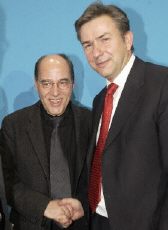 |
| Photo Opportunity: Berlin mayor Klaus Wowereit (R) of the Social Democrats shakes hands with Party of Democratic Socialism (PDS) politician Gregor Gysi in Berlin, Dec. 20, 2001 (Photo: AFP). |
As Austria's weekly newsmagazine Profil complained on Dec. 10, "Dealing with politics in Berlin is no fun anymore." Profil put it mildly. Not only is Berlin creaking under a mountain of debt amounting to nearly US$40 billion, but Germany's capital is facing one of its most arduous political challenges: The Social Democratic Party (SPD), Germany's oldest democratic party, has formed a coalition with East Germany's Party of Democratic Socialism (PDS), successor to the notorious East German Communist Party, which built the Berlin Wall. Many [West] Germans still consider it a political taboo to allow the ex-communist political party, which the Associated Press has called a "haven for old Stalinists," to help govern the city. But others see this as Berlin's chance to leave its history behind and truly unite East and West. Time will tell if the new government, scheduled to convene on Jan. 17, 2001, can deliver what the city needs: an aggressive policy to get the city's finances in order. If it fails, economists predict, Berlin may find itself bankrupt and in need of a federal bailout in four years.
The Social Democrats emerged the strongest party in the October 2001 city elections, but fell short of an outright majority in the legislature. Coalition talks with the Free Democrats (FDP) and the Greens collapsed after four weeks of sometimes tumultuous negotiations, leaving the PDS as the only possible coalition partner. Chancellor Gerhard Schröder was not the only one to cringe at this outcome. He had hoped for the so-called "Ampelkoalition", or "traffic-light" coalition, between the SPD (red), under Mayor Klaus Wowereit, the FDP (yellow), and the Greens. Schröder still hopes for such a coalition on the federal level after his likely re-election in 2002. The strong showing of the PDS at the ballots—the party won 47.6 percent of the vote in the eastern part of the city—is likely to affect next year's federal elections as well. And it is seen as a sign that the former communists have been rehabilitated in the eyes of the electorate: "In principle it's a good thing," said 35-year-old Axel Bergmann, who works at East Berlin's Charité hospital. "One set of people will no longer see them as the red devil, and the other will no longer view them as a savior."
This, however, is not the first coalition between the SPD and PDS in the united Germany. Similar coalitions function smoothly in the parliaments of eastern German Länders Mecklenburg-West Pomerania and Saxony-Anhalt. But Berlin is a different matter entirely. This is the one city that the rest of the country, and the world, have always scrutinized under a magnifying glass.
Former communists are welcomed in politics elsewhere. In France, for example, the communists govern together in a comfortable alliance with the socialists, to few complaints. But Germans cannot help but regard Berlin as a special case. "The center of the Cold War is now falling into the hands of former communists," argues Constanze von Bullion in Munich's centrist Süddeutsche Zeitung (Dec. 12). And the leader of Germany's conservative Christian Democrats (CDU), Friedrich Merz, proclaimed that a red-red coalition in Berlin would hurt Germany's standing in the world.
Coalition talks with the Greens (a partner in Chancellor Schröder's federal coalition) and the centrist FDP took weeks. In contrast, the arrangement with PDS was finalized in days and was regarded by the German news media as a pragmatic compromise. But the speed with which matters were finalized left many commentators speechless—it took only 12 hours of negotiations to come up with a joint political program for the next five years. Such haste caused others to hint that the SPD had envisioned governing with the PDS from the start and had entered coalition talks with the FDP and Greens only to show that it tried honestly to circumvent the PDS but failed. Within a matter of days, Mayor Wowereit and PDS leader Gregor Gysi, who will become deputy mayor and will be in charge of the city's finances, were photographed arm in arm under a Christmas tree at City Hall.
"Now, there will be more wishful thinking than actual governing in Berlin," smirked Lorenz Maroldt of Berlin's conservative Tagesspiegel (Dec. 21). But the same day, Berlin's left-wing taz asserted that "a governing post-communist party in this city is a sign of European normalization—and the symbolic end to Germany's special political status within the E.U." Conservative commentators, however, feared that a governing PDS would boost the party's reputation and eclipse its notorious past. Gysi, in turn, vowed to help turn Berlin into a cultural and scientific capital once again. This after his party had apologized for building the Berlin Wall in 1961.
Hamburg's liberal weekly Der Spiegel, in a Dec. 6 article headlined "Santa Klaus Wowereit And His Elf Gysi," predicted that the coalition could resemble a two-man show, since both Wowereit and Gysi are known to be fond of the media, outspoken, and charismatic. "The East bloc is knocking on our doors," Der Spiegel joked on Dec. 10, calling the coalition "the biggest political experiment since reunification, which could prove risky for Chancellor Schröder." Risky because the chancellor might lose the support of the political center by turning the PDS into a viable left-wing alternative to the Greens, whose support is slipping because of their participation in the U.S. campaign in Afghanistan, leaving the PDS as the lone, stern voice speaking out against the U.S. war in Afghanistan. This could become a headache or, worse, an outright embarrassment for Schröder, who has already given an unconditional pledge of support to U.S. President George Bush and has even sent peacekeeping troops to Afghanistan.
"There is no alternative [to the PDS]," said Edzard Reuter, the former chairman of Daimler-Benz, and son of the mayor of postwar Berlin, in a Dec. 10 interview with Der Spiegel. "One shouldn't vilify everything that was done under communism. Just imagine that we, in postwar Germany, had vilified everything that had to do with our brown [as in brown shirt, or fascist] past. We should give Gysi a fair chance." Not so fast, other commentators say. Renowned author Günter Kunert, who fled what was then East Germany in 1979 to settle in the West, writing in Franfurt's conservative Frankfurter Allgemeine Zeitung, concluded simply, "Politics is dirty business…The victims of yesterday are long forgotten. Now, the SPD has rehabilitated the same party that had treated the socialists as its arch enemy to the point of imprisoning its supporters." 

