Gambia 
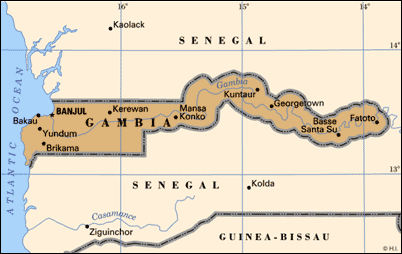


Facts
Background: The Gambia gained its independence from the UK in 1965. Geographically surrounded by Senegal, it formed a short-lived federation of Senegambia between 1982 and 1989. In 1991 the two nations signed a friendship and cooperation treaty, but tensions have flared up intermittently since then. Yahya JAMMEH led a military coup in 1994 that overthrew the president and banned political activity. A new constitution and presidential elections in 1996, followed by parliamentary balloting in 1997, completed a nominal return to civilian rule. JAMMEH has been elected president in all subsequent elections including most recently in late 2006.
Location: Western Africa, bordering the North Atlantic Ocean and Senegal
Area land: 10,000 sq km
Area water: 1,295 sq km
Coastline: 80 km
Country name conventional long form: Republic of The Gambia
Country name conventional short form: The Gambia
Country name former: Republic of The Gambia
Population: 1,797,860 (July 2011 est.)
Age structure: 0-14 years: 40% (male 360,732/female 358,440); 15-64 years: 56.9% (male 501,946/female 520,826); 65 years and over: 3.1% (male 26,645/female 29,271) (2011 est.);
Population growth rate: 2.396% (2011 est.)
Birth rate: 34.19 births/1,000 population (2011 est.)
Death rate: 7.65 deaths/1,000 population (July 2011 est.)
Net migration rate: -2.58 migrant(s)/1,000 population (2011 est.)
Sex ratio: at birth: 1.03 male(s)/female; under 15 years: 1.01 male(s)/female; 15-64 years: 0.98 male(s)/female; 65 years and over: 0.98 male(s)/female; total population: 1 male(s)/female (2011 est.);
Infant mortality rate: total: 71.67 deaths/1,000 live births; male: 77.3 deaths/1,000 live births; female: 65.87 deaths/1,000 live births (2011 est.);
Life expectancy at birth: total population: 63.51 years; male: 61.23 years; female: 65.86 years (2011 est.);
Total fertility rate: 4.23 children born/woman (2011 est.);
HIV/AIDS - adult prevalence rate: 2% (2009 est.);
HIV/AIDS - people living with HIV/AIDS: 18,000 (2009 est.);
HIV/AIDS - deaths: fewer than 1,000 (2009 est.);
Nationality: noun: Gambian(s); adjective: Gambian;
Ethnic groups: African 99% (Mandinka 42%, Fula 18%, Wolof 16%, Jola 10%, Serahuli 9%, other 4%), non-African 1% (2003 census);
Religions: Muslim 90%, Christian 8%, indigenous beliefs 2%;
Languages: English (official), Mandinka, Wolof, Fula, other indigenous vernaculars;
Literacy: definition: age 15 and over can read and write; total population: 40.1%; male: 47.8%; female: 32.8% (2003 est.);
GDP (purchasing power parity): $3.406 billion (2010 est.); $3.244 billion (2009 est.); $3.073 billion (2008 est.);
note: data are in 2010 US dollars
GDP (official exchange rate): $1.04 billion (2010 est.);
GDP - real growth rate: 5% (2010 est.); 5.6% (2009 est.); 6.3% (2008 est.);
GDP - per capita (PPP): $1,900 (2010 est.); $1,800 (2009 est.); $1,800 (2008 est.);
note: data are in 2010 US dollars
GDP - composition by sector: agriculture: 30.1%; industry: 16.3%; services: 53.6% (2010 est.);
Population below poverty line: NA%;
Household income or consumption by percentage share: lowest 10%: 2%; highest 10%: 36.9% (2003);
Labor force: 777,100 (2007);
Labor force - by occupation: agriculture: 75%; industry: 19%; services: 6% (1996);
Unemployment rate: NA%;
Budget: revenues: $183.9 million; expenditures: $202.5 million (2010 est.);
Industries: processing peanuts, fish, and hides; tourism, beverages, agricultural machinery assembly, woodworking, metalworking, clothing;
Industrial production growth rate: 8.9%;
note: although The Gambia had the highest industrial growth rate in the world in 2009, this growth is from a tiny industrial base (2010 est.)
Electricity - production: 160 million kWh (2007 est.);
Electricity - consumption: 148.8 million kWh (2007 est.);
Electricity - exports: 0 kWh (2008 est.);
Electricity - imports: 0 kWh (2008 est.);
The Gambia in the News
Rachel S. Taylor profiles Gambian jurist Hassan Bubacar, chief prosecutor for the International Criminal Tribunal for Rwanda.
Gambian reaction to the terrorist attacks on the United States