Click
an area of the map for world news.
Click
an area of the map for world news.


Affiliated Programs: 


World Press Review is a program of the Stanley Foundation.
|

Israeli
Minister's Murder Leaves Peace Hopes in Peril
Elisa Ben-Rafael
World Press Review Correspondent
Jerusalem
Oct 18, 2001.
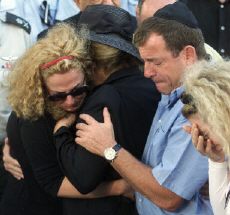 |
| Israeli
Tourism Minister Rechavam Ze'evy's daughters, wife, and
son grieve during his funeral at Jerusalem's Mount Herzl
military cemetery Oct. 18, 2001 (Photo: AFP). |
Israeli
Minister of Tourism, Rechavam Ze'evy, was assassinated near
his hotel room at the Hyatt Hotel in northeastern Jerusalem
early Oct. 17, 2001. The Popular Front for the Liberation of
Palestine (PFLP) has claimed responsibility for the action stating
that it is in retaliation for Israel's killing of the PFLP leader
Mustafa Zibri Abu Ali Mustafa in his Ramallah office on Aug.
27, 2001. Israeli security sources believe Zibri was behind
a series of terrorist bombings.
Rechavam Ze'evy was born in Jerusalem in 1926. A graduate of
the Command and General Staff College of the U.S. Army, he rose
through the ranks of the Israeli Defense Forces (IDF), eventually
attaining the rank of Major General responsible for the central
region of Israel, including the West Bank. In 1974, he left
the IDF to serve as Advisor to Prime Minister Rabin on Anti-Terror
Matters and Intelligence, a post he occupied for three years.
Ze'evy was first elected to the Knesset in 1988 as Chairman
of the Moledet (Homeland) faction. He has served as a member
of the Knesset House, Foreign Affairs and Defense, Education
and Culture, and State Control Committees. He served as a minister
without a portfolio from 1991 to 1992 in the Shamir government.
In March 2001, he was appointed Minister of Tourism in the Sharon
government.
Ze'evy, head of the National Unity-Israel Beitanu Knesset Faction,
had resigned from his ministerial post on Tuesday, Oct. 16 in
protest of the government's decision to withdraw Israeli forces
from Palestinian neighborhoods in Hebron. His resignation was
to have taken effect the afternoon of Oct. 17. Instead, the
Knesset held a special session at the time his resignation was
to have taken effect to eulogize the slain minister.
Ze'evy's assassination is the first of a ranking Israeli politician
since Prime Minister Yitzhak Rabin's in 1995, and—given
the PFLP's claims of responsibility—the first at Arab hands
since the establishment of Israel in 1948. His death has already
had serious repercussions. The assassination took place after
Prime Minister Ariel Sharon had announced that he would personally
lead the anticipated negotiations between Israel and the Palestinian
Authority, negotiations that Sharon said would lead to the establishment
of a Palestinian state. Sharon's first reaction was an unequivocal
reversal of this position. Sharon, paraphrasing U.S. President
George Bush, said, "What has been until now will be no
longer… We will wage a war without mercy against the terrorists.
Only criminal terrorists could dream of assassinating elected
members of a democratic state. I hold Arafat fully responsible,
inasmuch as he set the terrorism in motion, even though he knew
what the consequences would be." After a series of emergency
cabinet meetings, the Israeli government issued an ultimatum
to Yasser Arafat and the Palestinian Authority, demanding that
the murderers be turned over to Israel immediately. "If
the Palestinian Authority does not meet our demands, there will
be no choice but to consider it as an entity that supports terrorism
and to act accordingly," Gideon Saar, the cabinet secretary,
said after the emergency meeting.
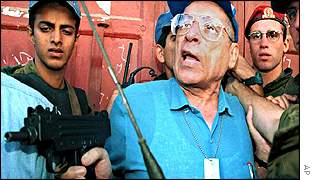 |
| Ze'evy
on a tour of Hebron, in the West Bank (AP/wideworld Photos). |
Ziyad
Abu Zayad, advisor to Palestinian leader Yasser Arafat, responded
to Sharon's ultimatum with a strong condemnation of Ze'evy's
assassination. But Zayad insisted that, while the Palestinian
Authority would arrest the assassins and bring them to trial,
they would not extradite them to Israel.
The Israeli military response was swift. On the morning of Oct.
18, IDF tanks entered the West Bank towns of Ramallah and Jenin.
In Jenin, an 10 year-old schoolgirl was killed when Israeli
tank fire hit a Palestinian school, sources at a Palestinian
hospital said. Israel has denied that it fired on a school.
Hours later, an explosion—alternately attributed to a car
bomb and army helicopter fire—killed three Palestinians,
including Atef Abayat, the Bethlehem military commander of Arafat's
Tanzim faction.
The Palestinian Authority later announced it had banned the
PFLP and arrested 12 of its members.
As the battle raged, Rehavam Ze'evy's body lay in state in the
Knesset plaza. Israelis came together to pay their last respects
to a man whom they deeply respected. Many arrived early in the
morning from far away in order to be able to walk past his flag-draped
coffin. Assaf, a young man from Eilat, drove six hours through
the night in order to stand before the coffin for a few minutes.
Assaf said: "I didn't agree with him. But he was a good
man who deeply loved Israel. How could I not be here?"
An American-Israeli woman who preferred not to identify herself
other than to say that she was from the Beth-El settlement said:
"I am very angry. I think that what needs to be done now
is what Bush has done. This murder must be revenged." Suzi,
sitting stiffly in her wheelchair, had made the journey from
Hadera [near Haifa, in northern Israel] simply because she wished
to pay final respects to a man whose controversial political
perspective she shared.
Rabbi Meir, a teacher at a religious school for boys in East
Jerusalem, brought his 5th grade students. With his students
standing around him, Rabbi Meir quietly said: "Rehavam
Ze'evy had the courage to stand up and say what so many of us
believe in. He was a deeply spiritual man. I would often see
him walking in the Old City. He defended the Old City as a soldier
and worked to build up and defend the country." Then, in
front of his students, the rabbi began to cry.
Controversial, But Loved
Throughout his career, Ze'evy was known for his far-right views.
He gained notoriety for comparing Palestinian leader Yasser
Arafat to Adolf Hitler and for advocating the "transfer,"
or expulsion, of Palestinians from areas Israel seized in the
1967 war.
In June, 2001, he referred to Palestinians working illegally
in Israel as "lice" who must be stopped as if they
were "cancer spreading within us."
But despite the fact that Ze'evy's unapologetically hawkish
views often brought him into conflict with more moderate elements
in the Israeli government, he maintained deep personal friendships
with politicians from across the political spectrum. Politicians
and members of Knesset from all political parties unanimously
expressed their admiration for him today. Shulamit Aloni, former
Chairwoman of the left-wing Meretz Party said, "Ze'evy
and I were friends. We knew that we would never persuade each
other politically, but there were many other things for us to
talk about. Both of us shared a love for literature, poetry,
and theatre, and so we spoke about that. Occasionally we would
speak of politics. In our political arguments he was always
straightforward, logical, and honest."
Abd el-Malek Dahamsha, a member of the Knesset for the United
Arab List party, said: "Despite the fact that we are political
opposites, Ze'evy and I had a friendship born of fundamental
respect for one another. Sometimes we would speak strongly to
one another, but we always respected one another."
As he was buried this afternoon, Ze'evy's close friend, actor
Chaim Topol, told Israeli Broadcast Authority Television (government-owned),
"We all loved him. He was always true to his convictions.
For me he was too left-wing."
Following Ze'evy's death, the Israeli government faces serious
challenges. It has already decided to dispatch a diplomatic
team of four senior ministers to Washington. They are likely
to try to win support for a new strategy in their dealings with
the Palestinians. The Israeli government has promised to avenge
Ze'evy's assassination and has stated that it will not tolerate
this type of action against its ministers. Meanwhile, the PFLP
has claimed that this is only the beginning and that they will
target other members of the Israeli government. This is a new
and different kind of battle and does not bode well for either
side. Now Israelis and Palestinians alike have decided to use
a policy of targeted killings to attempt to achieve their goals.
This further distances both sides from the negotiating table
and does not portend well for the already tenuous peace process.
 |
|
|