Americas

The United States Swings Right
The International Press on the U.S. Midterm Elections
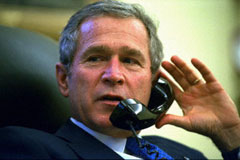 |
| U.S. President George Bush at the Oval Office, Nov. 6, 2002, the day after his party swept midterm elections in the United States (Photo: Eric Draper/AFP). |
Toronto
The Toronto Sun (conservative), Nov. 8: Amazing! Two short days after U.S. President George W. Bush led his Republicans to a decisive congressional election victory, France and Russia were finding ways to agree to a tough U.S. resolution to disarm Iraqi dictator Saddam Hussein. Some call it realpolitik. Others call it opportunism—the political art of backing down while trying to claim you had won.—Bob MacDonald
Tehran Resalat (conservative), Nov. 7: [The results were] predictable. According to the opinion polls, the public had believed the pessimistic view of the Republicans on the security situation. Not even the realities of America’s economic decline or the more painfully evident effects of that decline on working American families were able to trump the Republicans’ line on national security. In any case, regardless of whether we consider the American public as deceived or whether we see it as ruling over the structure of politics and government, the votes of the Americans are in line with the political games of the leaders of that country. This means that extremism has become a predominant wave in America.
—Heshmatolah Falahat-Pisheh
Paris Le Monde (liberal), Nov.7: Split over Iraq, and split over tax cuts, the Democrats failed to find a proper angle of attack: You cannot criticize the President if the country is under threat. The United States, though at the summit of its absolute power, considers itself vulnerable. This paradox explains this paradoxical President, who cultivates a man-in-the-street image, who approves a gigantic defense budget, and who, having been elected under less-than-ideal conditions, has just achieved an almost exceptional political success.
Bangalore Deccan Herald (independent), Nov. 11: The midterm election results do not reflect a revolutionary shift in the political preferences of the nation. The electorate did not turn against Democrats with fury. It did not give Republicans an overwhelming mandate. There were only narrow wins and narrow defeats and in the two houses of Congress [in terms of the popular vote], Republicans only have slender leads....The marginal shift in the voters’ preferences will have disproportionate political impact because the Republicans have gained a majority in the Senate. The significance of the mid-term results also lies in the huge impact it is having on Democrats....The party’s strategy and its principles have come up for a serious re-examination. Has the progressive centrism adopted in the recent years become a liability? Has the party moved away from its roots? The way some Democrat legislators went out of the way to support Bush’s policies fudged the brand distinction, making the two parties indistinguishable in the eyes of the voters.
—L.K. Sharma
London The Independent (liberal), Nov. 7: In the end, and contrary to every prediction, it wasn't even close. The election night that was supposed to be a cliffhanger turned into a rout of the Democrats. And the reason may be spelled out in two words: George Bush. Blame the outcome—and inveterate Bush-haters will—on the fact that the Republicans had far more money, on the spinelessness of the Democratic leadership, or on the relentless and cynical exploitation of Iraq and the war on terrorism by the White House in order to squelch discussion of other issues. There is more than a grain of truth in all these excuses. But the unalloyed, incontrovertible truth is that this was a colossal personal triumph for the president.... This is an election whose result will reverberate not just around America but the world, from the United Nations to Jerusalem, Riyadh, Pyongyang, and Baghdad.
—Rupert Cornwell
Budapest Magyar Hirlap (independent), Nov. 7: A Bush has won and a Kennedy has lost. Tuesday's election performance of the two key political clans of the United States symbolized everything that has taken place this week in domestic politics overseas….True, neither the recent past nor the near future convey a sense of normality in the United States. The attacks in September 2001, the Afghan war, the anti-terrorism actions, the ceaseless alarms at home, and even the activities of the serial killer captured the other day have strengthened the need for stability and order. Not to mention Iraq…. War is believed to be unavoidable. And so the sense of duty and self-respect that called for supporting the commander in chief also favored Bush. By no coincidence, the necessity of toppling Saddam Hussein for the sake of the U.S. national interest was the most frequent theme in the president's campaign speeches.
—Zsolt Ivan Nagy
Lahore The Nation (conservative), Nov. 8: The democratic verdict of any people is a majestic thing and is to be respected. But it must also be clear that the Republican triumph is not a carte blanche for the Bush administration, allowing it to carry out its aggressive, bordering on imperialist, global agenda. For that there is the U.N.’s own democratic process, which even the most powerful country in the world and its high-powered president must learn to respect and support. The American people may regret the mandate they have given a president whose policies might result in the body bags, dreaded since Vietnam, heading back home.
Jerusalem Jerusalem Post (conservative, English-language), Nov. 6: The election and its aftermath should be of more than just passing interest to America’s friends and foes abroad. From the beginning, Bush was widely viewed as an accidental president lacking a real political mandate. Yet Bush, who traveled to more than 15 states in the past two weeks and raised more than US$140 million for Republican candidates, proved that his political skills were real, not just the knock-on effect of a rally-round-the-leader syndrome in the wake of Sept. 11.... What matters to Americans is that their president be strong, decisive, purposive—and that he have a Congress to support him.
Islamabad The News (independent), Nov. 7: The success achieved by the Republican Party in the U.S. Congress elections might well be a signal for President George W. Bush to go ahead with his planned attack on Iraq. The loud clamor in the United States opposing any action against Saddam Hussein had given an impression of widespread antiwar sentiment. The elections have now put to rest any such an assumption as the result is a personal victory for the president. He can now move with confidence on his plans to either get the U.N. weapons inspectors back into Iraq without any conditions or unseat Saddam Hussein, which is his real objective.
Jakarta The Jakarta Post (independent, English-language), Nov. 9: This is an American leader who has a history of defying international opinion on many occasions, such as on issues like global warming, on the establishment of an international criminal court, on trade matters, and lately on the war on Iraq. This is an American leader who seems to derive his legitimacy more from the American people, even on matters of international affairs.... This is also the leader of one of the most democratic countries in the world. President Bush’s powers, as omnipotent as they may seem to the rest of the world, are not without democratic checks and balances at home. If there is still any force in the world that could stop President Bush from attacking Iraq, if would be the American public. If there is any force in the world that can prevent him from extending his war, it will have to be Americans themselves. We may recall that America lost the Vietnam War in the 1970s partly because of public opinion at home.
New Delhi Outlook (independent weekly), Nov. 18: The Republican Party’s stunning success in wresting control of the U.S. Senate from the Democrats by increasing its seats in a non-presidential election year—one of the very few times this has happened in American history—provides stunning proof that paranoia and jingoism can be converted into votes in a democratic system.... The consequences for the world could be devastating. To begin with, it has all but sealed Iraq's fate. Armed with this endorsement, the Bush administration is virtually certain to ignore any hurdle the U.N. Security Council may put up, and declare war unilaterally on that unfortunate country.
—Prem Shankar Jha
London The Guardian (liberal), Nov. 8: As long as national security concerns remain paramount, and as long as Bush and the Republicans are seen as more effective in meeting them than the Democrats, independents will continue to back Republicans, and Republicans will enjoy an advantage in congressional and presidential elections, just as they did during the 1980s. But if American fears of terror from abroad recede, or if the Bush administration should be unsuccessful in prosecuting the war on terror—having become bogged down, for instance, in a protracted and expensive occupation of Iraq—then the political environment will quickly change. If the war against terror finally abates, as it has periodically in other parts of the world, Americans will return to the preoccupations of post-industrial society, which favor Democratic politics... and long-term domination by Bush and the Republicans is unlikely. It won't end tomorrow, but it could in two or four years.
—John Judis
Sydney The Sydney Morning Herald (centrist), Nov. 9: While the president wants to press ahead with tax reform, the new Congress must first urgently pass a budget that [calls for] big spending cuts to control the deficit caused partly by the first round of [tax] cuts. Adding to the pressure on Bush and the Republicans will be myriad special interests that funded their campaign: pharmaceutical companies, insurance companies, banks, and finance houses. All want their agendas pushed through Congress. After delivering record donations, they will not be easily brushed aside. To juggle all this and war with Iraq will strain even Bush’s political skills. But after his victory this week, he made it clear that he was not inclined to take too many backward steps, and that he was prepared to gamble on his own political judgment.
—Marian Wilkinson
Ottawa Ottawa Citizen (conservative), Nov. 10: Europeans do not understand the curious civilization that the current America is becoming, and the grip that a visceral and idiosyncratic conservatism has on its national discourse.... George Bush Jr. is a chip off the old multilateralist, transatlantic establishment, runs the European argument. He may seem hawkishly conservative but, in the end, he seeks U.N. resolutions like other American presidents. Even at home, his bark is worse than his bite. Wrong, wrong, and wrong again.... Georgia's Republican Party, for example, is now led by Ralph Reed, a longtime crusader against abortion, divorce, and single parent families.... He is part of U.S. conservatism’s ideological hard core.... America is not a happy place. A generation of increasingly conservative policies has shrunk the American middle and induced not just fantastic inequality but a sharp decline in social mobility and opportunity.... The trouble was that this silent liberal majority was only prepared to voice its preoccupations at state rather than national level, if it bothered to vote at all. The Democrats had to find a way of voicing the concerns of the mass of Americans while not undermining the president during a national emergency, but to do that they had to have a powerful pitch based on a liberal ideology as animating and dynamic as that of the conservatives. They didn't and they lost.... In the meantime, despite its flaws, give thanks to the European Union for partial shelter from the conservative storm.
—Will Hutton