Prizewinning Film Denounces Violence in Algeria
Rachida's Hard Path
Meron TesfaMichael, Jan.16, 2003
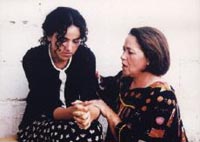 |
| Rachida (Ibtissème Djouadi) is comforted by her mother (Bahia Rachedi) in a scene from Yamina Bachir's Rashida. (Photo: AFP) |
Rachida, a feature film by Algerian-born filmmaker Yamina Bachir Chouikh, is winning praise for denouncing the violence that has steeped Algeria in blood and chaos for the last twelve years.
Inspired by true events, Rachida (2002) looks at Algeria’s worst years of terrorism through the eyes of a young schoolteacher and her mother.
Going to work one morning, Rachida (Ibtissème Djouadi), is set upon by a gang of youths. They order her to set a bomb off in her school. She refuses to cooperate, and the ensuing conflict ends with the gang leader shooting her. Miraculously, Rachida survives and takes refuge in a nearby village, where the nightmare continues.
The French-financed movie tells a story of how extreme physical and emotional violence against a community’s most vulnerable is undertaken as a matter of strategy. "In reality, the teacher was killed," Bachir told Middle East Online (Jan. 7). "I wanted to bring this woman back to life, to show her daily life, to speak about her courage."
In January 1991, the Algerian army interrupted parliamentary elections after the first round to prevent the Islamic Salvation Front (FIS), an Islamist party, from winning a landslide victory. Radical Islamists reacted to the army's move by taking up arms against the state and the government responded with a massive crackdown that marked the beginning of a bloody campaign. It has so far contributed to the deaths of more than 100,000 people.
In the few weeks since the beginning of 2003, more than 40 soldiers and 13 members of two families—including two young children, a woman, and a disabled person—have been killed. According to a 2002 report by Amnesty International, some 200 people continue to die every month as a result of the continuing conflict. "Many are civilians, including women and children, killed in targeted and indiscriminate attacks by armed groups," the report states.
Bachir, who now lives in France, told World Press Review that she took the project upon herself simply out of pain as "a tiny contribution on my part toward the healing of the deep wounds of my people."
In the movie, the camera roams around the village and depicts the day-to-day lives of its women, whose days are filled with distress, abandonment, and violence. Rachida slowly overcomes her fear and starts to teach again—only to have her momentary peace shattered by a gruesome massacre one night, when armed groups raid a wedding ceremony in the village and leave a blood bath in their wake. The following day Rachida courageously decides to return to the village’s wrecked school, an act of courage that is emulated by her pupils, who arrive one by one and reclaim their ravaged classroom.
“Rachida is my hymn to peace, tolerance, and the courage of countless anonymous faces in my country” Bachir said. She particularly wanted to depict “a people held hostage between violence that was said to be justified and one that was obviously barbaric, and a youth who had lost all points of reference, who was humiliated and ready to join any extremist faction."
Born in 1954 in Algiers, Bachir entered the filmmaking industry in 1973 as a scriptwriter and film editor for documentary and feature films. She worked in collaboration with a number of Algerian filmmakers including Abdelkader Lagda, Noureddine Mefti, Ahmed Rachedi, and her husband, director Mohamed Chouikh on The Citadel (1989) and The Arch of the Desert (1997). Rachida is the first feature film she has written and directed.
Since its debut at the 2002 Cannes International Film Festival in France, Rachida has been touring international film festivals. It has won numerous prizes, including Un Certain Regard at the 2002 Cannes Film Festival; a Special Jury Prize at the 2002 Marrakesh Film Festival; the Satyajit Ray Award at the 2002 London International Film Festival, and the Best Film Directed by a Woman of Color at the 2002 African Diaspora Film Festival in New York.
Though it has yet to be released in Algeria, Bachir told Paris's Le Monde (Jan. 15)that she had no fear about its reception there. "I only regret not having filmed it at the moment I wrote it, because there have been so many more deaths since then. But fear, no. What's important to me is to have been as honest as possible in my gaze...and in that, I think I succeeded."

