Ghana 


Facts
Background: Formed from the merger of the British colony of the Gold Coast and the Togoland trust territory, Ghana in 1957 became the first sub-Saharan country in colonial Africa to gain its independence. Ghana endured a long series of coups before Lt. Jerry RAWLINGS took power in 1981 and banned political parties. After approving a new constitution and restoring multiparty politics in 1992, RAWLINGS won presidential elections in 1992 and 1996, but was constitutionally prevented from running for a third term in 2000. John KUFUOR succeeded him and was reelected in 2004. John Atta MILLS took over as head of state in early 2009.
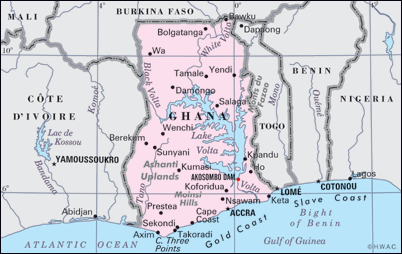
Location: Western Africa, bordering the Gulf of Guinea, between Cote d'Ivoire and Togo
Area land: 227,533 sq km
Area water: 11,000 sq km
Coastline: 539 km
Country name conventional long form: Republic of Ghana
Country name conventional short form: Ghana
Country name former: Gold Coast
Population: 24,791,073
Age structure: 0-14 years: 36.5% (male 4,568,273/female 4,468,939); 15-64 years: 60% (male 7,435,449/female 7,436,204); 65 years and over: 3.6% (male 399,737/female 482,471) (2011 est.);
Population growth rate: 1.822% (2011 est.)
Birth rate: 27.55 births/1,000 population (2011 est.)
Death rate: 8.75 deaths/1,000 population (July 2011 est.)
Net migration rate: -0.58 migrant(s)/1,000 population (2011 est.)
Sex ratio: at birth: 1.03 male(s)/female; under 15 years: 1.02 male(s)/female; 15-64 years: 1 male(s)/female; 65 years and over: 0.84 male(s)/female; total population: 1 male(s)/female (2011 est.);
Infant mortality rate: total: 48.55 deaths/1,000 live births; male: 51.99 deaths/1,000 live births; female: 45.01 deaths/1,000 live births (2011 est.);
Life expectancy at birth: total population: 61 years; male: 59.78 years; female: 62.25 years (2011 est.);
Total fertility rate: 3.48 children born/woman (2011 est.);
HIV/AIDS - adult prevalence rate: 1.8% (2009 est.);
HIV/AIDS - people living with HIV/AIDS: 260,000 (2009 est.);
HIV/AIDS - deaths: 18,000 (2009 est.);
Nationality: noun: Ghanaian(s); adjective: Ghanaian;
Ethnic groups: Akan 45.3%, Mole-Dagbon 15.2%, Ewe 11.7%, Ga-Dangme 7.3%, Guan 4%, Gurma 3.6%, Grusi 2.6%, Mande-Busanga 1%, other tribes 1.4%, other 7.8% (2000 census);
Religions: Christian 68.8% (Pentecostal/Charismatic 24.1%, Protestant 18.6%, Catholic 15.1%, other 11%), Muslim 15.9%, traditional 8.5%, other 0.7%, none 6.1% (2000 census);
Languages: Asante 14.8%, Ewe 12.7%, Fante 9.9%, Boron (Brong) 4.6%, Dagomba 4.3%, Dangme 4.3%, Dagarte (Dagaba) 3.7%, Akyem 3.4%, Ga 3.4%, Akuapem 2.9%, other 36.1% (includes English (official)) (2000 census);
Literacy: definition: age 15 and over can read and write; total population: 57.9%; male: 66.4%; female: 49.8% (2000 census);
GDP (purchasing power parity): $38.24 billion (2010 est.); $36.53 billion (2009 est.); $35.09 billion (2008 est.);
note: data are in 2010 US dollars
GDP (official exchange rate): $18.06 billion (2010 est.);
GDP - real growth rate: 4.7% (2010 est.); 4.1% (2009 est.); 7.3% (2008 est.);
GDP - per capita (PPP): $1,600 (2010 est.); $1,500 (2009 est.); $1,500 (2008 est.);
note: data are in 2010 US dollars
GDP - composition by sector: agriculture: 33.7%; industry: 24.7%; services: 41.6% (2010 est.);
Population below poverty line: 28.5% (2007 est.);
Household income or consumption by percentage share: lowest 10%: 2%; highest 10%: 32.8% (2006);
Labor force: 10.56 million (2010 est.);
Labor force - by occupation: agriculture: 56%; industry: 15%; services: 29% (2005 est.);
Unemployment rate: 11% (2000 est.);
Budget: revenues: $5.518 billion; expenditures: $7.025 billion (2010 est.);
Industries: mining, lumbering, light manufacturing, aluminum smelting, food processing, cement, small commercial ship building;
Industrial production growth rate: 5% (2010 est.);
Electricity - production: 6.746 billion kWh (2007 est.);
Electricity - consumption: 5.702 billion kWh (2007 est.);
Electricity - exports: 249 million kWh (2007 est.);
Electricity - imports: 435 million kWh (2007 est.);
Ghana in the News
 1 2 3 4 5 6
Displaying 9 to 12 of 23 items.
Six hundred Liberian refugee women and children are currently detained in Ghana and face imminent deportation for holding a peaceful protest in the Buduburam refugee settlement.
Many top African universities have many more enrollees then available spaces.
Many Liberian refugees remain in a long-term, permanent camp in Ghana
New York Student works at a snack shack in Accra, Ghana