Americas

Viewpoints
The International Press on the Republican National Convention
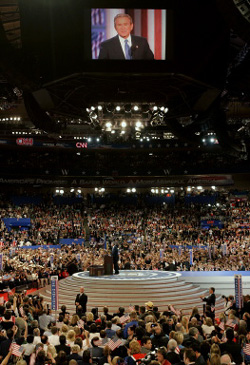 |
President George W. Bush addresses delegates at the Republican National Convention in New York City on September 2, 2004. (Photo: Jeff Haynes/AFP-Getty Images) |
Sydney The Australian (conservative), Sept. 1: Republicans have boldly claimed the September 11 terrorist attacks as a central re-election theme for George W. Bush. ... Numerous speakers at the convention in New York repeatedly revived images of death and tragedy in order to recall Mr. Bush's actions in the aftermath of the attacks, which marked his highest point in the polls. ... The Democrats were timid on September 11 at their Boston convention, for fear of being accused of exploiting the tragedy. They held a brief and simple candlelit prayer. The Republicans had no qualms about making it a central point of the first day of the convention. Whether it is exploitation of almost 3000 dead people is open to debate.
— Roy Eccleston
London The Guardian (liberal), Sept. 1: Laura Bush has made it her job to be nice and inoffensive, but last night she put her quiet, librarian's charm to powerful effect in painting a portrait of her husband as a thoughtful, dignified man who only wants to do good at home and abroad. ... It was not a well-delivered speech but it carried authority and appeared insightful. ... And on Iraq she debunked the idea of George Bush the warmonger. ... Without releasing a single barb towards the Democrats, the speech dwelt also on domestic themes of education and business development, and the liberation of Afghan and Iraqi women. But at its heart was the message: here stands an ordinary, decent American woman who believes in her husband — how could you not vote for him?
— Matthew Wells
Tokyo The Japan Times (independent, centrist), Sept. 1: The GOP convention promises to be a spectacular: Republicans have always demonstrated an innate understanding of the pomp and pageantry required of such events. Still, this year's conclave needs to be much more than a glorified television show: Now, more than ever, President George W. Bush needs to tell his country — and the world — what he intends to do if he is elected to a second term in office. ... [But] rather than discuss serious concerns, the GOP convention will showcase the president's accomplishments and try to make the party attractive to the rest of the country. ... He will promise answers to future challenges but is unlikely to tell us what those answers are — other than to underscore the need for fortitude, conviction and certainty of purpose. It will take considerably more than that to win in November. We, like American voters, are waiting to hear what Mr. Bush would do in a second term.
Amman The Jordan Times (independent), Sept. 1: The conservative Bush political machine has captured the Republican Party and crushed or co-opted its moderate and liberal factions and personalities. ... Right-wing conservatives make no compromises with those who disagree with their approach and policies. ... Through bluster and bullying, the conservative minority has silenced and sidelined the majority of the members of his party who, unfortunately, will still vote for Bush, however undemocratic his behaviour.
— Michael Jansen
Toronto The Globe and Mail (centrist), Sept. 2: For Republicans, the loosely defined Christian right is ... integral to the party's body and soul. But for many Americans, especially independent voters, religious conservatives are a disquieting lot with their moral absolutism and determination to blur the lines between church and state. So the public face of the Republican convention — the one reflected in the selection of speakers — has blotted out the Christian right. ... If this convention were a fair and accurate reflection of the Republican Party, there would be representatives at the podium of the Christian Coalition or Focus on the Family or the Family Research Council or a couple of evangelical Christian preachers. For the millions of people whom these groups represent are important spear-carriers in the party's grassroots army.
— Jeffrey Simpson
London The Times (conservative), Sept. 3: In what was probably the President's last opportunity to address the American people without the intermediation of television interviewers or his rival in this autumn's presidential debates, he made a forceful and impassioned case for his re-election. ... But Mr. Bush's principal case for his re-election centred on his ... personality. He reminded the audience of his presidency's finest hour — the days and weeks after September 11. He struck a tone that was mostly soft-spoken and designed to accentuate what polls suggest is an advantage for him over Mr Kerry — his personal likeability. Self-deprecating at times — he confessed to a swagger, but insisted what Texans call a walk — he sought to show some of the humility that has not been much of a feature of his presidency.
— Gerard Baker
Toronto Toronto Star (liberal), Sept. 3: U.S. President George Bush cloaked himself in sunny optimism last night, vowing to build "a more hopeful America" if he is awarded a second term. ... But the Republican campaign machine spent most of the past week peddling fear, rather than hope. Words like "terror" and "war" were far more prominent in speakers' mouths at the Republican National Convention in New York city, than "jobs," "health" and "homes." ... Republican strategists are scrambling to frame the 2004 election as a narrow referendum on terror, which Bush can win, rather than a vote on his broader management of the nation's affairs, which he might well lose. ... Years after 9/11 Al Qaeda's impact continues to be felt. The fear factor still holds the world's mightiest nation firmly in its irrational grip.