Middle East

The Israeli Press on Palestinian Reform
The Expectation of Palestinian Reform: Innocence or Naiveté?
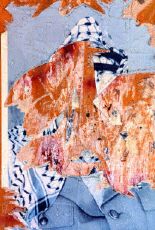 |
| The disappearing Yasser Arafat: Only Arafat's signature kaffiyeh remains of a poster in Nablus, Feb. 18, 2002 (Photo: AFP). |
Many in the Middle East and in the United States are talking about the intention and the need for Arafat to implement structural and political reform in the Palestinian Authority. This proposed reform would include new elections for the head of the authority and the Palestinian legislative council, as well as more openness and democratization.
Unfortunately, those who believe that structural reforms will occur soon do not understand that the authoritarian reality of the region—including the Palestinian Authority—has existed for more than 50 years. Given that structural reforms are not likely in Saudi Arabia, Egypt, or Syria, one should not expect them in the Palestinian Authority.
When an Arab leader is in distress he calls for a referendum or some kind of election. He does not intend to start a democratic process; rather, his intention is to once again gain the support of his people, in keeping with the authoritarian model of the Arab world—the Baaya oath. The oath provides a contractual connection between the ruler who is committed to concern for the social stability of his people and the wider public, which in turn is obligated to express unreserved devotion to the ruler.
According to Middle Eastern custom, rulers renew their mandates after a crisis... Saddam Hussein called a referendum after he killed his son-in-law in the mid-1990s. Two days before King Hussein died, he called on the Jordanian people to recognize his son Abdallah as his successor...
And thus the paradox developed that typifies Arab regimes today. At first blush, Arab governments seem to be based upon democratic foundations: a constitution, a parliament, political parties, freedom of the press, civil liberties, and referendums. In actuality, what predominates is an allegiance to a traditional, antiquated view of the ruler and the ruled.
Egyptians and Tunisians stood up and dared, for example, to limit the time a president could stay in office. But this reform didn't survive. Soon, power was granted to the president to rule to his dying day. [Egyptian President Hosni] Mubarak has ruled Egypt for the past 21 years [under a perpetual state of emergency].
Arafat fought with all his might against the suggestion of a constitution formulated by a group of Palestinian legal experts led by Anis El-Kassem. The idea of a constitution deviates from the Baaya model of classical times, and thus was never adopted in the Palestinian Authority. Arafat's powers were never defined. Instead, Arafat preferred to establish a central Palestinian authority, based on three principles: nepotism, corrupt management, and painful inefficiency.
Before Arafat, Palestinians in the territories were in some ways closer to democracy than all other Arabs. The increase of ideologies, political parties, the use of the high court, organizations for human rights, and the influence of Israeli society, were all abandoned when Arafat established an authoritarian government in the territories when he imported political views from other Arab states and turned the Palestinian Authority into just another Arab regime.
What can one expect from Arafat in light of Palestinian “soul-searching,” as it was called at the close of operation “Defensive Shield?” Very little, given the logic of his authority in the territories. His position as “Father of the Nation,” derived from the strength of the Baaya contract, will not change in any way. At the very most, ministers will be moved around within the government or elections for parliament will be held. Anyway, Arafat sees his existing parliament as a nuisance. That Arafat established yet another Arab-style government in the region, with all the serious maladies typical of such regimes, is a disaster for Israel. But first and foremost, it is a disaster for the Palestinians, for whom democratization was close at hand.