Africa

NEPAD, the African Press, and the G8 Summit
Crumbs from the Table
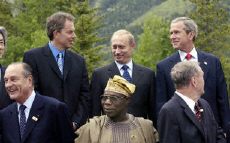 |
| June 27, 2002: As African presidents mingled with G8 leaders in Kananaskis, Canada, there were some who preferred to look away. (Photo: Luke Frazza, AFP) |
Hopes for a significant commitment of aid to Africa ran high as the G8 summit assembled in Kananaskis, Canada, on June 27, with the attendance of four high-profile African leaders on a day slated as “Africa Day.”
On the table was NEPAD, an ambitious plan for Africa’s economic recovery. Modeled on the U.S. Marshall Plan for the economic recovery of Europe after World War II, NEPAD is the brainchild of the leaders of South Africa, Nigeria, Algeria, and Senegal—all of whom were present at the G8 summit. Under the terms of NEPAD, participating African countries guarantee good governance in return for financial aid. NEPAD's supporters hope that with an annual US$64 billion in public and private investment, a growth rate of 7 percent of gross domestic product could be secured in participating countries. To guard against corruption, those countries pledge to use a system of peer review to monitor each other’s deployment of funds and progress toward good governance.
Prior to the G8 summit, there was disagreement in Africa over whether NEPAD was as revolutionary as its creators claimed. Banjul’s The Independent (April 29) called it “the most ambitious, comprehensive, and authentically African” rescue plan for Africa yet, and Isaac Aluko-Olokun, writing in Lagos’ This Day (May 6), found much to praise in the way that NEPAD “offers African methodology and solutions to African problems.” But others criticized South Africa’s Thabo Mbeki and his NEPAD co-founders for approaching European leaders before consulting their own governments or people. “The average African...has grave misgivings about NEPAD, as most do not even have an idea what it is about,” wrote Chama Nsabika in Lusaka’s The Post (May 2).
On June 27, South African president Thabo Mbeki and his three co-authors addressed the G8 summit, hoping to secure a substantial commitment of aid from the world’s eight most important industrialized nations. But as “Africa Day” drew to a close, Mbeki and his colleagues found that they’d received little more than crumbs from the G8 table.
The “G8 Africa Action Plan,” issued June 27, pledged to provide additional funding to make up a US$1 billion shortfall in debt relief owed by African nations. But it fell short of the development aid commitment sought by Canadian Prime Minister Jean Chretien and his British counterpart, Tony Blair: an annual investment of US$6 billion of the G8’s US$12 billion surplus. Instead, stated the 19-page document filled with supportive words for NEPAD, each G8 country would be able to determine its own level of aid “in accordance with our respective priorities and procedures,” and only if African nations could prove that they were serious about fighting corruption.
The lack of a firm commitment of aid to Africa was “pathetic” and “abysmal,” said Stephen Lewis, the United Nations Special Advisor on AIDS. “The leaders of the world's richest nations were able to find $20 billion to assure the dismantling of nuclear warheads in Russia…but they couldn't find even a fraction of that to save 2.3 million lives that are being lost every single year in Sub-Saharan Africa alone,” Lewis told Jim Cason of the online news agency allAfrica.com (June 28).
An opposite view was offered by columnist Simon Jenkins in The Times of London (June 26), who argued that, despite NEPAD’s promise of accountability, aid was likely to be misappropriated. “What could be more absurd than to offer African countries billions of dollars on condition that they refuse to allow those billions to corrupt their politics, yet knowing that they will?” Jenkins wrote. “The one help that Africa most needs is trade. It needs Western markets open to its primary produce. This, of course, is the one help that Africa will not get. George Bush and the European leaders in Canada…are protectionists to a man.”
Other commentators suggested that doubts over the peer review system might have weakened G8 support. Writing in the Zimbabwe Independent (June 28), Dumisani Muleya speculated that the crisis over Robert Mugabe’s rule in Zimbabwe had “cast a huge shadow” over the G8 leaders’ deliberations, since “despite committing themselves to a ‘peer review’ mechanism to monitor each other's rule, the continent's heavyweights have been unable to halt President Robert Mugabe's incremental autocracy.”
The African leaders themselves issued careful responses to the G8 Action Plan. “Our view is that the commitments are adequate but time lines (for implementation) will come only with specific projects,” Mbeki told a press conference in Calgary. Nigerian President Olusegun Obasanjo expressed satisfaction with the outcome of the meeting, but added, "There is nothing that is human that can be regarded as perfect."
British Prime Minister Tony Blair said that the meeting had established a “genuine partnership for the renewal of Africa,” and that it would send out a “signal of hope.” But, according to a June 25 editorial in Johannesburg’s The Star, the real test for NEPAD would come at the first summit of the new African Union in Durban on July 9 and 10, when African leaders will decide how to enforce the peer review mechanism. “Good governance, and the peer review mechanism by which it will be advanced, are really the most important elements of NEPAD,” read the editorial. “Unless they can give [peer review] real credibility in the eyes of the world by dealing honestly and firmly with bad leaders, NEPAD is doomed to join many other grand African development plans, in the litter bin of history.”