Middle East

Skepticism in the Israeli Press
Sharon Hasn’t Changed
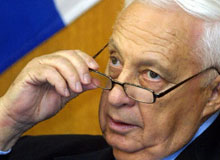 |
| Ariel Sharon addresses a Likud party meeting in Jerusalem, May 26, 2003 (Photo: Gali Tibbon/AFP). |
We shouldn’t harbor any illusions. The prime minister is still using all his power in a way that promotes violence in the Middle East. His words can hardly quiet this tempest. They are void of meaning.
This week Ariel Sharon repeatedly said almost everything that one could ask for. He solemnly declared that it’s a terrible idea to rule millions of Palestinians. He admitted that ruling over another people is a disaster for the economy. He emphatically warned that Israel must make big concessions to reach peace, and actually sounded serious. Serious enough to prompt Likud Knesset members like Ehud Yatom to immediately demand that Sharon retract his words.
Truly, when one listens to what Sharon has been saying, one can slide into a lasting euphoric mood and think that the moment of truth has arrived. Ariel Sharon, one of the architects behind the settlements in the West Bank and Gaza, has seen the light and come to a new realization: that the Jews who have insisted on moving to the heart of Hebron solely because somebody wasn’t able to stop them in time, really are a big problem.
Beyond the nice words, though, there is nothing in Sharon’s actions that shows he is indeed prepared to take the necessary steps to pave the way for the eventual establishment of a Palestinian state. Ariel Sharon hasn’t even taken the slightest action to stop settlers from populating new hills in the West Bank. He hasn’t hinted, winked, or even said anything in a roundabout way that would halt the expansion of the settlements. If he did take some sort of action and I wasn’t paying attention, I’ll gladly admit I was wrong.
It’s not surprising that there is no panic in Judea and Samaria [the West Bank] as a result of his words. Even in the settlements in the Gaza Strip—which, behind the scenes, everyone admits are a thorn in Israel’s side—there is no protest. It’s not the first time the settlers have heard such talk. In fact, the last time was barely a month and a half ago. Those wise Jews understand that Sharon talks but takes no action, that his words carry no threat to their way of life.
The bigger problem is that last year a new trend in [Haifa University’s] National Security Studies Center came to light. Many at the think-tank are now moving away from the idea that the settlers are at the heart of the problem and represent the greatest obstacle on the path toward a solution. The difficulties of the past three years, especially the heavy price extracted by the suicide bombers, led to a shift in Israel’s political center of gravity. There is a new way of looking at things. Academics are debating whether the settlements and the occupation of the West Bank preceded and occasioned the suicide bombings, or vice-versa. It almost resembles the question of the chicken and the egg.
Against this background, people are accepting Sharon’s declarations in all seriousness as if they represent a big and impressive step, instead of receiving them with the doubt and cynicism that they deserve. One need only look at the maps of the security fence slowly rising between the West Bank and Israel, a long and winding line [encroaching upon land inhabited by Palestinians to encompass nearby Israeli settlements], to see that all the writing on this wall reads: “The seeds to the next conflict are being planted here.” This much should be known: Sharon didn’t come to solve problems but to create more difficult facts on the ground, facts of the kind that will later prove impossible to rectify…or that at the very least will take more bloodstained years and large sums of money to erase.
[We] can’t separate the reality of the fence from the things that Sharon says. There’s no choice but to conclude that the planned path the fence is proof of Sharon’s insincerity and of his lack of real will to reach a real solution. It looks like Sharon is simply interested in gaining more time. He’ll get a ceasefire and it will be pleasant for a few months. By the time the Palestinians’ rage explodes all over again, his name will already be remembered as one that brought us some peace and quiet.
But [we] shouldn’t harbor any illusions. The prime minister of Israel is still working with all his power, around the clock, in a way that encourages violence in the Middle East. His words can barely quiet the tempest (in a cup of tea with no sugar). They are void of meaning.