Middle East

Middle East
Israeli Press Review: After Aqaba
 |
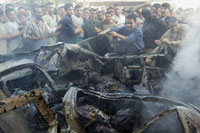 |
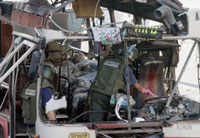
| TOP: Israeli police sappers inspect a bus destroyed in a Palestinian suicide attack in Jerusalem June, 11, 2003 (Photo: Gali Tibbon/AFP). BOTTOM: Palestinians try to rescue charred bodies from the remains of a car hit by an Israeli helicopter in Gaza, June 11, 2003 (Photos: Gali Tibbon and Mohammad Abed for AFP/Getty Images). |
A week of violence between Israel and Palestinian militant groups has squelched whatever optimism Israeli journalists expressed following the June 4 summit in Aqaba, Jordan. The meeting between Palestinian Prime Minister Mahmoud Abbas, Israeli Prime Minister Ariel Sharon, and U.S. President George W. Bush was meant to set the stage for the implementation of the “road map,” the guideline for the revival of Palestinian-Israeli peace negotiations backed by the United States, the United Nations, Russia, and the European Union.
Many journalists, particularly from the Israeli left, were eager to believe that the road map would jump-start negotiations and bring much needed impetus to the Middle East peace process that collapsed in September 2000, though others cautioned that the violence would continue and that a civil war over the dismantlement of settlements was just a matter of time.
A day after the summit, in a June 5 article for Tel Aviv’s centrist Yediot Aharonot, Sever Plotzker was among the Israeli journalists striking an optimistic tone. Abbas, he wrote, was “on his way to becoming a Palestinian [equivalent to former Egyptian President Anwar] Sadat [who became the first Arab leader to sign a peace agreement with Israel in 1973] and out to surprise us all.”
“Israel is at a juncture where three streams converge to form a mighty waterfall,” Yoel Marcus argued in Tel Aviv’s liberal Ha’aretz on June 5. “The first is the U.S. president, who is demanding an agreement so he can continue his messianic fight against the forces of evil; the second is the elimination of the strategic threat we’ve been living under, now that Iraq has been beaten and Syria and Iran have been warned; and the third, of course, is Israel’s failing economy in the wake of a war that has made us understand that ‘land for peace’ means ‘land for money, investors, tourism, and a return to the good life.’ ”
A Ha’aretz editorial the same day referred to the Aqaba summit as a “vision that we shouldn’t underestimate” and stressed that Palestinian President Yasser Arafat was out of the picture. “But,” they cautioned, “without a fundamental change in outlook on both sides, the road map is doomed to fail. Without that, the meeting in Aqaba will only go down as yet another public relations stunt rather than a new page in our relations.”
As it turned out, Ha’aretz’s skepticism was justified. According to counts published by the Israeli Ministry of Foreign Affairs, the Palestine Red Crescent Society, and Ha’aretz, 45 Palestinians and 26 Israelis were killed in a series of attacks and counterattacks between June 4 and June 15. The Palestinian extremist group Hamas rejected pressure from Abbas to accept a cease-fire and vowed to target “every Israeli man, woman, and child.” Sharon vowed to “wipe out” Hamas completely.
The week’s events shifted the tone of the coverage in the Israeli press. Ofer Shelach, writing in Yediot Aharonot on June 9, reacted gloomily to U.S. calls to get the peace process back on track: “Yesterday, the American wise man, U.S. President George W. Bush, echoed Shimon Peres’ remarks from a bygone era, calling on both sides to continue negotiating despite the killings. Tomorrow, maybe the day after, Bush’s determination will come to an end, and he will once again leave us alone with our troubled souls. The noise that you hear is not the sound of an orchestra accompanying the ceremony [in Aqaba]. It’s just a bunch of terrified people whistling in the dark.”
In a June 8 commentary for the right-wing, pro-settler Hatzofeh, under the headline “The Axis of Evil Versus the Axis of Stupidity,” Yaron Ostrovsky chose stronger words: “The road map would place Israel on a one-way street with no exits—just like a child who easily inserts his finger into the neck of a bottle but can’t manage to pull it out.…Israel has placed itself in the same situation…with the childish belief that everything will ‘turn out OK.’…What is going to happen, however, will be far from OK…. [Israel is] left with just a deal, and we are the merchandise.”
Nir Baram, writing in Tel Aviv’s centrist Ma’ariv on June 9, the day after Palestinian militants killed five Israeli soldiers at a Gaza checkpoint, agreed. The Aqaba summit, Baram argued, represented the victory of the Intifada. The editors of Hatzofeh likewise mourned the soldiers as “the first victims of Sharon’s road map policy.”
In contrast, Yediot Aharonot, in a June 8 editorial, urged the Israeli security forces “to show maximum military restraint in the coming period,” so as not to undercut Abbas. “[The Palestinian prime minister] is a national Israeli interest, like peace,” Yediot Aharonot’s editors wrote. And when, on June 10, Israel attempted to assassinate senior Hamas leader Abdel-Aziz al-Rantissi, Yediot Aharonot's editors responded by calling the strike on Rantissi “an error of judgment, at best, and an attempt to wreck the first step in the 1,000-mile journey to peace, at worst.”
The editors of Ha’aretz went even further in their June 11 editorial, claiming the assassination attempt “seriously damaged Israel’s credibility, along with that of [Sharon].” Asher Levi, writing in Tel Aviv’s centrist Ma’ariv the next day, asked, “Why, Arik [Sharon’s nickname], Why?”: “We wanted to support you, hoping for a real solution, but the assassination attempt killed that hope….You owe an explanation to the people, who, as you know, believe in a two-state solution and in evacuating a great number of settlements.”
Hamas vowed revenge and promised a wave of deadly retaliation. On June 11, the group carried out a devastating suicide bombing on a Jerusalem bus at rush hour, killing 17 people, including the Arab bus driver, and injuring 100. The suicide bomber was disguised as a religious Jew. Israel retaliated on June 11: Its helicopter gunships struck three targets in Gaza that left seven people dead, among them two men the Israeli army identified as leading members of Hamas. The rhetoric on both sides culminated in a declaration of war. Israeli Defense Minister Shaul Mofaz instructed his security chiefs to escalate their operations against Palestinian terrorist groups, especially Hamas, “using every means at our disposal.”
“Both sides exchange blows whenever they can,” Amir Oren wrote the following day in Ha’aretz, asserting that Israel should have delayed the assassination attempt on Rantissi until another suicide bombing by Hamas had claimed more lives.
Yet few Israeli commentators seemed surprised at the continuing violence after the Aqaba summit. “The war with the Palestinians will reach its end only when both sides collapse,” the editors of Yediot Aharonot predicted on June 9. “No one believed anything ended or began at the summit….No one is willing to listen anymore.”
Many in the Israeli press despaired of the possibility of striking an agreement with Abbas, who they saw as having a shallow base of support within Palestinian government and society. Khaled Abu Toameh, writing in the conservative, English-language Jerusalem Post on June 16, called Abbas “a punching bag for Palestinians from across the political spectrum,” after the prime minister was strongly criticized by fellow Palestinians for his conciliatory approach toward Israel. Yediot Aharonot’s editors, also writing on June 16, expressed the feelings of many Israelis: “A cease-fire? Between whom? The Palestinian Authority does not exist. What does exist in Palestine is poverty, unemployment, hatred, and fanaticism. There is the man in the street consumed by hatred who has nothing to lose but his life, which, in any case, is worth nothing.”
“A few months ago, Abbas was our big hope,” lamented a June 15 editorial in Yediot Aharonot. “Finally there was someone whose word we could trust, who was looking for progress and prosperity for his people….We can kill [the Palestinians] and occupy their land, we can decide that we won’t talk to them, except through missiles. But we cannot, however hard we push and try, decide who leads them.”
“Arafat is back,” Danny Rubinstein declared in the June 16 edition of Ha’aretz. “Abbas’ star is declining fast, and Arafat…has quickly reassumed control over the leadership.” Yediot Aharonot’s editors had expressed similar fears on June 10. “While Sharon and Abbas openly talk about the strategic choices in the diplomatic process,” they wrote, “the fact remains that it is not the prime ministers who are determining the agenda, but the extremists….Abbas desperately needs a cease-fire with the Palestinian terrorist organizations.” Hatzofeh’s June 10 editorial put it with characteristic bluntness: “Abbas does not control the Palestinian Authority….If anybody doubts this, recent events have proved it yet again.”
Uzi Benziman, writing for the June 16 edition of Ha’aretz, summarized the current situation thus: “Two weeks after the Aqaba summit, the road map does not look to be leading anywhere. The hope that sprang from the summits in Sharm al-Sheikh and Aqaba has already dissipated into the violent routine that has colored life here for the past two-and-a-half years.”