Middle East

Middle East
Israelis Skeptical of Decision to Exile Arafat
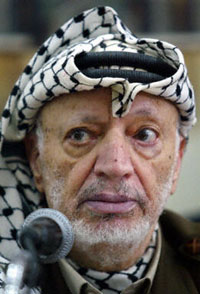 |
| Palestinian President Yasser Arafat meets with the central committee of the Fateh movement, Sept. 7, 2003 (Photo: Pedro Ugarte/AFP-Getty Images). |
On Sept. 9, two suicide bombings—one at a bus stop near the Tzrifim Military Base south of Tel Aviv and one at Cafe Hillel, on Jerusalem’s Emek Refaim street—killed 15 people and forced Israeli Prime Minister Ariel Sharon cut short his official visit to India. Two days later, on Sept. 11, he called an emergency meeting of the Security Cabinet. After the meeting, a spokesman for the prime minister told reporters: “Prime Minister Ariel Sharon has today instructed the security forces to act relentlessly, continuously, and determinedly to eliminate the terrorist organizations and take all appropriate measures against their leaders, commanders, and operatives until their criminal activity is halted....Events of recent days,” the statement continued, “have reiterated and proven again that [Palestinian President] Yasser Arafat is a complete obstacle to any process of reconciliation between Israel and the Palestinians. Israel will work to remove this obstacle in a manner and at a time of its choosing.”
But the next day, Israel's morning papers, as well as a number of Jerusalem residents interviewed while having their morning coffee on Emek Refaim, seemed skeptical that exiling Arafat would improve Israel’s security.
Aluf Benn opened his Sept. 12 analysis for Tel Aviv’s liberal Ha’aretz by quoting one of the cabinet ministers’ response to the question of what the government could do to stop the suicide bombings. The minister was “forthright” in his response, Benn wrote. “No one has a solution,” the minister reportedly said. “What will happen the day after he’s expelled?”
Sitting at her usual early Friday-morning table in a cafe on Emek Refaim, Yael, an Israeli who describes herself as a member of “the sobered left,” unwittingly echoed the minister’s comments. “Yesterday’s Cabinet meeting gathered together the smartest Israeli military minds in order to tell me that Arafat is bad. What’s the big news?” she asked. “World opinion is against this decision. What the Cabinet should have done was to tell Arafat, ‘We will let you out of the Muqata [Arafat’s compound, mostly destroyed by successive Israeli barrages, where he has been under virtual house arrest since December 2001] after three months without attacks.’ Yesterday the Israeli government gave Arafat what he wants. All this will accomplish is to make people angrier—it’s a non-starter decision. They just appeased and satisfied people on the right because overall they know that the consensus is that Arafat should go. It is a decision born of impotence, because the government won’t antagonize Bush by carrying it out. It is a decision devoid of creativity, showing once again that Arafat is the ultimate manipulator and the ultimate survivor.”
Hanna, who describes herself as “a concerned mother,” likewise chalks up the government’s new policy to its need “to feel that it is doing something because of all the terrorist attacks. The government has taken this decision fully expecting the Americans to veto it. I think it is better to leave Arafat where he is in Ramallah at the Muqata instead of letting him move around the world. Expulsion doesn’t accomplish anything. In an ideal world, Arafat, Ahmed Yassin, and other ideological heads of terrorist organizations, as well as the terrorists, wouldn’t exist. But they are vermin: You kill them and they come back. Or is it that they are like the Hydra? You cut off one head and two more grow in its place. If people who carry out the terrorist attacks and the ideologists behind them are killed, there will be others to take their place.”
Ha’aretz’s editorial comment was similar: “Even before Prime Minister Ariel Sharon had returned from his visit to India, members of his entourage were promising that a harsh response [to the Sept. 9 terrorist attacks] would be forthcoming this weekend, and in the discussions held over the last two days, various ideas were raised whose common denominator was the search for a fitting response to the feelings of anger and the desire for vengeance against the terrorist organizations’ murderousness....But the necessary war against the terrorist organizations, first and foremost Hamas and the Islamic Jihad, cannot be based on shock or draw its justification from the longing for revenge.…Against this background, what some Israeli politicians view as the ultimate solution should be rejected out of hand: The expulsion of Yasser Arafat. This idea is raised anew every time the government appears powerless to prevent attacks.”
Some Israelis saw more cynical motives behind the cabinet's pronouncement. Janet, “an American Israeli who wants peace,” saw it as the “intentional creation of a crisis. The government knows the result will be more terror. This is similar to Sharon’s actions on Sept. 30, 2000, when he went up to the Temple Mount and contributed to the start of the Al-Aqsa Intifada. The government’s decision raises Arafat to the level of a saint or more of a hero in the eyes of the Palestinians and gives them a strong rallying point. Unfortunately, without Arafat it would be no different, as it is not up to one person to decide. I believe that instead of looking to military maneuvers, the Israeli government should use problem-solving skills to negotiate a solution.”
Standing just inside a kiosk in the West Jerusalem neighborhood of Kiryat Shmuel, a woman wearing a headscarf that identified her as an Orthodox Jew seemed emboldened by the sight of this reporter—a woman in secular dress—buying Hatzofeh, the organ of the right-wing National Religious party. Speaking to no one in particular, but at the same time to everyone, she exclaimed: “The government is right! What we need is to take decisive military action, get rid of Arafat, continue targeted killings and make Israel safe for us.”
Hatzofeh’s editors seemed to agree. “In the next few days,” they wrote in the Sept. 12 edition, “it will be a decade since the signing of the Oslo agreement between the government of the late Yitzak Rabin and the head of the PLO [Palestine Liberation Organization], Yasser Arafat. That agreement was meant to open ‘an age of peace’ between Israel and the Palestinians, but at the end of the day, it lead to the deepening of hatred and an increase in Palestinian violence against the Jews—the worst attacks ever inside the state of Israel.” The editors recognized that Arafat is not working alone, but nonetheless concluded that “without the removal of Arafat, it is impossible to get on the road that will lead to an agreement between the Palestinians and the State of Israel. It is also time that Abu Ala [Ahmed Qureia], the designated Palestinian Prime Minister, understand this.”
In a mid-morning interview for Israeli Broadcasting Authority’s “Reshet Bet,” Effi Eitam, Israel's housing minister from the National Religious party, said that he wanted to bring Arafat to court for crimes against humanity—a marked change from his usual calls for Arafat to be killed.
But in recent days, others have publicly called for Arafat’s death. The editors of the conservative, English-language Jerusalem Post began their Sept. 11 editorial with a call for blood: “The world will not help us; we must help ourselves. We must kill as many of the Hamas and Islamic Jihad leaders as possible, as quickly possible, while minimizing collateral damage, but not letting that damage stop us. And we must kill Yasser Arafat, because the world leaves us no alternative.”
Rafael, an elderly Israeli man sitting in another coffee shop on Emek Refaim, would doubtless disagree. Looking up from his copy of the centrist newspaper Ma’ariv, he said with emphatic exasperation: “I don’t think that the government will succeed in eliminating terrorism by using these methods!” The Ma’ariv article he was reading said that there is a military unit of the Israeli Defense Forces that has been training to carry out the order to expel Arafat should it come. According to the article, the unit’s officers expect that it will be difficult to seize Arafat and keep him alive through the probable gun battle.
And a recent survey conducted by Tel Aviv’s centrist Yediot Aharonot indicates that most Israelis feel that it would be a mistake to kill Arafat. The survey found that 63 percent of Israelis believe that Sharon is not dealing properly with terrorism. Only 37 percent of respondents said they thought that Arafat should be murdered. Forty-two percent said that the violence against Israelis would continue even if Arafat were expelled.
Despite the government’s decision to expel Arafat from the region, it seems that most Israelis believe Israel’s “great military minds,” to use Yael’s words, have yet to find a strategy for achieving security, let alone peace.