Middle East

Middle East
Light Years Away
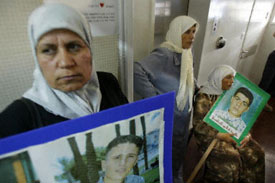 |
| Jerusalem, Sept. 1, 2003: Arab Israeli women hold portraits of slain relatives at a press conference moments after the publication of the Or Commission's conclusions (Photo: Pedro Ugarte/AFP-Getty Images). |
The rift between Arab Israelis and the government of Israel had already begun in 1948. The successive Israeli governments over the years never really tried to mend that rift, and so it continued to grow and to deepen. Today, the separatist movement in the Arab Israeli community is stronger than ever, and terms such as “the justice department of the national minority” are not considered exceptional. The conclusions of the Or Commission [of Inquiry, appointed to investigate the causes of October 2000 riots in Arab areas of Israel, which left 13 Israeli Arabs and one Jewish citizen dead], which pointed to governmental prejudice against and neglect of Israel’s Arabs didn’t surprise anyone in the Arab population, though the majority of the Arab public is certain that efforts to bring Jews and Arabs closer will remain on paper (Ma’ariv’s introduction).
Once, when Jafar Parah walked with his young children to the beach, he used to tell them, “If you get lost, look for the nearest police officer, explain your problem and trust him to help you.” Today, says Parah, a central activist in the Arab population, he’s doubtful his children will listen. “After they’ve seen police officers hit Arabs on television, they are simply afraid and they don’t want to see a police officer stand next to them. And I don’t want them to find one either, because I don’t know what that officer is capable of doing, considering the hatred many in the police department have for Arab Israelis.”
The gaping chasm between the Arab citizens and the state of Israel deepened during those difficult 10 days in October 2000; days that the Or Commission documented in great detail; yet we’re not dealing with a dramatic change. The strong feelings of the Arab population toward the Israeli establishment and its avatars had already begun during the [1947-1948] War of Independence, continued during the period of martial law [from 1948-1966, Israeli Arabs lived under tight military rule, despite having been declared citizens in 1948] that was obliterated only in 1966, and got even stronger in our time. This gloomy history is accompanied by bleeding wounds such as the killing of 41 Arabs in Kfar Kasem in 1956. The officer who was convicted of giving the order to kill the Palestinian workers, who had asked to return to their homes during curfew, was sentenced to a fine of one penny. During this week’s talks of granting pardons to the police officers who were involved in the fatal October 2000 incident, the Arab community remembered the 1956 incident. “Apparently, [one penny] is the value of an Arab citizen in Israel; it seems nothing has changed since then,” one of the Arabs we interviewed said.
Cutting Off Communication
Watching the Hezbollah Channel
The events of October 2000 opened a wound in the relations between Israel and Arab Israelis, who constitute 20 percent of the population. Many years will pass before this scar—a scar based on feelings of neglect, prejudice, frustration, lack of faith, and, recently, even true hatred—will heal. It seems that the report issued by the Or Commission will be unable to bridge the deep gap that has widened between the two peoples.
The commission’s report determined that the government’s treatment of the Arab sector was characterized mostly by neglect and disregard. “The establishment didn’t show satisfactory sensitivity to the Arab sector and didn’t take enough steps to allocate the national resources evenly to include this sector. The establishment didn’t do enough and didn’t make enough of an effort to guarantee equality to its Arab citizens and to remove prejudice and neglect,” the report says.
Arab Israelis have not seen themselves as part of Israeli society for a long time now. Many of them are die-hard soccer fans who watch the Israeli team’s games but purposefully cheer for the opposing team. The national flag is not their flag. The words of “Hatikvah” [Israel’s national anthem] are meaningless to them. The local national and commercial television channels completely ignore them. Recently, Israeli television ceased its broadcast in Arabic on Channel 1 and moved it to the Middle East satellite station, whose future is doubtful. An appeal to the Supreme Court has already been issued regarding this matter, but even before the move, the majority of Arab Israelis watched Arab channels such as Al-Jazeera [which is funded by the government of Qatar] and Al-Manar, which belongs to Hezbollah. “When I was young, I used to watch Channel 1. Today, my children can’t watch anything on this channel because there isn’t a program that suits them. So they watch Abu-Dhabi television,” Jafar Parah says.
In the age of satellite dishes, which can be seen on every roof in the Arab sector, the exposure to Palestinian culture and the poisonous words that are heard every once in a while on some of the Arab channels are quick [to spread]. When the uprising began in the Occupied Territories and the picture of the young boy, Muhammad al-Dura, who was killed in Gaza, was shown again and again on the screens, there wasn’t much else needed to shock Arab Israelis into taking to the streets.
The [1967] Six Day War and the opening of the borders to the West Bank, not only resulted in closer familial, social, and economic ties between Arab Israelis and the Palestinians from the other side of the border, but it also bettered the status of Arab Israelis. When they realized how good they had it compared to their brothers in the territories, they became more confident. Many of them took advantage of their knowledge of the Hebrew language and their involvement in Israeli society to become contractors and manpower brokers for the thousands of Palestinians who asked to work in Israel. Those were years of putting down roots, bettering lives, and interweaving with the local society.
Political Disengagement
“The Parliament of the Israeli Arabs”
The first major crack occurred in 1976. As a result of the confiscation of land in Galilee [near the Lebanese border], thousands of Arabs protested in a series of demonstrations that earned the name “Day of the Land.” Violent confrontations resulted in the death of six Arab citizens. Since then, the Day of the Land has been observed in the Arab sector on March 30; it’s a day that has become a national holiday for Arab Israelis, who have begun to form an independent identity.
The first signs of a separatist movement began to appear in the Arab sector in the 1980s. The Israeli Arab Leadership Monitoring Committee, which was formed in 1982 to express solidarity with the Palestinians in Lebanon after the events of Sabra and Shatila, is a surviving example of it. The committee has already been dubbed “The Parliament of the Israeli Arabs,” and there are those who see in it the first step in the process of solidifying the Arab separatist movement. Only difference of opinions, personal struggles, and a crisis in leadership prevented the committee from holding personal elections for the “parliament,” which today is made up of Arab Knesset members, the heads of local Arab municipalities, and other representatives of the Arab political parties and their various factions.
Knesset member Azmi Beshara, chair of the Balad party, is an enthusiastic supporter of the idea that Israel must recognize Arab Israelis as a national minority within the country. Beshara says: “The serious misconception of the Or Commission is that it treated Arab Israelis solely as citizens and detached them from the general context of a national minority. That is why it perceived the events as violent manifestations and not as a protest of a minority nationality within Israel. From this starting point, all the rest is derived. Their conclusions deal with granting individual rights to Arabs, without treating them as a collective national minority whose members have an absolute right to protest and to express solidarity with their Palestinian brothers.”
If in the first Intifada, which broke out at the end of 1987, Palestinians living within Israel expressed solidarity with their brothers in the Occupied Territories, then the Oslo agreements turned that upside down. Arab Israelis felt betrayed and disappointed by the Palestinian leadership and by the strategic decision of the Palestine Liberation Organization (PLO) to officially wash their hands of Arab Israelis. As they became even more frustrated with Israeli government policies, many in the Arab sector concluded that they must take matters into their own hands.
A change in Arab Israeli leadership occurred. Young, educated, and energized Arab Israelis, members of the Arab parties that sprouted like mushrooms after the rain, replaced the members of the old political parties that were identified with “the establishment.” They set the tone on the streets and were nicknamed “the proud generation.” These young nationalists weren’t willing to accept defeat, being stepped on, or humiliated.
Social Severance
Separatist Organizations Flourish
At the same time, Arab separatist organizations started to develop rapidly. From his office in Haifa, a city which is actually considered a symbol of successful co-existence, Ameer Makhoul runs Ittijah, an umbrella organization encompassing several Arab nonprofits. “The goal is to represent the common interests of the volunteer organizations and become an influential body for the country, and in international forums as well,” he explained.
Many organizations that represent an alternative to similar Jewish groups are coming into being: the Organization for the Arab Prisoner, for example, or The Organization for Educational Development. In the last few years, more central organizations have been established. Adalah works for the legal rights of Israel’s Arab minority. The Galilee Society seeks to provide health services and conducts related research. Al-Amal has become a channel for transmitting information to local and international media about happenings in the Arab sector [and develops cultural activities in Palestinian villages]. These are actually the first “national institutions” of autonomous Arab Israelis, and act as the “department of justice,” the “department of health,” and as the “government communications bureau” of the national minority. The building in Shefaram [near Haifa], which houses some of these organizations has already been nicknamed “the Orient House of Arab Israelis” [the Orient House was home to the Palestinian Ministry of Jerusalem Affairs until Israeli soldiers took it over in August 2001].
Officially, the majority of Arab Israeli leaders refrain from saying that these are roadblocks on the road to autonomy. They explain that these groups exist to fight against prejudice and governmental neglect. “The discriminatory policy of the Israeli government is consistent and decades old,” says Jafar Parah, head of the group Mussawa, which works for the rights of the Arab minority. “The only step in the right direction was the inclusion of Arab villages on the list of national priorities under [Yitzhak] Rabin’s government. But the first thing that [Benyamin] Netanyahu’s government did was to cancel this plan. Nazrat Elit [Upper Nazareth, the Jewish part of the town] was included in the project and Arab Nazrat [Nazareth] was not.”
The results of financial discrimination are apparent in everyday life. Here are only a few examples (taken from Mussawa): Every second Arab Israeli child lives under the poverty line. Arab Israeli families account for 30 percent of all the poor in Israel. The infant mortality rate among Arab Israelis is 12 per 1000; the national average is 5.5 per 1,000. The unemployment rate in the Arab sector is 15 percent—a figure that doesn’t include women, who aren’t registered with the employment service. All of the villages that lead the national list of Israeli towns with the highest unemployment rates are consistently Arab.
Economic Severance
The Funds Don’t Flow
In 2000, in the days of the [Ehud] Barak government, an additional effort was made to erase the gap. The Ministerial Committee for the Arab population, headed by Matan Vilnai, prepared a multi-year, 4 billion-shekel [$897-million] plan. The program was prepared before the events of October 2000, but because of delays, was approved only after the events. So it was seen as the government’s surrender to the Arab sector and as a prize to compensate the rioters.
This week Vilnai said: “The Ministerial Committee for Arab affairs was able to establish close and active cooperation with public leaders who partook in the committee’s discussions. We were successful in passing a law that [calls for] the integration of Arab board members into [public] companies and the appointment of Arabs to government positions. The first Arab deputy minister was appointed by me, in the Ministry of Cultural Affairs. He was, I believe, the first [Arab deputy] nominated in Israel.”
The program hasn’t come to fruition until today. Only a small fraction of the money the government promised to the Arab sector reached its destination. Coincidentally, the Ministerial Committee for Arab affairs, which rarely meets, held its most recent meeting a week before the Or Commission’s report was published. In a statement that appeared to pay lip service [to the importance of bettering Arab Israelis’ position in society], it announced that it was carrying out the multi-year plan. “After we left, the government stopped monitoring the application of the law, and today it’s not applied,” Vilnai says. “Now, with the publication of the commission’s report, the government has tried to create a smokescreen by claiming that it’s initiating these things that should have been done a long time ago.”
The last three years have shown that there are already many Arab-Israelis who are willing to take an active role in terrorist activities. The most relevant example is that of Ahmed Habashi, a resident of Abu-Sinan [in northern Israel], who last year became the first Arab-Israeli suicide bomber when he executed the attack in the train station in Nahariya [in northern Israel]. The sense of many is that in the face of poverty, unemployment, and a harsh reality, there’s nothing left to lose, many in the Arab sector say.
“Arab Israelis should remain outside this ping-pong game between the Israelis and the territories,” says Sheikh Hisham Abd al-Rahman, one of the leaders of the Northern Islamic Movement. Since the 1980s, the Islamic movement has become yet another important player in the Arab sector. In the last few years, the movement has become a target of Israeli security forces, who have arrested some of its members on suspicion of involvement in illegal activities. Only recently, the heads of the movement were arrested as part of a sweeping operation. Among them were two former mayors of Um al-Fahm, Sheikh Ra’ad Salah and Suleiman Aghbaria. They are suspected of illegal financial activity for having allegedly transferred money to members of Hamas in the Occupied Territories under the guise of humanitarian aide.
“The Israeli government, like the Bush government, is chasing the Islamic movements and is trying to hurt us,” says Knesset Member Abd al-Malik Dahamsha, the representative of the movement in the Knesset [Dahamsha is the leader of the United Arab List, an Israeli political party]. Dahamsha, like Salah, was warned by the Or Commission after he was accused of engaging in “incitement,” but in the end the commission did not recommend any action be taken against him. In the last few years, Arab Knesset members have complained that a campaign of scare-tactics is being waged against them, the features of which include the restriction their activities, visits from police who treat them as “the usual suspects,” and the curtailment of their freedom of speech. Even though the majority of them don’t have broad support from the public, many do see the campaign against them as further evidence of the government’s scorn for the Arab sector. By the same token, the Or Commission’s criticisms of them is perceived as unbalanced. “How can you compare someone responsible for the death of 13 people to someone who speaks his mind?” asks Mohammad Barakeh, a Hadash-party member of the Knesset.
Severance from the Land
“Impossible to Build Houses”
Um al-Fahm, situated off Vadi Ara road, is the second-largest Arab city in Israel. In the last few years, the Jewish public has come to see it as a hornet’s nest. Until recently, Salah served as the city’s mayor. When he retired, he was replaced by Aghbaria. At the moment, both are behind bars. Sheikh Hisham Abd al-Rahman was chosen to be Northern Islamic Movement’s candidate for mayor of the city. “I hope that I’ll be able to change the image of the city,” he says. “But what are the 40,000 residents of Um al-Fahm supposed to feel in a city that doesn’t have a single industrial park when they go to Vadi Ara? If they look to their right, they see Afula. If they look to their left, they see Hadera. Either way they see flourishing cities.”
In the Galilee town of Majd al-Krum, the situation is far from enchanting. Twelve thousand residents live in a town that holds the record for several dubious distinctions. “We lead in unemployment, car accidents, in everything. We don’t have a comprehensive plan because they won’t authorize it, and we can’t develop and build houses,” says Muhammad Kanaan, the head of the town's council. Following the events of October 2000, plans to build new neighborhoods in the town, at the edge of the Akko-Tzfat junction, were frozen. “They told us that building a neighborhood like this would become a security hazard,” he says. “On the one hand, they don’t give us a comprehensive plan so that we could build according to the law, and on the other hand, they accuse us of breaking the law.”
The issue of land and illegal development is the most infuriating issue today in the Arab sector, where today there are an estimated 35,000 houses built without a license. A decree to destroy them can be issued at any time. In 1998, riots arose in the Shfaram region [of northern Israel] when the police acted on a decree to destroy three of the illegal houses in Um al-Sahali. The houses, by the way, were rebuilt the next day and are still standing today. A few months later, the storm rose again at a protest of the residents of Vadi Ara who protested the confiscation of their land in Al-Ruha. Both of these events were warning signs of the coming eruption in October 2000.
When Netanyahu’s government fell, Arab Israelis were riding a wave of “the new hope” that Barak was supposed to bring. At the time, Barak won 96 percent of Arab votes, who hoped that he would follow in Rabin’s footsteps and make real changes. As big as the expectations were, the disappointment was even bigger. Barak didn’t do much to improve the status of Arab Israelis, and after the failure of the Camp David talks, the Arab Israeli community blamed him for trying to force the Palestinians to surrender.
The wick continued to burn. Several weeks before the events in October 2000, people became aware that there was a decree to destroy houses that were built illegally in Sahnin. Residents set up nightly watches. Tension was in the air, and there was a fear of pandemonium among Arab Israelis. In the end, the decrees never came to fruition, but the festering anger of Arab Israelis was looking for different ways to combust.
Severance from the Law
“This Isn’t an Important Norm”
The reason for the protests that began at the end of September 2000 in the Arab sector was “the massacre at the Al-Aqsa Mosque”—violent clashes between worshippers and the security forces that followed Ariel Sharon on his visit to the Temple Mount. From that moment, Arab Israelis’ solidarity with their brothers on the other side of the border was absolute.
The monitoring committee declared a general strike and protests that ran out of control. The wave of protests freed frustrations that had been pent up over the last few decades. The unfolding of events only strengthened their feelings. After the death of the protesters during the first two days of the clashes, the monitoring committee gathered in an emergency nighttime meeting at Kfar Manda. Mourning and outrage spawned a decision to continue the general strike and the protests. Later on, Barak agreed to meet with the Arab Israeli leadership, a meeting that they will never forget. “Barak sat there with [Minister of Defense Binyamin Ben-Eliezer, nicknamed] Fouad, and laughed the whole time. It was terrible,” recalls Abed Anabtawi, a spokesman for the monitoring committee.
In the meeting, Barak said the police weren’t using live ammunition, but rather rubber bullets. Muhammad Zidan, then the head of the monitoring committee, tried to disprove these claims by bringing in shells from firearms that the police used against Arab citizens and laying them on the desks of the ministers. “How did you manage to get these shells past security?” one minister joked.
When Zidan left the meeting, he was notified that one of his relatives had been killed at a violent protest in his village, Kfar Manda. Despite this, the committee called on the Arab public to show restraint. A “cease-fire” was called in the area. The protests, now funeral processions, were confined to the areas where residents had been killed and were now relatively subdued.
After it seemed as if things had calmed down, riots broke out again on the eve of [the Jewish day of atonement] Yom Kippur. A number of residents from Nazrat-Elit attacked the Arab neighborhood of Nazrat. The police got involved, and, according to the monitoring committee’s account, actually supported the Jewish offenders. “It was a racial attack perpetrated by the Jews and the police,” Anabtawi claims. His statement opens up a small window of insight into what today seems like the heart of the Arab population’s alienation from the state.
“The authorization to kill Arabs has been given. The hands of the police are loose on the trigger. Since this is so, even regular citizens feel no compunction in attacking Arabs, hitting them for no reason, and torturing them, knowing that nothing will happen to them in return.” says Alhan Nahas-Daoud, a lawyer who prepared a special report on the death of an additional 14 Arab citizens at the hands of the security forces since the events of October 2000. The Arab sector takes this report very seriously and talks of 27 citizens who were “murdered by the state” over the past three years. “In everything that has to do with the Arabs, the police are quick to shoot and kill. It’s silly to say that these last few shooting incidents were criminally related. Is there also such a number of deaths among Jewish criminals?” Nahas-Daoud asks.
A survey done by Arieh Retner, a professor at the University of Haifa, over the past two years brought some astounding facts to light: 44 percent of the people surveyed from the Arab sector believe that following the law isn’t important; only 21.4 percent of Arab Israelis think that the police are acting fairly; and only 14 percent think that the police treat Jews and Arabs equally.
Yaakov Borovski, commander of the police in the Northern District, the district that was the subject of the Or Commission, is aware of the problem and believes that there are have already been improvements in communication with Arab authorities. “In the majority of towns, [we’ve] already established police stations with the help of local leaders,” says Borovski. “We can certainly sense in the mood a willingness to work together.”
Even Amram Mitzna, Haifa’s former mayor, believes that communication is the key. “From this angle, the Or Commission didn’t tell us something we didn’t already know. In Haifa, there’s been communication and cooperation [between Jews and Arabs] for years now. I appointed an Arab accountant to city hall. And during my tenure as mayor, an Arab from the Hadash party was nominated as deputy mayor for the first time.” When, as the riots of October 2000 spread, dozens of youngsters tried to inflame reaction, Mitzna was in the midst of a municipal meeting. When he heard what was happening, he rushed to the scene. Police officers stood behind him as he faced the protesters and asked to speak with them. Later on, he got even further involved, and asked the police to release some of the detainees—a request that has since drawn censure. “The talking helped calm the situation, and in Haifa it was simply different. One of the important messages of the report,” says Mitzna, “is the perception among the police that Arab Israelis are the enemy.”
Connecting to Reality
“The Or Report in Schools”
The report will be studied in the Arab sector over the coming days. The monitoring committee will convene tomorrow to formulate its official reaction, and in so doing, will decide the mood of the commemorative events that will take place on Oct. 1 to mark the third anniversary of the riots. The 13 victims have become “martyrs” in the Arab community. Streets, squares, and buildings have been named for them. “Despite a reluctance to deal with certain issues, and despite what is not addressed, the Or Commission’s report represents an important document that should be used to further advance its recommendations,” says Hassan Jabarin, a lawyer and general manager of Adalah. Jabarin commends the commission’s judgment on the actions of the police and believes the report should be regarded as a legal document that, for the first time, addresses state discrimination against Arab Israelis.
Muhammad Darousha, an activist campaigning for better relations between Israeli Jews and Arabs through the organization Givat Haviva, says that the report represents a “road map” of the policy of the Israeli government toward the Arab population, but as with a national road map, destinations should be determined, as well as timetables and the specifics of how recommendations will be carried out. Sara Osazki-Lazar, also from Givat Haviva, suggests that Arabs and Jews establish an egalitarian joint national authority to improve Jewish-Arab relations. “We also need to hold discussions at a higher level, that will include experts on the subject from both peoples. These are the practical steps [we] must take to begin the healing process,” Osazki-Lazar says.
Knesset Member Jamal Zahalka, from the Balad party, already called for a decree requiring Jewish schools to include the Or Commission’s report as part of the curriculum. Shauki Hatib, chairman of the Higher Arab Monitoring Committee, says that Israeli attitudes toward Arabs haven’t changed. “The ink hasn’t yet dried on the Or Commission’s report, and already they’ve begun talking about giving amnesty to the police officers who are accused of killing 13 Arab citizens,” he said to prove his point. “But we won’t give up. We’ll fight so that the conclusions of the Or Commission’s report will be fully implemented.”
The members of the Or Commission summarized their report in the hope that their work would contribute to reconciling Jewish and Arab Israelis. Sadly, today this hope seems light years away.