Middle East

Middle East
Sharon Assassinates His Own Plan
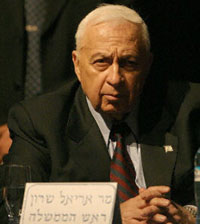 |
| Israeli Prime Minister Ariel Sharon addresses Latin American immigrants in Jerusalem, March 23, 2004. Sharon told the crowd that Israel's assassination of Hamas Leader Sheikh Ahmed Yassin had removed the Palestinians' "chief terrorist." (Photo: Eitan Abramovich/AFP-Getty). |
[Hamas leader] Sheikh Ahmed Yassin was marked for death. His whole life was devoted to bloodshed and raising the level of burning hatred between the two peoples of the Land of Israel [that is, biblical Israel, which included the West Bank and parts of Jordan]. Yassin always deserved to be assassinated. His release from an Israeli prison was granted following the failed attempt on the life of Hamas' leader in Jordan, Khaled Mashal. He entrenched himself in Gaza and devoted his life to terrorism and nothing else. One feels a pang of “he deserved it” upon hearing that Yassin paid with his life for the death he sowed in Israel. But there are still many open questions.
The first and most central is: Why now? After all, the obvious idea to strike at Yassin came up long ago, at the peak of the Intifada. [Israeli Prime Minister Ariel] Sharon was tempted for a moment. But when the actual plan was about to be presented to him, he reconsidered, responded “not now,” and refused even to discuss it. Why did he change his mind now? Because of the [March 14 suicide] attack in [the port city of] Ashdod, which was not “mega” at all, but rather confirmed that the terrorists have few access routes left due to the unshaken success of the security fence around Gaza?
The inevitable answer is that Sharon is angry at himself. He is torn by inner conflict because of his current position in favor of dismantling the settlements of the Gaza Strip. The right wing views Sharon as an ideological deserter—no longer the “father of the settlements.”
Killing Yassin was an unconscious psychological compensation for the disengagement plan. This way he is again perceived by the public as Papa Security. The Big Brother of the war against terror. The big detester of the Palestinian terrorists, who forced him to reach the painful conclusion of the unilateral withdrawal. Nobody embodies that more than Yassin. There was a desire not to let Yassin live to see the day settlements are uprooted.
Such a personal feeling is understandable as a motive for the assassination. It is by no means wise, and more power to [Deputy Prime Minister and Minister of Justice] Yosef Lapid, who stood alone in the cabinet in his objection to the assassination of the terrible sheikh. Especially when the long-term result is bad for Israel. First of all, because Sharon has already placed obstacles before the disengagement plan, and if he really did mean to go through with it, then by killing Yassin he made it harder (in his heart of hearts is he really sorry? Who knows? We can only say for sure that the green light for the elimination of the Hamas leader did not result from the opposition the Likud ministers expressed to the disengagement plan. The permission to strike at Yassin came before their meeting with the prime minister).
The bewilderment deepens considering Hamas’ reaction to the disengagement plan. Yassin said publicly in the last week that his organization would stop terror attacks for a period of time. Hamas was preparing to compete with the Palestine Liberation Organization for control of the Gaza Strip after the withdrawal. Such a struggle between the Palestinian organizations, whether bloody or merely verbal, is good for the disengagement and for the relations between the peoples. The assassination nipped a desirable development in the bud.
The disengagement could have eased tensions in Gaza. Something like the quiet hostility on the northern border. Signs are also increasing of what [Defense Minister] Shaul Mofaz has pointed out, that after the disengagement, terrorism from the West Bank would increase. Is that bad? Compared to today’s reality there is something positive about such a development. After all, one front is better than two, as generals Sharon and Mofaz know. On the other hand, killing Yassin heated up a third front. Despite all of the denials, there has heretofore been a tacit understanding that both sides avoid striking at political leaderships. At least they don’t aim at them. The assassination of Israeli politician Rehavam Ze’evi by Palestinians was the exception, not the rule.
Now it’s over, and that’s a shame. Because Sharon allows laborers from Gaza into Israel, and yesterday morning he antagonized and infuriated a lot of them. As a result, not only will Jews be stabbed and shot in larger numbers than usual at the private initiatives of incidental terrorists, but ministers and military officers will also have to go into a cumbersome, unnecessary, and expensive defensive mode.
The assassination of Yassin is not just another assassination of a senior terrorist. It ought to have been brought to the full discussion of the security cabinet. There is reason to hope that if it were, Lapid would not have been alone in his reasoned and sober position. As it actually happened, in the mini-cabinet, he could only express it. At the sound of the missile strike there was a pang of satisfaction, but the operation attested to confusion and a lack of sophistication, if not to a hidden, vague intention, born deep in Sharon’s psyche, to disengage from the disengagement plan.