Middle East

Palestinian Territories
Between the Corrupt and the Corrupt
 |
|
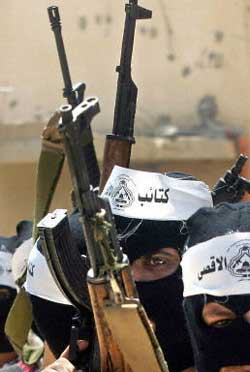
Palestinian gunmen of the al-Aqsa Martyrs Brigades march in Jenin on August 1, 2004. (Photo: Saif Dahlah/AFP-Getty Images) |
Palestine Report Online interviews Hisham Ahmed, professor of political science at Birzeit University, on the recent security situation in the Palestinian territories.
PR: How much is the current security crisis about corruption and corrupt officials?
Ahmed: What is happening in Palestinian society lately certainly deals a big blow to the Aqsa Intifada on the one hand and to the Palestinian national struggle on the other. The last thing that Palestinian society wants to see is an internalization of the conflict. I think it is worth realizing that there have been a variety of forces within Palestinian society that are not interested in seeing the Aqsa Intifada continuing and bringing results. It is my belief that perhaps such forces have coalesced together in order to shift direction and attention from the Intifada to other issues.
Certainly, there is corruption within the Palestinian Authority. There is corruption in many other institutions in society as well. This is not to suggest that Palestinian society itself is corrupt. On the contrary, I think we have a people who demonstrated greatness and who have struggled continuously and who have persevered. But if we were to speak specifically of the PA itself, there are layers that are badly structured and are mismanaging a variety of affairs. But I am not one of those who would accept the confinement of the practice of corruption to Yasser Arafat himself. Arafat has been under siege by [Israeli Prime Minister Ariel] Sharon’s tanks for a number of years. But he has also been under siege by corrupt officials who have been mismanaging affairs and who have not taken into consideration the Palestinian national interests but who have focused on their own self-interests.
I think it also important to note that Palestinian society is not the only one ailing from such problems. Let us keep in mind that Israeli society has, for over the past year, been engulfed in severe crises pertaining to corruption of some of its own officials including Sharon.
PR: Don’t you think that by keeping these people around him, Arafat is also protecting his own seat of power?
Ahmed: Definitely, Arafat should take the very courageous and badly needed step and get rid of these corrupt officials. However, without falling into the trap of justification, I believe these officials participate in imposing a siege on Arafat when it comes to information and accurate reports about what is happening. They also help in tightening the noose around Arafat in order to participate in morally and politically assassinating him in the midst of his own people. In other words, after the collapse of Sharon and Bush’s attempts to assassinate Arafat physically, I believe there are Palestinian elements who participate in diminishing Arafat’s popularity within his own circles.
I would agree that he bears the responsibility for keeping these officials around and in not paying attention to the amount of damage they cause to him as a symbol of the Palestinian national struggle but also the damage they cause to the overall Palestinian question. Therefore, he has to take the lead in getting rid of them.
However, what has confused many Palestinians in the latest events is the fact that many people say that the conflict is between corrupt people and other corrupt people. I believe that this is what has kept many people on the sidelines. Certainly, many Palestinians want to get rid of these corrupt officials on both sides of this conflict but they have not felt that the conflict taking place is doing more than shifting the Palestinian question in the wrong direction and this is why many people have chosen to adopt a “wait and see” attitude.
PR: Why do you think Prime Minister Ahmad Qrei’ reneged on his resignation?
Ahmed: For me, Qrei’s resignation represented another layer of the pressure and siege being imposed on Arafat. What is the resignation for? Who is to be blamed for the collapse of the security situation in Palestinian society? Doesn’t the government itself – that is, Qrei’s cabinet – bear a big responsibility when it comes to this? Why did the Legislative Council pass a resolution that the resignation should be accepted because it is the government that bears the responsibility? The fact that Qrei’ went back on his resignation deepens my belief that the resignation itself was a pressure tactic rather than anything else. We know for a fact that in the cabinet there are several corrupt ministers. Why didn’t Qrei’s cabinet heed the advice and resolution of the Legislative Council and get rid of these corrupt officials, some of whom have been involved in cement deals for the apartheid wall. There are serious issues here at hand and I think the Palestinian arena is undergoing a serious process of redefinition and reconfiguration, one of which, if we don’t pay enough attention, could lead to the unforgivable trap of an internal conflict.
PR: How much is this playing into Israel’s hands?
Ahmed: No doubt, the main beneficiary of these new developments is Sharon. He has succeeded in leading the Palestinian arena into this situation, especially in the Gaza Strip. Sharon has every right to celebrate as far as these new developments are concerned.
PR: Do you think that the problem is primarily within Fateh?
Ahmed: Given that is it the biggest political faction, what happens in Palestinian society is mirrored by Fateh and vice versa. It is because many of the corrupt Palestinian officials see it fit and self-serving to identify with Fateh basically as a measure of self-protection, so definitely it is influenced by their behavior. Because of this, we feel that most of the conflict that is taking place is being conducted within Fateh.
Fateh needs to undergo a serious process of refinement. It has been all along my conviction that without the Intifada, Fateh could have undergone the most serious process of collapse and dismantlement.
The active participation of the Aqsa Martyrs Brigades in the resistance against the occupation was what kept Fateh intact, albeit temporarily, until this latest conflict evolved. Therefore, perhaps the key to keeping Fateh intact until its structural and functional dimensions are evaluated is to support and to pave the road for the resistance in Fateh to take its proper place in society.
It must be said, however, this focus on Fateh in a way deviates attention from the corruption in many other Palestinian political factions and organizations. The fact that Fateh is at the surface because of its role in the peace process has kept it open to criticism.
PR: Do you think the PA would do better to dissolve itself?
Ahmed: I have never been of the school of thought that calls for the dissolution of the PA. I think that this kind of thinking tries to treat a severe illness by a worse illness. It is reactive, counter productive, shortsighted and narrow-minded and I don’t think it would serve the Palestinian interests in any way.
The step that should be taken is for Arafat himself to come out in public in a historic speech to his people and to the world, resign, and call for elections while maintaining the right like any other Palestinian citizen to run for elections again. In other words, to put the PA on a temporary track. In that way he would succeed in creating a constructive international crisis and he would compel the enemies of the Palestinian people – the US and Israel – to pay immediate attention to what is going on. I think he would also be able to treat a lot of the internal problems. But if the PA continues in managing crises in this old-fashioned manner, I am afraid to say that in a month or so we will go back to square one.