Middle East

As the Fence Goes Up, Checkpoints Come Down
The Great Barrier Relief?
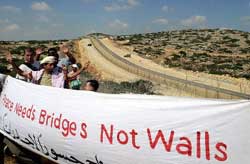 |
Members of the International Solidarity Movement hold a banner which reads "Peace Needs Bridges Not Walls" on August 1, 2004. (Photo: Saif Dahlah/AFP-Getty Images) |
Rust eats away at the white-painted metal archway that once welcomed visitors to the West Bank village of Sinjil, just seven kilometers north of Ramallah. No one comes or goes this way anymore. Since the outbreak of fighting in September 2000, the IDF has blocked Sinjil's access to the main Ramallah bypass road with a mound of rubble.
Overrun with children and goats, the ramshackle home of Issa Ahmed Khalil, 51, is at the very edge of the street he cannot use; instead, Khalil must take the back roads to Ramallah, adding another 18 kilometers to his trip.
"I have to pass two checkpoints, at Atara and Surda," Khalil says, "and if there is a 'flying checkpoint' along the way, that makes three." Flying checkpoints are military vehicles that appear without warning and block off a street.
There are approximately 200 checkpoints and roadblocks throughout the West Bank.
The army argues that these barriers have saved hundreds of Israeli lives by preventing drive-by shootings and suicide bombings. But the Palestinians counter that these draconian measures have also made driving on West Bank roads a living hell.
Since last year, 20 checkpoints have been taken down and another 40 barriers are scheduled to come down as well. Ironically, this easing up of West Bank travel restrictions is due to the continued construction of the security fence-the very fence recently lambasted by the International Court of Justice for its "acute impact on the Palestinian population."
According to the Foreign Ministry, more than 250 Israeli men, women and children were killed in the seven-year period between the signing of the Oslo Accords on September 13, 1993, and the beginning of the violence. Since then, the total of number of terror victims has spiraled to nearly five times that number.
In 1993, the government first tried a policy of seger (closure) on the territories to keep suicide bombers from reaching Israeli cities. Three years later, the noose tightened: Checkpoints were used in the keter (crowning), or blockade, of Ramallah. During Operation Defensive Shield in 2002, all West Bank cities found themselves in a similar position.
Nablus, a notorious center for manufacturing bombs, is still ringed by checkpoints. Flanked by two watchtowers, the Hawara checkpoint controls all traffic in and out of the city's south side. Paratroopers in flak jackets and helmets stand behind concrete blocks with M-16 rifles ready, ordering Palestinian men, women and children to open their bags at a safe distance.
Then ID cards and permits are checked. Those without the necessary paperwork are turned back or join the half dozen young men sitting in a makeshift detention area under a light camouflage net.
It is not a pretty sight.
But neither is a 16-year-old wired to detonate.
On March 26, the Aksa Martyrs Brigades in Nablus sent 16-year-old Husam Abdu to Hawara wearing eight kilograms of explosives in a special vest. Seduced by 100 Israeli Shekels and promises of 72 virgins in the hereafter, Abdu was set to detonate himself, had the soldiers at the checkpoint not disarmed him.
"Once the Palestinians shifted from shootings to mega-attacks by suicide bombers," explains Labor MK Binyamin Ben-Eliezer, a former general and defense minister, "it became crucial to interfere, as much as possible, with the free movement of terrorists."
It is far easier to encircle a city than to try to close off a whole region, but humanitarian considerations dictate that eventually even the most effective blockade on a city has to be lifted. That is when a terrorist will make his escape and weave past scattered West Bank checkpoints on his way to Israel.
A source within the IDF's Judea and Samaria Division says that only 15 percent of would-be suicide bombers in 2004 were caught at checkpoints and most of those were at "flying checkpoints."
Intelligence is the key to nabbing a suspect.
Still, checkpoints do draw out the trip the suicide bomber must make to an Israeli city, buying precious time for security forces to intercept him. Says Maj. Gen. Oren Shahor, a former military coordinator in the territories: "The idea is not to make it easy for suicide bombers."
West Bank checkpoints, and their attendant roadblocks, do not make it easy for the Palestinian population either. Even if it takes only 20 minutes to drive through one checkpoint, there is still another checkpoint. And another.
"Once, a taxi cab ride from Ramallah to Bethlehem took me six hours when it should have taken more or less an hour," says Hisham Ahmed, a political science professor at Bir Zeit University.
The lucky few get special travel permits to work in Israel, or to leave a city under keter. The whole process takes several weeks, but through one of the seven IDF District Coordinating Liaison offices in the West Bank, an applicant with a clean record can get a one-year security clearance (a magnetic card) and either an external or internal travel permit.
But try waving a permit at an anti-vehicular trench cut into a road. Or at the Border Police.
"People with permits to travel between cities will get stopped at 'flying checkpoints' run by border policeman and will be told that their permits are not valid," says Gershon Baskin, co-director of Israel-Palestine Center for Research and Information (IPCRI).
Ambulances are supposed to be allowed through checkpoints by soldiers in almost all circumstances. However, human rights groups charge that the army often holds up Palestinian ambulances at checkpoints, and harasses and humiliates their medical teams.
The IDF counters that the terrorist groups use ambulances to ferry arms and fighters.
Indeed, in May 2002, soldiers at a checkpoint near Ramallah found an explosive belt used by suicide bombers hidden under a sick child in an ambulance. Two months ago, in the East Jerusalem village of Eizariya, police uncovered a warehouse where GMC vans were touched up to look like Red Crescent ambulances.
Due to security checks and assorted road obstacles, ambulances are slow to reach those in need-Palestinian sources say that more than 50 women have given birth at checkpoints-but trying to get to the hospital without them can be deadly. Two years ago, edgy soldiers at a roadblock south of Nablus fired on a speeding car and wounded 22-year-old Maysoun Alhayek, who was in labor at the time. Her husband Muhammed was killed.
"A checkpoint is more than an Israeli, a Palestinian, and a barrier," says Bassem Eid, head of the Palestinian Human Rights Monitoring Group. "There are good soldiers and there are bad soldiers."
In early July, Ha'aretz published an article about one of the bad soldiers, a paratrooper sergeant who was arrested by the Military Police for beating Palestinians at the Hawara checkpoint. An IDF Education Corps film crew taped the soldier breaking the windows of taxis as well as kicking and slapping detainees.
The paratrooper case begs the question: Did the film show rare abuse at checkpoints, or is abuse at checkpoints rarely filmed?
Professor Hisham Ahmed, who is blind, says a soldier shoved him two months ago at the Container checkpoint, southwest of Jerusalem.
"In the long run, checkpoints cause anger and frustration," he says. "If you want to see where a suicide bomber is created, go to a checkpoint."
The army says that in the West Bank there are currently 43 checkpoints (down from 63 last year) and 155 roadblocks, over a quarter of which are being phased out. However, a UN report from March counts a grand total of more than 750 assorted barriers, from swinging, yellow road gates to lone observation towers.
It is all a matter of how one counts clusters of obstacles. The UN Office for the Coordination of Humanitarian Affairs (OCHA), for example, breaks down the defensive line around the settlement of Shavei Shomron into 21 barriers: one checkpoint, three trenches, three concrete blocks, and 14 mounds of earth.
But however they are counted, checkpoints come down as the security fence goes up.
Construction began two years ago on the planned 720 kilometer fence, and though only a quarter has been completed, it has already proven itself in keeping terrorists at bay, says Maj. Gen. Uzi Dayan, who heads the Public Committee for the Security Fence in Israel. This year, Israel has seen only two successful suicide bombings from the West Bank-both from Bethlehem, which hasn't yet been fenced off.
Better security and fewer checkpoints sound like an ideal situation.
However, the overwhelming majority of activists who oppose West Bank checkpoints oppose the security fence with equal tenacity. The Arab media call it the Apartheid Wall.
For the most part, the security fence runs along the 1949 armistice line, or Green Line; however, in certain places within the West Bank, it takes wild twists and turns, enveloping Israeli settlements and Palestinian villages. This puts approximately 15,000 West Bankers on the wrong side of the fence, says Marc Luria, spokesman for the Public Committee.
Thousands more would have to travel through Israeli-controlled gates to get to their olive fields.
But the International Court of Justice (ICJ) included East Jerusalem Arabs with Israeli residency ID's in its tally of "237,000 Palestinians" when it ruled on July 9, that the fence "imposed substantial restrictions in the freedom of movement of the inhabitants of Occupied Palestinian Territory."
With no progress being made at the peace table, the Sharon government has only two choices in defending Israeli citizens against terrorism-a fence that hems in 237,000 Palestinians, or a roadblock regime that affects 2.2 million. Evidently, the ICJ prefers the latter.
Israeli grandmothers monitor checkpoints
One of the most unlikely features of the IDF checkpoint is a tiny contingent of gray-haired ladies who stand off to the side, and with pad and pen in hand, monitor the behavior of soldiers and police officers.
Three women belonging to Machsom Watch conduct their regular inspection of the a-Ram checkpoint, north of Jerusalem. Most Palestinians-inhabitants of villages located within the municipality-breeze past with a flash of their blue "permanent resident" ID cards, but for some reason, the Border Police have detained two men.
The afternoon sun beats down on their heads.
"How long have these men been standing in the sun?" asks Daniella, a 60-ish woman who refuses to give her last name.
"Just a short while," answers a border policeman.
But the young man in the forest-green beret can smell trouble. To avoid a problem with someone who could be his grandmother, he ushers the two men away from the women activists and into the shade afforded by the Border Police post.
In January 2001, three immigrants-Ronnee Jaeger, Yehudit Keshet and Adi Kuntsman-formed Machsom Watch following media reports of human rights abuses against Palestinians at checkpoints. The group now claims 400 members countrywide.
Unlike more established human rights groups, Machsom Watch reports are soaked with rhetoric. One from April reads: "Chilling thoughts are evoked by the arbitrariness, the lack of basic humanity, harassment and hazing inflicted on millions of people-is this us? Is it for real? Surely it's a nightmare, from another time and place?"
The group is on the left of the political spectrum, allying itself with the likes of New Profile, an organization that supports conscientious objectors. Members, as a matter of principle, are opposed to checkpoints and to the security fence being built in the West Bank.
In an age of suicide bombers, it is not a popular opinion.
"We are a minority of a minority," admits Daniella.
After a-Ram, the next stop for Daniella and her two colleagues is Kalandiya.
Three kilometers south of Ramallah, not far from a concrete wall section of the security fence, the checkpoint is a work in progress. Soldiers are installing corrugated tin roofing to provide shelter from the sun for those pedestrians who are waiting in line to cross into Israel.
When the women of Machsom Watch arrive, the Military Police are processing the crowd relatively quickly. The walk through the explosives detectors and the makeshift documents check-in desk takes under two minutes.
But Muhammad Qarhin, a 44-year-old lawyer from Ramallah, says the Kalandiya checkpoint is not always this easy to pass. Depending on the time of day and the security situation, "especially after a suicide bombing," the wait can take half an hour or more.
A lot also depends on the mood of individual soldiers. Last April, an a-Najah University student fell prey to a sadistic IDF officer at the Seida checkpoint, 12 kilometers northeast of Tulkarm. According to a report by the B'Tselem human rights group, the officer carved a Star of David into the young man's arm with a piece of broken glass.
At yet another checkpoint, Palestinians were allegedly subjected to mock executions.
A slim, dark colonel takes notice of the Machsom Watch women and, flanked by junior officers, comes over to Daniella.
Col. Miki Edelstein, the new commander of the Binyamin Brigade, which operates in the greater Ramallah area, will not debate the merits of checkpoints. Nevertheless, he takes out a pen and notebook and starts writing down what Daniella reports as examples of soldiers humiliating Palestinians.
Edelstein's obliging manner does not satisfy a more radical member of Machsom Watch who, in private, describes the brigade commander as a "war criminal who will stand trial at The Hague." The same woman argues with a soldier who will not let a Palestinian laborer, lacking the proper documentation, pass through the checkpoint.
This sort of activism is not always appreciated. On June 26, two members of Machsom Watch were arrested at an anti-security fence demonstration, while police beat a Yediot Aharonot photographer covering the event.
"It is so hard being a moral person," says Daniella.