Middle East

Israel/Palestinian Authority: Rumors of War
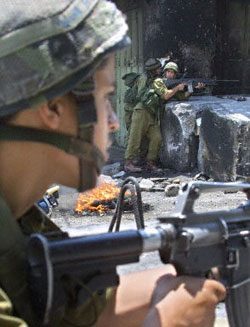 |
| Chafing at the Bit? Israeli soldiers take aim at Palestinian demonstrators after Friday afternoon prayers in Hebron (Photo: AFP). |
The recent report by Jane’s Foreign Report that Israel had mapped out plans for a major military offensive to destroy Yasser Arafat’s Palestinian Authority was met with sharp denial by Israeli officials. Israeli Foreign Minister Shimon Peres was quoted in the international press as saying that “war is not an option. We will continue to negotiate with Arafat, the elected leader of the Palestinians.” But his words failed to quell suspicions of an impending strike.
As WPR went to press, Peter Hirschberg of Tel Aviv’s liberal Ha’aretz (July 17) reported increased speculation about an impending military maneuver after Defense Minister Binyamin Ben-Eliezer canceled a trip to the United States following a July 16 suicide bombing in Binyamina that killed two Israeli soldiers.
The possibility of an Israeli military assault in the territories has been bandied about by Israeli and Arab commentators since the early summer. Israeli Prime Minister Ariel Sharon’s trips to the United States and Europe to rally support in the 10th month of violence between Palestinians and Israelis contributed to the mounting speculation. “Sharon has…failed in Europe just as he had failed during his second visit to the United States last month to get a U.S. or a European green light to launch a large-scale military campaign against the PA,” declared the privately owned, pro-Palestinian Authority Jerusalem-based Al-Quds (July 8).
Herb Keinon (July 6) of the conservative English-language Jerusalem Post remarked that if “Sharon comes to the conclusion that Europe is unwilling to sufficiently twist Arafat’s arm, then he may be left with no other option than to use the massive force to twist Arafat’s arm himself.”
Writing in Beirut’s independent Al-Nahar (July 5), Ali Hamadeh said that Sharon’s visits to Germany and France were a prelude to a large-scale military operation against the PA. The goal of the steady Israeli escalation, he said, is to establish new rules of the game between Israelis and Palestinians and to close the door on the Oslo era.
In an editorial, London’s Palestinian expatriate Al-Quds al-Arabi (July 4) commented that Israel’s continuing “liquidation” of Palestinian militants is aimed not only at ending the Intifada but “also at the PA itself.” Citing remarks by Israeli officials about the option of crippling the PA, the editorial said, “all signs indicate that Sharon has a put forth a plan to invade the autonomous areas.”
Some Arab and Israeli commentators feel that a military escalation could be a suicide bombing away and that the PA is acutely aware of the hair-trigger climate within the Sharon government. After Hamas and Islamic Jihad threatened bombings inside Israel in revenge for Israel’s assassination of Palestinian militants, Danny Rubenstein of Ha’aretz wrote on July 9 that Palestinian leaders believe such attacks would unleash a ferocious Israeli response.
“Palestinian Authority Chairman Yasser Arafat and his colleagues do not want suicide attacks in Israel,” Rubenstein said. “They are satisfied with a relatively low level of violence (from their point of view) in the form of shooting attacks on Israeli soldiers and Jewish settlers in the West Bank and Gaza, violent demonstrations in the territories, and the throwing of stones and Molotov cocktails. If the violence becomes more intense, the very existence of the PA is placed at risk.”
Tough talk from right-wing Israelis is not surprising. But a larger segment of the Israeli population may be close to supporting all-out war against the PA, according to Ha’aretz’s commentator Gideon Samet (July 11).
Ghassan Khatib, publisher of the Jerusalem Media and Communication Center’s Palestine Report (July 18), wrote that “public opinion polls indicate that over 70 percent of Israelis support the policies and actions of the Sharon government.” He concluded that “the only obstacle now is American, European, and Arab efforts that are pushing for self-restraint. Sharon is trying to neutralize this factor. He will wait for the right moment, one providing him with justification and difficult to oppose.”
Some analysts, including Al-Nahar’s Hamadeh (July 9), regard Israel’s Peres as the only check on a full-scale assault against the Palestinians. According to Graham Usher, writing in Cairo’s semi-official Al-Ahram Weekly (July 5-11), Peres dissuaded the inner security cabinet “from ordering a new strike at PA installations.” They instead opted for additional assassinations, reported Usher.
Palestine Report’s Khatib wrote on July 11 that Israel is “less able to tolerate a long-term, low-intensity conflict and [has] been trying to push for either full-fledged confrontation, whereby they can use their military advantage, or a complete end to the confrontation on their political or security terms.”
Although the U.S.-brokered “ceasefire” was violated from the outset, he wrote, it limited the scope of violence in the territories. It thus prevented Sharon from achieving “his goal of all-out war or an end to the Intifada,” Khatib maintained. He concluded that the weaker Sharon becomes, the more apt he might be to take extreme measures.
On one point, some commentators on both sides agree: A military escalation will not solve the larger conflict. Al-Quds al-Arabi’s July 4 editorial noted that “an invasion of the Palestinian areas would end the PA, but it would not end the resistance.” In his July 11 analysis, Ha’aretz’s Samet predicted: “There is nothing to gain from a comprehensive military operation....If it were to break out, it would be immediately doused by international intervention, but not before it wreaked death and destruction there, and here, too.”
December 2001 (VOL. 48, No. 12)Overline Overline Overline OverlineHeadline Headline Headline HeadlineName
ID Tag
City
Date