Middle East

Palestinians: Who Calls the Shots?
Palestine: Beacon to Arab Nations
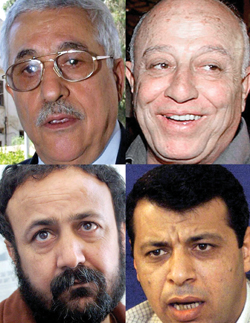 |
| In the Wings: Possible Arafat successors (clockwise): Arafat deputy Mahmoud Abbas; Ahmed Qurei, speaker of the Palestinian Legislative Council; Mohammed Dahlan, former head of preventative security services in Gaza; and Marwan Barghouti, Fatah's West Bank leader currently jailed in Israel (Photo: AFP). |
It is inevitable that a number of Arab peoples are envious of the special treatment that the Palestinians seem to enjoy from the current American administration. This preferential treatment was made abundantly clear in [Bush’s] latest speech. As he outlined it, he envisions the establishment of a Platonist republic in the West Bank and Gaza Strip, or in other words, a completely democratic nation governed by transparency, accountability, and constitutional institutions.
These specifications were not, however, requested from any of the other Arab nations. Reform is indeed required, and Bush’s commendable demand necessitates a follow-through by individuals blessed with good intentions and the sincere desire to encourage and extol the reform process. Sadly, we think that the American president is not one of these.
For years, none of the American administrations have called for democracy and human rights in the Arab world, which form part of the pillars of its foreign policies. In actuality, they have completely supported the opposite, having aided, in the past and even currently, corrupt Arab governments whose people haven’t experienced any elections, and which
specialize in manipulating the general wealth of the nation and give us the greatest examples of human-rights violations. Oh, Mr. President, we didn’t hear you under any circumstances request your official governmental guests from Egypt and Saudi Arabia to hold honest elections and establish constitutional institutions, or to expand the scope of political participation, or to distribute resources equitably.
You certainly didn’t threaten the Egyptian government with a cutoff of its yearly American financial assistance—to the tune of US$2 billion—if it doesn’t respect human rights and permit true political plurality in Egypt.
Yes, the Palestinian Authority is corrupt, and a call such as Bush’s, in its stipulatory manner, is a kind of fixative. Yet, some of the corrupt ones who were censured by these stipulations have long been ministers and continue to be at the helm of their positions, having not been included in the latest ministerial changes.
The thing that has changed is the presence of an American president who sees the world from the viewpoint of the extremist Israeli wing that currently rules in Tel Aviv. And so, suddenly, Bush condemns the Palestinian president as a liar who has reneged on the Oslo agreement with the igniting of the Intifada, and who either stands behind the martyr operations [suicide bombings] or at the very least did not exert sufficient effort to
prevent them. However, he doesn’t see any shame in the lies of [Ariel] Sharon and his establishment of 40 new settlements [in the occupied territories] despite the previous promises to American delegations to stop building settlements, just as he doesn’t consider the return of the occupation to the cities of the West Bank—and the destructive policies that accompany it—as outside of the ordinary. After Bush’s speech, are we now going to see American initiatives aimed at those nations strongly allied with Washington?
Are we going to hear demands to change their governments to become exemplary democracies that respect human rights? Will it be stipulated that they reform their security apparatuses and transform them into police forces that truly work in the service of the people and aren’t used for repressing them? Perhaps President Bush is presenting such a sound plan to the Palestinian people.
Through the process of establishing their own exemplary republic—or at the least stemming the corruption in the region—we shall see the emergence of a solitary Palestinian democratic entity that will reclaim its national existence in complete harmony with its surroundings without any more clashes.Fantasy aside, we reiterate that we do support fundamental reform and haven’t agreed with the Palestinian president in his administration of the affairs of the Palestinian people, nor his reliance on a handful of corrupt advisers, assistants, and a security apparatus that is a proxy for Israeli forces. However, we need reform in accordance with Palestinian national directions and conditions, reform that steers us toward the fulfillment of all the loopholes of former negotiations and that lays the foundation for a Palestinian society that does not neglect legitimate legal rights.
A reform that would steer us toward relinquishing valid legal rights—such as the Right of Return for the 6 million Palestinian refugees—we don’t need.