Middle East

Palestinians: Who Calls the Shots?
Deciding What We Want
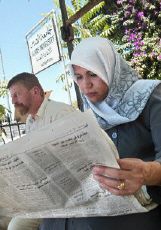 |
| Jerusalem, July 22, 2002: An employee of East Jerusalem's Al-Quds University reads a local newspaper as she waits for her offices to reopen after Israel's security ministry closed them for two weeks (Photo: AFP). |
After we heard President [George W.] Bush’s speech and the broad analyses by intellectuals; after our long acquaintance with [Israeli Prime Minister Ariel] Sharon and his policy, which we see and live daily; after we witnessed the mild European influence on Israeli policy dictates in the Middle East; and after we witnessed the absence of Arab sway on this policy and the death of [Saudi Arabia’s Crown] Prince Abdullah’s [peace] initiative, we know what they want. But do we know what we want? It is time we sorted this question out thoroughly. When Sharon and Bush agree that the Palestinians must enact fundamental reforms, beginning with a change in the Palestinian leadership and its head President [Yasser] Arafat, it’s time for us to pose the key question: Must we follow our desires or their orders?
It is common knowledge that it all started with our own desire for reforms and that we had debated the matter at length and reached our own conviction regarding the need to enact reforms. When we failed to implement these reforms, they seized our demand and used it to realize their objectives.
While we believed the reforms should be enacted with regard to financial and administrative issues and the rule of law, they first demanded the restructure of the security services, and then they added the word “change,” saying that the change must include the head of the Palestinian leadership. In other words, they believe that any Palestinian administration whose top priority is not to attain security for the Israelis is corrupt. Therefore, they use the policy of incursions, siege, oppression, and humiliation of the Palestinians as the only way to persuade or force the Palestinians to bring about the change and reforms they want in order to alleviate the people’s ongoing suffering.
Perhaps they think that in the end, we will follow our desires and not carry out their will, and therefore, they are increasing the pressure on and torture of our steadfast people until we will lose our patience and succumb. The Palestinians have evinced a remarkable ability to remain steadfast, forbearing, patient, and unyielding, so I don’t believe the Palestinians will bow down even if they increase their pressure. I believe, however, that we should discuss the matter from another angle and ask ourselves: Is it in our interests to replace President Arafat? In order to answer this question, we must ask ourselves, if we replaced Arafat, would the Palestinians gain justice and fulfill their aspirations for an independent state that lives in dignity, tranquility, and comfort among the nations of the world?
Undoubtedly, the answer to the second question hinges on the person we might elect in Arafat’s place. If we elected another national figure whom we trust, who might be more or less of a hard-liner than Arafat, there is no doubt that he would pursue Arafat’s national method and attitude. They should not be surprised by that. We would once again find ourselves back at the same point where they would ask us to change the new president or would find the right fatwa [religious edict] to abolish the elections and impose a different reality that does not satisfy us. Naturally, if they imposed a known or unknown figure as a candidate for the post of president, I don’t believe the Palestinians would go to the ballot boxes. Either way, they will not give us anything, and the conflict will continue for a longer time.
From a different perspective, the question now is: Will Arafat run in the next elections? Naturally, we cannot know for sure. The only person who can reply is Arafat himself. Let’s assume that Arafat has decided to run in the elections, which is his natural right on the merits of his record and struggle for the past half a century, which make him, in the eyes of the vast majority of Palestinians, the preferred candidate. This raises the question: Would another Palestinian figure nominate himself to run against Arafat?
Any real opponent will think long and hard before running in the elections. No matter who will compete against Arafat, the odds that he will win the elections are very slim because he will be under the microscope of the vigilant and yet skeptical Palestinians, who will consider allegations that he is affiliated with or supported by a foreign party.
Hence we must ask: What will happen if Arafat runs in the elections and is re-elected? Of course, they don’t want such a situation to happen and will work to prevent it by every means imaginable. If Arafat is re-elected against their [i.e. the United States' and Israels'] will, we will return to square one.
The ball would then be in their court, and they would have to deal with the Palestinians’ will and with the democratically elected Palestinian leadership. Then it would become their problem. Were we to assume that Arafat runs in the elections, we would have a real problem with regard to those who do run and the extent of Israeli-U.S. intervention, direct or through the media, to promote a certain person, to undermine somebody else whom we trust, or to sow sedition among our ranks—thus creating a new division in our society.