Middle East

Middle East
Palestinian Authority: Empty Chairs
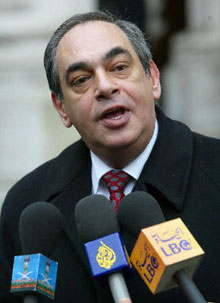 |
| Atif Safieh, the representative of the Palestinian Authority in London, addresses the media as he arrives for a meeting on Palestinian reform in London, Jan. 14, 2003 (Photo: Odd Anderson/AFP). |
England’s Prime Minister Tony Blair sponsored a long-anticipated conference for Palestinians in London on Jan. 14. The agenda detailed Palestinian internal reform and implementation of a “road map” that outlines concrete steps in resuming and fulfilling the Israeli-Palestinian peace process. In attendance were representatives of the “Quartet,” composed of the United States, the United Nations, the European Union, and Russia, as well as delegates from Egypt, Jordan, and Saudi Arabia.
With many Arabs viewing it positively, one editorial in Jerusalem’s Al-Quds (Dec. 19) called the conference a step in meeting England’s “historical responsibility.” However, the conference had at least one significant shortcoming: No notable Palestinians attended. Their absence resulted from an Israeli government ban on travel by Palestinians following two Palestinian suicide bombings in Tel Aviv on Jan. 5, which killed 23 other people and injured 100 more.
Despite Blair’s repeated personal diplomatic interventions with Prime Minister Ariel Sharon, the Israeli leader refused to alter his decision. Blair reportedly considered postponing the conference but decided that doing so would be counterproductive. Some Arab commentators concluded that British-Israeli relations had become rancorous and described a near crisis between London and Tel Aviv. An editorial in London’s Al-Quds al-Arabi (Jan. 7) pronounced Sharon’s intransigence “an affront to London and its international stature.”
Ultimately, Palestinian ministers joined the London discussions via video conferencing, with some calling from Ramallah in the West Bank and others from the Gaza Strip. The only Palestinians physically present were the London representative of the Palestinian Authority and a legal adviser who could travel under his U.S. passport. The symbolism of a travel ban to a conference on reform was not lost on Arab commentators, who saw in this latest episode proof that Sharon has no genuine interest in reform of the Palestinian polity.
Writing in Jordan’s Al-Ra’i (Jan. 8), Palestinian journalist Mahmoud al-Rimawi argued that despite Israel’s calls for reforms, Sharon’s administration “considers that an investigation into the issue of reform inevitably will take the shape of an evaluation of the current political situation…something Tel Aviv is very apprehensive about.”
Samih Shabib developed this perspective in Ramallah’s Al-Ayyam on Jan. 17, arguing that Sharon was nervous about London’s involvement because he wanted to define and thus restrict the definition of “reform,” because true reform would enhance the Palestinian Authority’s “staying power.” Serious attempts to improve the fuctioning of administration inside the Palestinian Authority would only further justify its existence, Shabib wrote; this would undermine Sharon’s efforts to discredit it a means of destroying it.
Other Arab analysts observed that Israel’s ability to control reality on the ground continued to preclude any substantial reform, which as Hasan Abu Nimah wrote in Al-Ra’i (Jan. 9), was the reason for Arafat’s postponement of Palestinian Authority elections.
The essential Arab argument is that the effects of the Israeli occupation cannot be ignored. Ayyida al-Najjar urged in Jordan’s Al-Dustour (Jan. 13): “If Blair truly wants ‘reform’…let him work toward the end of the occupation and on pressuring Israel to respect international resolutions.” After the conference, Adli Sadeq observed in Jerusalem’s Al-Hayat al-Jadedah (Jan. 17): “Preventing Palestinians from attendance at the conference doesn’t effect anything except to offer up further proof that good intentions are always circumscribed....With Israel the real authority in the occupied territories, how can Palestinians be blamed for a [peace] process over which they have had very little control?”
In an acerbic editorial in Al-Quds al-Arabi (Jan. 23), Bashir Musa Nafi described the conference as “political theater.” “Oh, sure, Blair can resurrect the peace process—but how can he do so without talking about an authority [the Palestinian Authority] that Sharon has surrounded, leaving one floor in a demolished building in the middle of a city blockaded by Israeli tanks?...Meanwhile, Sharon has made the Palestinian Authority and the Oslo agreement...as well as every peace proposal emanating from the accords, a political joke.” The pessimism of the Palestinian press was typified by a Jan. 15 Al-Quds editorial: “Closing all doors to a just political settlement will only lead to a continuation of the present [violent] situation.”