Middle East

Middle East
Israel: Labor Is Doomed in the Opposition
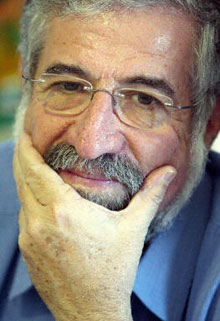 |
| Israeli Labor Party leader Amram Mitzna faces tough choices (Photo: Odd Andersen/AFP). |
The last elections have started a new era, the third in Israeli politics. Labor is about to make a big mistake that could take the party off the center of the political map for many years to come.
Until the historic change of 1977 [when, for the first time, Likud under Menachem Begin became the ruling party—WPR], Labor and its various incarnations had been in charge. Its power was undisputed, not only in the Knesset but also in Israeli society. Its impact was felt in the economy, in politics, and in culture. In the years since 1977, when the right governed for significant amounts of time, we entered another political era: an era of relative political equality between the left and the right blocs. Likud entered the public’s consciousness with Begin, who won the masses with the historic peace agreement with Egypt, the attack on the Iraqi nuclear facility, and with his plan to revive impoverished neighborhoods. Those were years of change—but not years of great decision-making.
The Labor movement didn’t rule the Israeli conscience any longer as it did in the first 30 years of the state’s existence. Likud rose through the periphery rather than through mainstream Israeli society. It succeeded in using to its advantage the dissatisfaction of the lower classes living on the periphery, and it better understood Israel’s demographics. The result was the creation of an almost complete equilibrium between the two main political blocs—the left, with Labor at its center, and the right, with Likud at its core.
With the latest elections, it seems that we are entering a new era. The last victory of the left in Israel was in 1999, when Ehud Barak beat Binyamin Netanyahu. But even then, despite Likud’s defeat, Labor lost a large number of seats [in the Knesset]. Overall, the camps were still close to one another, and the equilibrium between the two political blocs remained intact. But in the last elections, we witnessed the collapse of Israel’s left. Even with its 33 seats, which include the small Arab parties, the left has fewer seats than Likud. Moreover, Labor got many of its 19 mandates from last-minute sympathy votes.
A new wind is blowing in Israeli society. We are entering the third era, where the right rules Israeli society. The writing is on the wall and only a blind man can’t see it. Labor’s absolute power has lasted 30 years. The equilibrium between left and right lasted for the past 25 years. It is anybody’s guess how long the right will hold on to power, but it has the momentum and the backing of large strata of society. This is only the beginning of a new way, where the left loses power both on the periphery and in the urban centers. Its influence is waning even in the last bastion of leftist supporters: the kibbutzim and the moshavim [agricultural communes].
At the head of the right camp stands Ariel Sharon. Nobody knows how long this “last giant” will rule. As leader of Likud, and after a sweeping personal victory in the elections, Sharon is enjoying wide approval. Not too long ago, nobody would have believed that Sharon could become Israel’s prime minister. He’s the prime minister of the majority; he’s its undisputed leader. But competitors are already waiting in the wings: many rightful candidates, some vultures, and some merely thirsty for power. They all know that if they would take over Likud, the road to rule the nation would be paved. Sharon knows all too well what the people want; he understands that the public gave its trust, at least for the time being, to the “soft” right. Israelis apparently want to see a decision of some kind in the ongoing war with the Palestinians, but they also want negotiations to follow, so that an agreement can be reached.
Based on that, Sharon has opened the door to Labor, calling on it to join his unity government to bring with it at least some of its ideas, even though the people of Israel have had something different in mind on election day. There won’t be other leaders on the right who will open the door to Labor [as Sharon has], and perhaps it just might be that there won’t be an opportunity for Labor again to be part of the government any time soon. This party might find itself on the fringes of society, unable to push through its political agenda.
But Labor deliberately prefers the opposition. Despite its stinging defeat and its diminished size, Sharon and [Shinui leader] Tommy Lapid—two of the most prominent politicians in Israel today—continue to call on the left, to court it, to lend the party a hand and throw it a life jacket, to let its voice be heard—even if Labor’s leaders have disappeared.
For Labor not to join a unity government would be a mistake of historic proportions. This is the type of mistake that will be cause for regret for many years to come. It’s a mistake that can’t be fixed any time soon; it will cause damage that won’t be possible to repair. Labor is again closing itself off in arrogant isolation as it has done before, even though this could be its last chance.
Today, leaders of the left are asking to stay in the opposition to provide an alternative to the right. But it will not be a good alternative as long as its core values stay as they are. That Labor formed unity governments with Likud in the past played no role in its loss of power today. Rather, the party was unable to reach most of the Israeli public. The desertion of the national mainstream in favor of murky ideologies will push Labor even farther to the sidelines and will further alienate it from the political and social center stage.
Labor should read the writing on the wall. It doesn’t have followers among the poor or among the middle class. Its appeal has almost vanished. In the last elections, only one percent of the young voters voted for Labor. If a new party of retirees were to be launched in the next elections, Labor’s power could be cut in half.
Labor’s collapse wasn’t the fault of its leader, Amram Mitzna, of whom its been said, “nobody knows him yet,” as if that is an excuse. The party’s collapse has deeper roots, buried deep in Israeli society. It is enough to look at the results of the votes in Haifa, Mitzna’s home turf, to understand what is happening. Even there he was defeated, while Likud won its first victory in the history of this “red” city.
Mitzna, who is heading for the opposition at a time when his party has the chance to stay on the political map, is gravely mistaken. There is still a national interest that is more important than narrow political calculations. It seems the left is on its way to commit a historic mistake that will affect us for years to come.