Middle East

The Women and Girls of Gaza
A series titled "Whispered in Gaza," produced by the Center for Peace Communications (CPC), featured animated, anonymous interviews with Palestinians in the Gaza Strip about life under Hamas and began airing in January 2023.
In the series, Gazans spoke openly about how they despised and opposed Hamas, despite the extreme risk to them and the threat of retribution if the terrorist regime somehow discovered their identities.
The series, which used animation and voice-altering technology, served as a safe platform for Gazans, many of them women, to share their personal stories, struggles, and fears about Hamas with the world.
The purpose of the series was to break the communications blockade in Gaza, enabling residents to safely criticize Hamas and express hope for a future without it.
Then came Hamas's October 7, 2023, massacre of Israelis.
On November 1, 2023, I wrote an article about "Whispered in Gaza" to highlight Palestinian disdain for Hamas.
Fast-forward to now.
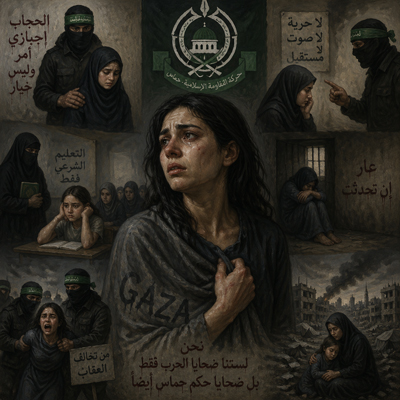
According to an April 2026 report by Britain's Daily Mail, women in the Gaza Strip are speaking out about life under Hamas, despite their fear of retribution.
According to the Daily Mail, chilling testimony is emerging from women in Gaza describing systemic sexual abuse by multiple Hamas militants, exploitation, sexual blackmail for aid or money, and sexual abuse by people in positions of power.
Their testimony comes amid growing concerns that Hamas is re-establishing control in Gaza, as global attention shifts to the conflict in Iran.
My question is: Where are the NGOs and organizations supposedly concerned with the women and children of Gaza? Why aren't they helping them?
Is it out of fear of Hamas, or out of their naive supposition that the women and girls of Gaza are perfectly fine under Hamas's control and authority?
I find it ironic that the NGOs and organizations supposedly concerned with the safety of women and girls in Gaza know full well that there is no law in Gaza prohibiting violence against women within the family, including sexual violence.
They also know that the police in Gaza intentionally refrain from publishing the number of complaints they receive each year, in an overt effort to discourage women from pursuing legal recourse and to encourage them to resolve matters within the family.
Further exacerbating the situation, the administrative bodies responsible for addressing these issues in Gaza, namely the police, courts, and school counselors, take little care to handle such sensitive matters discreetly, and women can find themselves the subjects of public ridicule, shame, and abuse when their stories spread.
In the absence of necessary laws and law enforcement mechanisms, violence against women and girls in Gaza continues at an alarming rate.
A form of gender-based violence that has not received enough attention is honor killing, the murder of women and girls accused of immoral sexual conduct. Honor killings are implicitly permitted by the Hamas government, if not explicitly condoned.
Under Islamic law, largely enforced by Hamas authorities, a woman's testimony is worth half that of a man's.
And a woman must pay her husband a substantial fee to divorce him, whereas a man can divorce his wife at no cost and for any reason.
Hamas has been working diligently to enshrine in law the requirement that women wear a hijab, the Islamic head covering, in schools, courthouses, or on beaches. Women in Gaza are regularly approached by the modesty police, who enforce the dress code through intimidation. The modesty code also prohibits women from smoking in public, learning to drive without a man present, using a male hairdresser, and even filing complaints of incest.
A United Nations Population Fund (UNFPA) report has found a surge in child marriage and adolescent pregnancy in Gaza. The report says that at least 400 girls ages 14 to 16 were registered as married over just four months in 2025. However, the UNFPA warned that this likely represents only a fraction of the true scale because of underreporting and the collapse of formal registration systems.
Fatima Abu Al-Asrar, a scholar and specialist in trans-state militias, said this about Hamas's exploitation of Palestinians: "Palestinians are gradually breaking the silence on their conditions, as they realize that Hamas has exploited their suffering in the pursuit of power, disregarding their wellbeing and fundamental human rights."
Here is what the former Jordanian Foreign Minister and Chief of the Royal Court said about the tragic situation facing parents and their children in Gaza: "Let us close our eyes for a moment and try to envision what Gaza would be like if it were allowed to reconstruct and prosper."