Click
an area of the map for world news.
Click
an area of the map for world news.

|

Philippine
Reaction to the Return of U.S. Troops
'Welcome Back, GI Joe'
Marites
Sison
World Press Review Correspondent
Manila, Philippines
Feb. 19, 2002
 |
| U.S.
special forces secure the perimeter of the Philippine
army base at Basilan, Feb. 17, 2002 (Photo: AFP). |
U.S. forces returning to the Philippines
in late January to aid the Philippine military in hunting down
Abu Sayyaf rebels were met with mixed reactions. "Welcome
back, GI Joe," read one placard at a gathering in Zamboanga,
southern Philippines, when the first U.S. troops arrived. At
the subsequent daily demonstrations facing the U.S. Embassy
in Manila, many protesters carried signs reading, "Yankee,
Go Home!"
Such diverse feelings are hardly surprising, given the historic
love-hate relationship between the Philippines and its former
colonizer, the United States. In September 1991, the Philippine
Senate voted against renewing an agreement allowing the United
States to maintain military bases in the country, ending nearly
a century of American military presence in the Philippines.
The decision, many nationalists believed, symbolized "the
slaying of the American father image." The United States
had occupied the Philippines in 1898, shortly after Spanish
authorities agreed to "surrender" Manila for US$30
million. Filipino guerrillas resisted, leading to the Philippine-American
War, one of the bloodiest wars of colonization in history. An
estimated 1 million Filipino soldiers and civilians, as well
as thousands of U.S. soldiers, died in that war. A period of
pacification followed, in which Americans introduced American-style
education and democracy. The United States propped up a string
of Philippine governments shortly after granting the islands
independence in 1946, and was the staunchest supporter of Philippine
dictator Ferdinand Marcos, who was ousted from power by a popular
uprising in 1986.
Philippine-American relations soured after the Philippine Senate
refused to renew its welcome to U.S. troops in 1991, only warming
up after the Sept. 11 terrorist attacks in the United States.
Philippine President Gloria Macapagal-Arroyo was the first Asian
leader to express support for the U.S. war on terror; she also
offered the use of Philippine air space for any reprisal. In
return, she secured a promise of aid and military equipment.
It turned out that Arroyo got more than she bargained for.
On Jan. 10, Filipinos were jolted with the news that 660 US
troops would join 1,200 Filipino troops in Mindanao, southern
Philippines. U.S. defense officials have called it the largest
deployment of U.S. troops outside Afghanistan.
Philippine and American officials insist that U.S. forces will
be in Mindanao only for "military exercises," not
combat operations against the Abu Sayyaf, which the United States
has linked to Osama Bin Laden's Al-Qaeda network. The Philippine
military estimates the strength of Abu Sayyaf at less than 1,000
troops, but they are heavily armed and enjoy some support from
the local Muslim population. Founded in the 1990s by the late
Khadaffy Janjalani, a charismatic Islamic fundamentalist who
fought and trained with the mujahedin in Afghanistan, Abu Sayyaf
has managed to build up its arsenal largely through million-dollar
ransom payments collected from kidnapping local and foreign
civilians.
Philippine Defense Secretary Angelo Reyes said 160 members of
the U.S. Special Operations Command Pacific would merely train
Filipino troops hunting down Abu Sayyaf militants. But, he said,
some U.S. troops would accompany Filipino soldiers in their
combat missions, "to evaluate their performance."
What critics find worrisome is Reyes' statement that U.S. troops
will be allowed to carry weapons for self-protection and will
be allowed to engage Abu Sayyaf rebels "in self-defense."
That, according to Senator Rodolfo Biazon, a former chief of
staff in the armed forces, "is another name for combat."
Critics have also found it unusual for such war games, called
"Balikatan 02-1," (shoulder-to-shoulder) to be conducted
close to conflict areas, and to involve live ammunition that
can be used against live targets. The United States has likewise
sent no less than the elite Joint Task Force 510, dubbed its
"crisis-response, rapid-deployment task force."
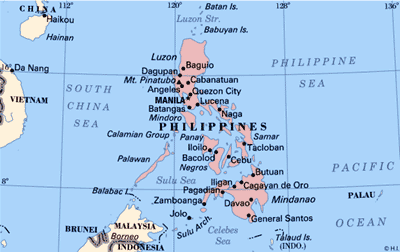
Map: Hammond
Atlas
Unusual, too, that the war games are expected to last for six
months or longer, since past exercises normally lasted no longer
than two weeks. Reyes has also insisted that U.S. forces "will
have no control over operations at any level," a statement
that was contradicted by U.S. defense officials, who say that
U.S. troops will be under U.S. command. Such exercises would
also involve the recovery of a kidnapped American missionary
couple being held by the Abu Sayyaf. Brig. Gen. Donald Wurster,
Special Operations chief of the U.S. Pacific Command, said the
United States was prepared to take casualties.
The exercises, slated to begin Jan. 31, 2002, were eventually
postponed to Feb. 17, following disagreements over the "terms
of reference" (TOR) or the rules that would circumscribe
the actions of the U.S. troops in the Philippines.
Constitutionalists—including former Senator Jovito Salonga,
who was Senate president at the time it rejected an agreement
that would have allowed the United States to maintain military
bases in the Philippines—decry the exercises as "a
violation of the constitution that bans foreign troops and foreign
facilities in the Philippines."
"After our Senate ended decades of foreign military presence
in the Phillipines, we are now back to the worst kind of military
intervention," says Salonga.
Arroyo, however, insisted the public supports the presence of
U.S. troops, citing an October 2001 nationwide poll conducted
by private Manila pollster Social Weather Station (SWS) that
found 84 percent of Filipinos approved of the idea. SWS has
since clarified that it did not directly ask whether Filipinos
were in favor of the presence of U.S. troops in Mindanao, only
if respondents would welcome foreign assistance to break Abu
Sayyaf.
Arroyo has some justification for her contention that Filipinos
support U.S. military help. Even as anti-U.S. demonstrators
rally in front of the American Embassy in Manila, there is also
palpable support for U.S. troops, especially in Zamboanga City,
where they are stationed.
Residents of this predominantly Catholic town have taken to
wearing T-shirts emblazoned with the English words, "Welcome
Joe."
"We were afraid of the Abu Sayyaf, but now at least there
is hope that the problem will be solved," sales clerk Grace
Lopez told Agence France-Presse on Feb. 17. "We believe
that the presence of American forces and the help they can give
to our military will really help solve the local terrorism problem,"
Zamboanga journalist José Marie Bue, who himself had
been taken hostage in November by the Moro Islamic Liberation
Front (MILF), told the news agency.
Arroyo's legal advisers argue that the Visiting Forces Agreement
(VFA) signed in 1999 covers the exercises. Justice Undersecretary
Manuel Teehankee maintained that while the government has no
treaty allowing the United States to set up bases here, the
VFA covers the entry, stay, and exit of U.S. soldiers in the
country. He said the war games are also justified under the
1951 Mutual Defense Treaty (MDT) between the Philippines and
the United States. Salonga, however, says the VFA only allows
for training, while the MDT involves cooperation in times of
"external armed attack," and not for crushing internal
rebellions.
Filipino analysts have questioned why the United States first
extended its military operations in the war on terrorism to
the Philippines. Randy David, a journalist for Manila's independent
Philippine Daily Inquirer, sees the presence of U.S. troops
as an unwelcome intervention: "This is a local war, and
the Abu Sayyaf are local bandits," he says. "That
Americans and other foreigners have been among their victims
does not make them global terrorists. This is an internal problem
that is being given an international dimension. Why?"
The arrival of the troops has put other armed insurgents on
edge as well, raising fears of a regional conflict extending
beyond the Abu Sayyaf. The Communist Party of the Philippines
(CPP), believes it will be the next target. The CPP's armed
component, the New People's Army (NPA), is among the groups
on the U.S. State Department's list of terrorist organizations.
Already, CPP chairman-in-exile José Ma. Sison has issued
a directive for the 8,000-strong NPA "to teach American
soldiers a lesson."
Other movements, including the MILF, which counterterrorism
experts consider the largest Muslim separatist group in the
Philippines, have also expressed alarm, citing a recent incident
where MILF fighters were killed after being mistaken for Abu
Sayyaf members. "[The military] is confused as to who are
Abu Sayyafs and who are MILFs," MILF spokesperson Ed Kabalu
told the English-language Manila newspaper Today on Feb.10.
"They are running blind out there, and it's dangerous for
us Muslims." He said the MILF, though participating in
ongoing peace talks with the Arroyo government, would not hesitate
to fight back if attacked, raising fears of a possible conflagration
in Basilan and other areas in Mindanao.
Moreover, some political analysts here believe that what the
United States really wants is greater access to monitor developments
in the region's hostile spots—more specifically, in Indonesia.
According to reports in the independent weekly Manila newsmagazine
Newsbreak, the Bush administration offered to train an
elite group of the Philippine Armed Forces, the Light Reaction
Company, in counterterrorism during Arroyo's November 2001 visit
to Washington. According to Newsbreak, the only stipulation
the Bush administration made was that the training should take
place on a base in Mindanao.
"I believe that the United States wants access in the guise
of training and exercises," a Filipino diplomat told Newsbreak,
speaking on condition of anonymity. "The Philippines' strategic
location makes it a suitable staging area for contingencies
in Southeast Asia. The United States has a long-term security
interest in the region, particularly the stability and security
in Indonesia."
The diplomat said the United States was also after Al-Qaeda
terrorist cells that it says exist not just in the Philippines,
but also in Indonesia, Malaysia, and Singapore.
Returning to the Philippines may have been easy for the United
States. The next question is whether the alliance will last
this time around.
Observers from a cross-section of Filipino society have expressed
concern over the return of U.S. troops. Human-rights activists
recall the abuses of military and paramilitary units trained
and funded by the United States in the 1980s and worry that
the TOR do not provide enough safeguards for civilians. Environmentalists
point to the toxic waste the United States left behind at its
former bases in Subic and Clark, in the northern Philippines,
and worry that the same fate could befall areas in Mindanao
where live ammunition will be used and new military technology
will be tested.
Others in the region, particularly observers in Indonesia and
Malaysia, have expressed alarm at the expansion of the U.S.
military presence in the region. "The dispatch of troops
is part of the larger U.S. agenda of demonstrating its military
power and imposing its hegemonic will upon other nations,"
Chandra Muzaffar, president of the Penang, Malaysia-based International
Movement for a Just World, told Rome's Inter Press Service in
a Feb. 10 interview.
But Muslim Filipinos themselves will prove the most resistant
to the presence of U.S. troops. Primary school history textbooks
here record that no colonial power—not the Spaniards who
colonized the islands in 1521, nor the Americans who arrived
three centuries later—has managed to subjugate them. This
is a point of pride for the country's Muslim population.
On the eve of the U.S. troops' arrival in Basilan, bomb blasts
ripped through the towns of Jolo and Zamboanga, killing five
and wounding 45 others. The blasts set the tone for the troops'
stay here. "The Americans may have succeeded in quashing
Afghanistan. Let them try to do the same in the Philippines.
They could be in for a surprise," says Mohamad Abbas, 21,
who makes a business selling pirated DVDs at the Muslim enclave
in Quiapo. 
|
|
|